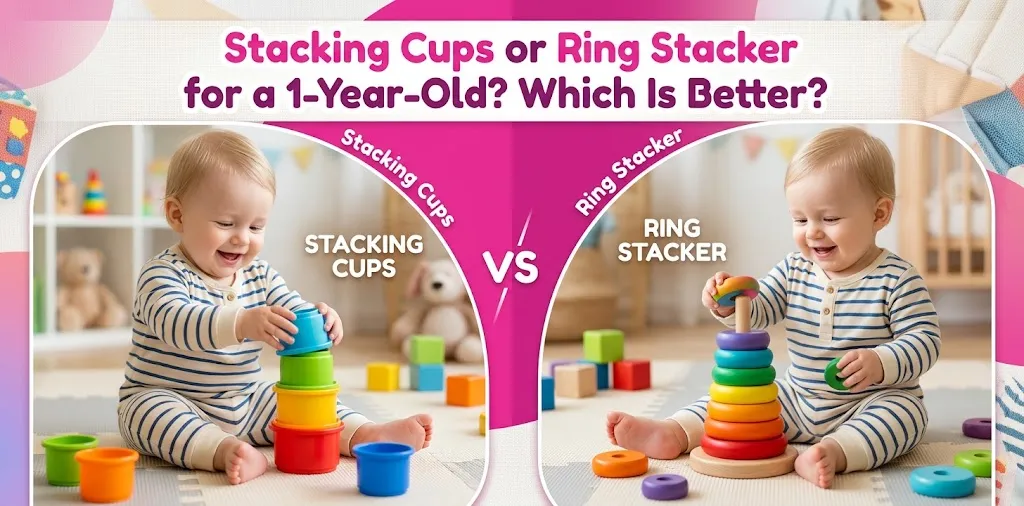
Stacking Cups or Ring Stacker for a 1-Year-Old? Which Is Better?

For most 1-year-olds, a ring stacker is the better choice if the main goal is practicing hand-eye coordination and controlled placement. Stacking cups are more versatile and offer more ways to play, including nesting, filling, dumping, and water play. The better option depends on whether you want focused fine-motor practice or more open-ended play.
Stacking Cups vs. Ring Stacker at Age 1
Both toys are simple, but they give a 1-year-old different challenges. A ring stacker asks the child to guide a ring over a post, while stacking cups allow the child to experiment with size, nesting, stacking, and containers.
The American Academy of Pediatrics specifically lists stacking or nesting cups as toys that can help young children practice small-muscle skills and figure out how to stack.
| Feature | Stacking Cups | Ring Stacker |
|---|---|---|
| Fine-motor practice | Good | Excellent |
| Hand-eye coordination | Good | Excellent |
| Nesting | Excellent | No |
| Building towers | Excellent | Good |
| Size comparison | Good | Excellent |
| Open-ended play | Excellent | Moderate |
| Bath or water play | Often yes | Usually no |
| Easy for a beginner | Yes | Yes, with some help |
| Best for focused stacking practice | Good | Excellent |
| Play possibilities as child grows | Excellent | Good |
Neither toy is automatically better for every child. At 12 months, some children may enjoy putting objects into containers, while others may be more interested in taking rings off a post or trying to put them back on.
What a 1-year-old can actually do with stacking cups
A 1-year-old may not immediately build a tall tower. That’s normal.
A child may:
- Pick up and bang cups together
- Put one cup inside another
- Take cups apart
- Put toys inside a cup
- Dump objects out
- Try to stack two or three cups
- Knock down a tower and rebuild it
- Use cups during supervised water play
This makes cups especially useful for children who like exploring objects in different ways rather than repeating one specific action.
Some stacking cups can also remain useful beyond the first birthday because toddlers can eventually use them for pretend play, sorting, sand play, and simple measuring games.
What a 1-year-old can actually do with a ring stacker
A ring stacker provides a more focused challenge.
At first, a child may simply remove the rings. Later, they may hold a ring over the post and try to lower it onto the peg. Eventually, they can begin noticing that the rings are different sizes.
The important part is not whether a 12-month-old can correctly arrange every ring from largest to smallest. The useful skill is learning how to grasp the ring, line up the opening, and control the movement.
One-year-olds are also developing quickly during the second year of life, with increasing exploration and imitation of objects and actions around them.
Which Toy Is Better for Development?
If you are choosing between the two specifically for fine-motor and hand-eye coordination practice, I would give the edge to the ring stacker.
The reason is simple: the child has to make a more precise movement. The ring must be positioned over the post before it can slide down.
Stacking cups still provide useful developmental play, but they are less restrictive. A child can stack, nest, fill, empty, carry, knock down, and combine them with other objects.
That difference makes each toy useful in its own way.
| Developmental area | Better choice |
|---|---|
| Precise hand movements | Ring stacker |
| Hand-eye coordination | Ring stacker |
| Nesting and containment | Stacking cups |
| Open-ended exploration | Stacking cups |
| Comparing sizes | Ring stacker |
| Fill-and-dump play | Stacking cups |
| Water play | Stacking cups |
| Practicing a simple stacking task | Ring stacker |
These toys should not be viewed as tools that a child needs to reach a milestone. The AAP notes that a particular toy is not necessary for a child to reach the next developmental milestone. The value comes from giving children safe opportunities to explore and practice skills through play.
When Stacking Cups Make More Sense
Choose stacking cups if your 1-year-old enjoys putting things in and taking them out.
For example, imagine a toddler sitting on the floor with six cups. Instead of trying to build a tower, the child puts a small toy into one cup, covers it with another cup, takes it apart, and starts again. That is still meaningful play.
Cups are also a strong choice when you want one toy that can support several types of play.
They can be used for:
- Stacking
- Nesting
- Filling and dumping
- Sorting
- Bath play
- Water pouring
- Sand play when age-appropriate and supervised
- Simple pretend play
This versatility is one of the biggest advantages cups have over a traditional ring stacker.
Stacking cups are especially useful for open-ended play
A ring stacker has a fairly obvious purpose: put the rings on the post.
Cups do not have to be used that way.
A toddler can decide what to do with them, which can make them useful for longer periods as the child develops new ways of playing.
For a family that wants to buy one inexpensive toy with many possible uses, stacking cups are a strong option.
When a Ring Stacker Makes More Sense
Choose a ring stacker if your child enjoys repeating a physical challenge.
A toddler may spend several minutes trying to place the same ring on the post, take it off, and try again. The activity is simple, but the child is practicing controlled movement each time.
A ring stacker is also useful if you want to introduce the idea that objects can be different sizes.
At first, don’t worry about getting the order right. A child may put the smallest ring on first or place the rings randomly. That is part of learning.
As the child becomes more experienced, you can casually model the larger-to-smaller order without turning play into a test.
Which One Is Easier for a Beginner?
Stacking cups are usually easier to explore without instructions.
A child can pick up a cup, turn it over, put something inside, or bang it against another cup. There is no single correct movement.
A ring stacker can require more precision because the ring has to be aligned with the post.
That does not make it too difficult for a 1-year-old. It simply means the child may need more opportunities to figure it out.
If your toddler gets frustrated, try giving them just two or three rings instead of presenting the entire stacker at once.
What Should Parents Look for When Buying Either Toy?
The design matters more than whether the toy is made from wood or plastic.
For a 1-year-old, look for:
- A clear age recommendation that is appropriate for the child
- Large pieces that cannot easily fit into the child’s mouth
- Strong construction
- Smooth edges
- Securely attached components
- Materials intended for children’s toys
- A design that is easy to clean
- No accessible button batteries
- No high-powered magnets
The AAP recommends choosing toys that are developmentally appropriate and large enough to reduce choking risk. It also advises avoiding toys with accessible button batteries and high-powered magnets.
Don’t assume “educational” means better
A basic set of cups does not need lights, sounds, numbers, or electronic features to be useful.
For a 1-year-old, a simple toy that encourages the child to physically manipulate objects can be plenty.
The goal is not to make the toy do more. The goal is to give the child something interesting to do.
Wood or Plastic: Which Is Better?
There is no universal rule that a wooden stacker is better than a plastic one.
A well-made plastic stacking cup can be extremely useful because it is lightweight, easy to clean, and often suitable for water play.
Wooden ring stackers can offer a different feel and may be appealing if you prefer traditional materials.
For a 1-year-old, safe design, appropriate sizing, durability, and ease of use matter more than the material alone.
Two Real-Life Buying Scenarios
If your toddler loves water and containers
Suppose your 1-year-old enjoys bath time, putting objects into containers, and dumping things back out.
In that situation, stacking cups are probably the better first purchase. You can use the same set for stacking on the floor and supervised water play.
If your toddler loves taking things apart and putting them back together
Suppose your child repeatedly removes objects, tries to put them back, and enjoys activities that require a little more precision.
A ring stacker may be the better choice because it gives the child a simple physical problem to solve: how to get the ring onto the post.
Neither example means every child will respond the same way. Toddlers have different interests, and their skills can change noticeably over a short period.
So, Which Is Better for a 1-Year-Old?
If you want a focused fine-motor activity, choose the ring stacker.
If you want a more versatile toy with several ways to play, choose stacking cups.
If your budget allows only one, I would slightly favor stacking cups for overall versatility. They can be stacked and nested, but they can also become containers, bath toys, and tools for simple open-ended play.
However, if your main reason for buying the toy is to give your toddler a straightforward stacking challenge, the ring stacker is the more targeted choice.
Frequently Asked Questions
Are stacking cups or ring stackers better for a 1-year-old?
Both are appropriate choices when the specific toy is labeled for the child’s age and used safely. Ring stackers provide a more focused hand-eye coordination challenge, while stacking cups offer more open-ended activities such as nesting, filling, dumping, and water play.
Can a 1-year-old stack cups correctly?
Yes, some 1-year-olds can stack a few cups, while others may mainly knock them over, nest them, or put objects inside them. There is a wide range of normal play at this age, so the child does not need to build a tall or perfectly ordered tower for the activity to be useful.
Should a 1-year-old know how to stack rings by size?
No. A 1-year-old may place rings randomly or simply remove them from the post. Correctly ordering the rings by size can develop gradually, and parents do not need to turn stacking into a test. The early goal is exploring the pieces and learning how they move.
The Bottom Line
For a 1-year-old who needs one versatile toy, stacking cups are the better overall choice. They offer more ways to explore and can stay interesting as the child discovers new forms of play.
Choose a ring stacker when you want a more focused activity involving grasping, aiming, and placing objects onto a post.
Whichever you choose, keep the activity simple: let your toddler experiment, make mistakes, knock things down, and try again. The best stacking toy is one that gives the child a safe reason to keep exploring.