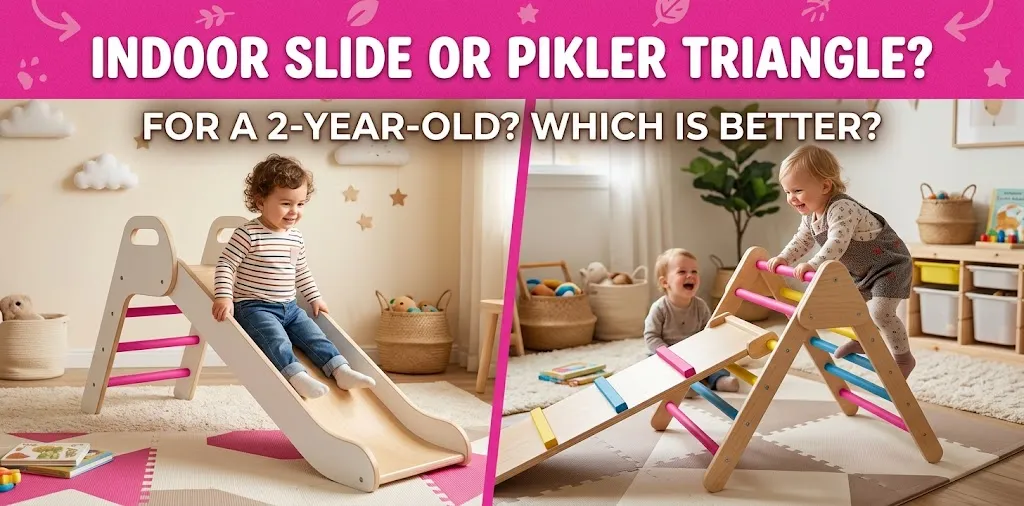
Indoor Slide or Pikler Triangle for a 2-Year-Old? Which Is Better?

For most 2-year-olds, a Pikler triangle is the better choice if you want one indoor toy that offers more ways to play. It supports climbing, balancing, crawling, and imaginative play, while an indoor slide is simpler and mainly focuses on sliding and repeated climbing. If your child already loves slides and you want easy, straightforward fun, an indoor slide may be the better fit.
| Feature | Indoor Slide | Pikler Triangle |
|---|---|---|
| Main activity | Sliding and climbing | Climbing, balancing, crawling, and play |
| Variety of play | Lower | Higher |
| Best for | Kids who love slides | Active kids who like climbing |
| Skill challenge | Simple and predictable | More adjustable and varied |
| Imaginative play | Some | More opportunities |
| Storage | Usually simple | Foldable models are easier |
| Can add accessories | Limited | Ramps, slides, arches, and boards may be available |
| Best overall for a 2-year-old | Good | Better for versatility |
The choice is less about which toy is universally “better” and more about how your 2-year-old likes to move. A child who constantly climbs furniture may get more use from a Pikler triangle, while a child who asks to go down the slide over and over may be happier with an indoor slide.
What Makes an Indoor Slide Different From a Pikler Triangle?
An indoor slide is designed around one basic movement: climb up and slide down. It is easy for a young toddler to understand and usually does not require much explanation once it is safely assembled.
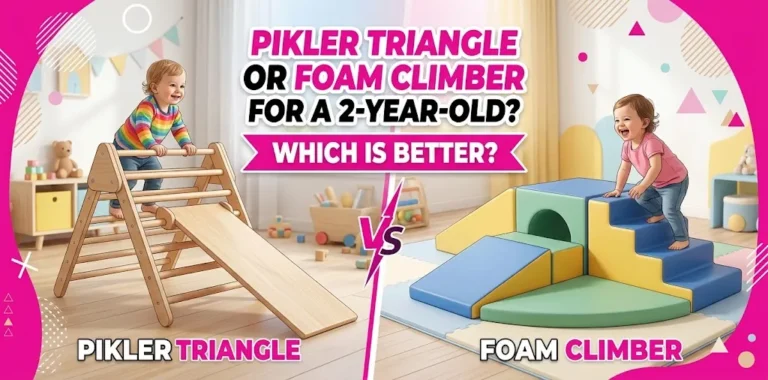
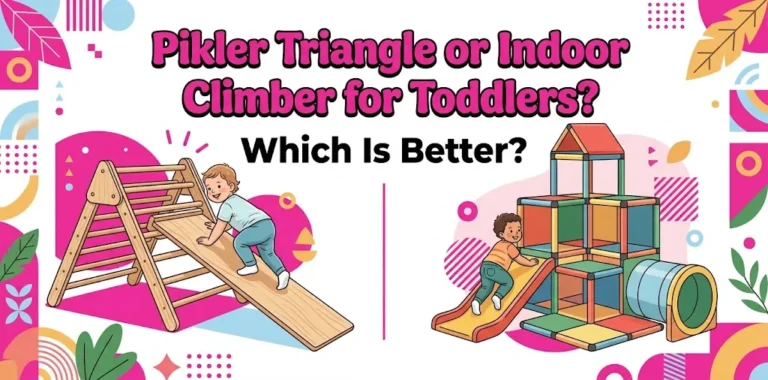
A Pikler triangle is a low climbing structure made with angled sides and rungs. Depending on the design, it can be used for climbing, standing, crawling underneath, balancing, or adding a ramp or slide attachment. Some current sets are designed to be reconfigured as children grow.
That difference matters when you are deciding how much variety you want from one toy.
A standalone slide gives your child a very clear activity. A Pikler triangle gives them more freedom to decide how they want to use the equipment.
When an Indoor Slide Is the Better Choice
An indoor slide can make more sense if your 2-year-old already enjoys sliding at playgrounds and you want to recreate that type of play at home.
It may be the better option when:
- Your child prefers simple, repetitive activities.
- They get excited about going up and down slides.
- You want something that is easy to understand without much setup.
- You have limited interest in climbing-focused play.
- You want a toy primarily for active indoor movement.
A standalone slide can also be easier for parents who do not want a more complex climbing setup.
For example, imagine a 2-year-old who visits the playground and immediately runs toward the slide every time. At home, an appropriately sized indoor slide may get much more regular use than a Pikler triangle simply because it matches what the child already enjoys.
The downside is that the play pattern can become repetitive. Your child may mostly climb, slide, and repeat.
When a Pikler Triangle Is the Better Choice
A Pikler triangle is usually the stronger choice when your 2-year-old loves climbing and exploring movement.
It can offer several different play patterns:
- Climbing up and down the rungs
- Crawling through or underneath the structure
- Practicing balance
- Using a ramp or slide attachment
- Creating a small fort with a blanket
- Incorporating it into an indoor obstacle course
- Changing the setup as the child’s abilities develop
Some current Pikler systems are specifically designed to work with ramps, slides, arches, or other components.
This flexibility is one reason a Pikler triangle can remain interesting after the novelty of a simple slide wears off.
However, it is not automatically the right choice for every toddler. A child who dislikes climbing may barely use it, while another child may want to climb it every day.
Which One Gives a 2-Year-Old More Ways to Play?
The Pikler triangle usually wins for play variety.
A slide has one obvious purpose. A Pikler triangle can become a climbing frame, ramp setup, hiding place, obstacle-course element, or part of pretend play.
Parent discussions also show that some children continue finding different uses for Pikler triangles beyond basic climbing, including forts, obstacle courses, and using ramps for toys. These are individual experiences rather than a guarantee that every child will play the same way.
That distinction is important. A versatile toy is valuable only if your child actually enjoys using it.
Which Is Better for a Child Who Loves to Climb?
If your 2-year-old is constantly trying to climb the couch, chairs, stairs, or other household objects, a Pikler triangle is the more natural match.
The attraction is not simply that it is a climbing toy. It gives the child a designated structure for practicing climbing indoors.
But parents should not assume that a Pikler triangle makes climbing risk-free. It is still climbing equipment, so falls are possible.
The U.S. Consumer Product Safety Commission specifically warns against placing children’s climbing gyms on hard surfaces such as wood, concrete, or asphalt.
That makes the play area part of the purchase decision—not just the triangle itself.
Which One Is Easier for a Small Playroom?
An indoor slide may appear simpler, but the answer depends on the design.
A Pikler triangle can be surprisingly practical if you choose a foldable model. Some current products are designed to fold for storage, while modular models can change configuration.
Before buying either toy, measure:
- The available floor space.
- The height of nearby furniture.
- The space needed around the toy.
- Where the child will land or step off.
- Where you will store it when it is not being used.
Do not measure only the toy’s footprint. A toddler needs room to move around it safely.
Safety Matters More Than the Toy Type
Both choices involve climbing and falling, so safe setup should be a major part of the decision.
For a Pikler triangle, check the manufacturer’s age and weight limits, assemble it exactly as instructed, and inspect the frame and hardware regularly. Current guidance from Pikler manufacturers commonly emphasizes stable placement, appropriate age limits, and supervision.
For either product:
- Place it on an appropriate cushioned surface rather than directly on hard flooring.
- Keep it away from stairs, windows, sharp furniture edges, and other hazards.
- Make sure the equipment does not wobble or move unexpectedly.
- Follow the manufacturer’s age and weight recommendations.
- Check screws, joints, rungs, ramps, and other connection points regularly.
- Stay close enough to respond if your child needs help.
- Keep the landing area clear.
The CPSC also advises parents to follow safety instructions and keep play areas clear of hazards.
If a Pikler triangle includes a removable ramp or slide, pay particular attention to how that piece attaches. A ramp that simply rests on a rung can create a different risk from a securely designed attachment. A recent parent report described a loose ramp being pushed off the triangle and falling onto another child, showing why attachment and storage deserve attention.
What Should You Look for When Buying One?
For a Pikler triangle, prioritize:
- A stable, sturdy frame
- Smooth, splinter-free surfaces
- Securely attached rungs
- Clear manufacturer age and weight guidance
- A design appropriate for your available space
- A reliable locking or attachment system for accessories
- A foldable design if storage is important
For an indoor slide, look for:
- A stable base
- Smooth edges and surfaces
- A slide height appropriate for the manufacturer’s recommended age
- A secure ladder or climbing section
- A clear landing area
- An appropriate cushioned play surface
Don’t choose a product based only on appearance or the number of accessories included. The U.S. toy safety standard ASTM F963 addresses hazards associated with toys and includes age-grading guidance, but parents should still follow the individual manufacturer’s instructions for the specific product.
What If You Want Both Climbing and Sliding?
This is where a Pikler triangle with a properly designed ramp/slide attachment can be appealing.
Instead of purchasing two separate pieces, one setup can provide both climbing and sliding. Some current products are sold with a separate ramp that functions as either a climbing surface or a slide.
For a 2-year-old who enjoys both activities, this can be a practical middle ground.
Still, don’t assume every “Pikler triangle with slide” is equivalent. Check how the ramp attaches, whether the manufacturer approves the configuration for your child’s age, and whether the entire setup remains stable during use.
Two Real-World Buying Scenarios
Scenario 1: Your toddler is a natural climber
Your 2-year-old climbs the couch, tries to scale cushions, and enjoys playground climbing structures. In this situation, a Pikler triangle is likely to provide more interesting opportunities than a standalone slide.
A model with a suitable ramp or slide attachment could make even more sense if your space and budget allow it.
Scenario 2: Your toddler only wants to slide
Your child is less interested in climbing but gets excited every time they see a slide. A simple indoor slide may be the smarter purchase.
There is little benefit in buying a more versatile climbing toy if your child consistently ignores climbing activities.
Indoor Slide vs. Pikler Triangle: The Simple Decision
Choose an indoor slide if your main goal is straightforward sliding fun.
Choose a Pikler triangle if your child enjoys climbing and you want more varied indoor movement and pretend-play possibilities.
Choose a Pikler triangle with a properly secured ramp/slide if you want both and have enough room for a safe setup.
For most families choosing only one, I would lean toward the Pikler triangle for a 2-year-old who already enjoys climbing. For a slide-loving toddler who does not show much interest in climbing, the standalone indoor slide can be the better match.
Frequently Asked Questions
Is a Pikler triangle good for a 2-year-old?
Yes, a Pikler triangle can be a suitable indoor climbing option for a 2-year-old when the specific product is rated for that age and used as directed. The child should use it in a safe setup with appropriate supervision and a suitable surface underneath.
Is an indoor slide safer than a Pikler triangle for a 2-year-old?
Neither is automatically safer simply because of its type. Both can involve falls, so stability, age-appropriate design, proper setup, a suitable surface, and supervision matter more than choosing one category over the other.
Should I get a Pikler triangle with a slide or a separate indoor slide?
A Pikler triangle with a properly designed slide attachment makes more sense if your child enjoys both climbing and sliding. If your child mainly wants to slide and you prefer a simpler setup, a standalone indoor slide may be the more practical choice.
The Bottom Line
For a 2-year-old, a Pikler triangle is the better all-around choice when the child enjoys climbing, while an indoor slide is better when sliding is the main attraction. The most useful purchase is the one that matches your child’s actual play style rather than the toy with the longest feature list.
Before buying, check the manufacturer’s age guidance, measure your available space, and plan the play surface first. For climbing equipment, a safe setup is just as important as the toy itself.