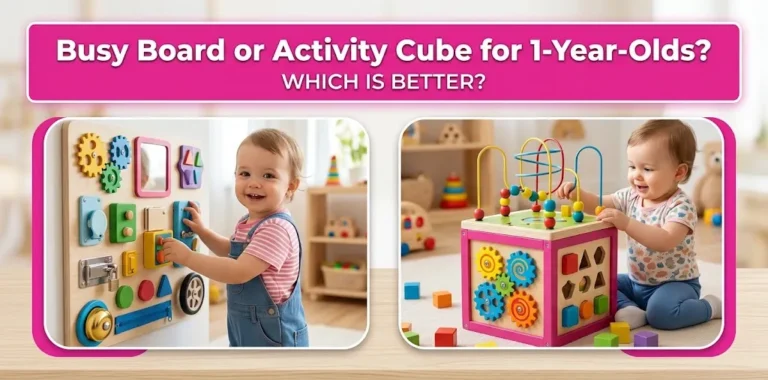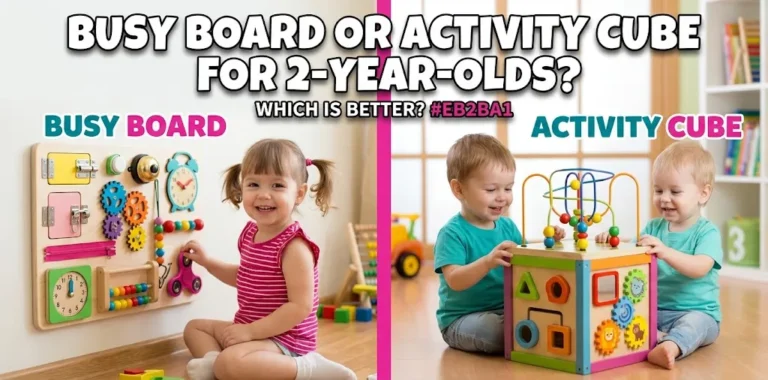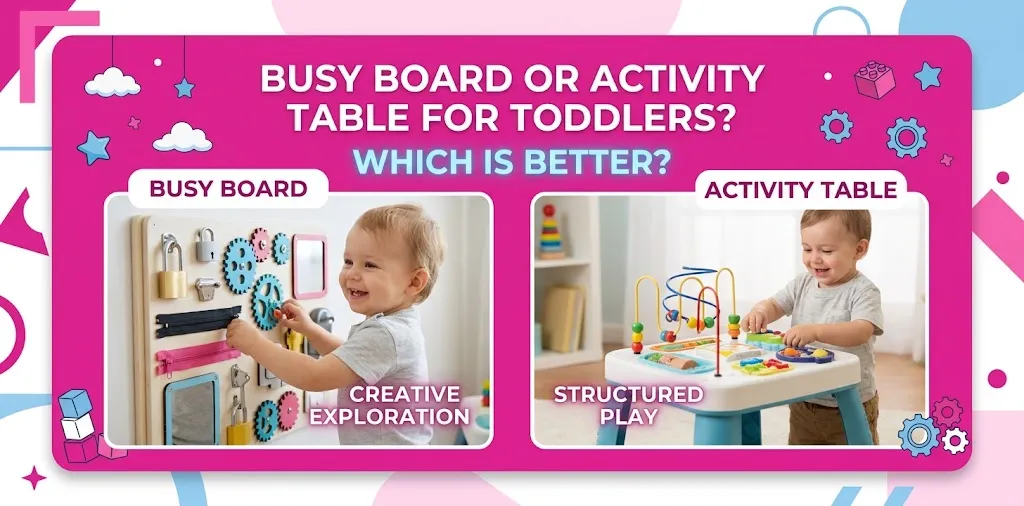
Busy Board or Activity Table for Toddlers? Which Is Better?

If your toddler enjoys hands-on activities such as zippers, latches, switches, and turning pieces, a busy board is usually the better choice for focused fine-motor play and smaller spaces. An activity table is a better fit when you want a larger play surface with several activities that can support longer, more varied play. The right choice depends mainly on your toddler’s age, interests, available space, and how you plan to use the toy.
Busy Board vs. Activity Table at a Glance
A busy board and an activity table can both give toddlers screen-free, hands-on play, but they create very different play experiences.
| Feature | Busy Board | Activity Table |
|---|---|---|
| Best for | Fine-motor and practical-life activities | Mixed hands-on play |
| Typical setup | Flat board or portable panel | Freestanding table |
| Space needed | Low | Moderate |
| Portability | Usually easier to move | Usually stays in one area |
| Activities | Zippers, buckles, latches, switches, sliders | Gears, bead mazes, shape activities, tracks, panels, sometimes pretend play |
| Play position | Floor, lap, wall, or low surface depending on design | Standing or sitting around the table |
| Good for | Focused, repetitive manipulation | Switching between different activities |
| Travel | Better suited to travel | Usually inconvenient |
| Storage | Easy for many designs | Takes more floor space |
| Best choice for | A toddler who likes figuring out mechanisms | A toddler who likes variety and moving around |
The main difference is how the child interacts with the toy. A busy board concentrates several small tasks onto one surface, while an activity table gives the child a play station with more room and often several different types of activities.
When a Busy Board Is the Better Choice
A busy board makes more sense when your toddler is fascinated by things adults use every day.
A child who constantly wants to:
- Open and close cabinets
- Pull zippers
- Push buttons
- Turn switches
- Undo buckles
- Move sliders
- Spin wheels
- Open latches
may enjoy a busy board because it gives them safe, toy-based versions of those actions.
The play is usually repetitive rather than goal-driven. A toddler may open a latch, close it, and repeat the same action many times. That is not necessarily a problem. Repeating a physical action can be part of how young children explore cause and effect and practice controlling their hands.
Busy boards also make sense when space is limited. A small apartment, bedroom, or play corner may not have room for a full activity table.
A busy board is especially useful for travel
Some soft or fabric busy boards can fit into a diaper bag or travel bag. That makes them more practical for car rides, waiting rooms, visits, or other situations where you need a compact activity.
A wooden board is less convenient to carry, but it can work well as a dedicated home activity.
If portability is your main concern, pay attention to the board’s weight, size, handles, attached pieces, and cleaning instructions, rather than simply counting how many activities it has.
When an Activity Table Is the Better Choice
An activity table is usually the stronger option when your toddler wants more variety and a larger play area.
Instead of concentrating on one type of manipulation, an activity table may combine several activities around one surface. Depending on the model, a child might move beads, spin gears, match shapes, roll objects, turn panels, or explore other interactive elements.
This can be useful for toddlers who quickly become bored with one activity.
An activity table also gives the toy a clear place in the room. Your child can walk over to it, stand or sit, play for a while, and then move away.
That makes it more of a play station than a portable activity.
Activity tables can work well for shared play
A larger surface can also make it easier for a parent, sibling, or another child to participate.
For example, a parent might sit beside a toddler and talk about shapes while the child works with a matching activity. The toy becomes a starting point for interaction rather than something the child has to use completely alone.
The American Academy of Pediatrics emphasizes that play gives young children opportunities to explore, interact, and learn, and that simple hands-on toys can support development without replacing real interaction with caregivers.
Which One Is Better for a 1-Year-Old?
For a younger toddler, a simple busy board can be a better choice than a complicated activity table, provided the specific toy is age-appropriate and its activities match the child’s abilities.
At this stage, you do not need the toy with the greatest number of features. A few simple activities that a child can actually manipulate may be more useful than a board or table filled with difficult mechanisms.
Look for activities that are easy to understand and physically manageable.
For example, a toddler may be able to:
- Pull a large zipper
- Turn a large wheel
- Move a simple slider
- Open a large flap
- Press a large button
A complicated buckle or difficult latch may simply frustrate a child who has not developed the hand strength or coordination needed to use it.
Age labels matter. The CPSC recommends choosing toys according to a child’s age, abilities, interests, and the safety information provided by the manufacturer.
Which One Is Better for a 2-Year-Old?
At around age 2, either option can work well.
The better choice depends more on what your toddler naturally enjoys.
Choose a busy board if your child likes:
- Opening and closing things
- Repeating the same hand movement
- Buckles and zippers
- Switches and latches
- Quiet, focused activities
Choose an activity table if your child likes:
- Moving between different activities
- Standing while playing
- Bead mazes and gears
- Matching and sorting
- Exploring several parts of a toy in one session
A two-year-old who spends half the day trying to operate door handles may get more value from a busy board. A toddler who constantly moves from one toy to another may prefer an activity table with several play areas.
Which One Is Better for a 3-Year-Old?
For many 3-year-olds, an activity table can offer more variety, especially if the table provides challenges that are appropriate for preschool-age play.
However, a busy board can still be useful if the child enjoys practical-life activities.
At this age, the question is less about whether a busy board is “for toddlers” and more about whether the activities are still challenging and interesting.
A board designed around very simple actions may become boring once your child has mastered everything. On the other hand, a more advanced board with different fasteners and problem-solving activities may remain interesting longer.
Busy Board or Activity Table for Fine-Motor Play?
If fine-motor manipulation is your main reason for buying the toy, I would give the busy board a slight advantage.
Its activities are often directly centered around hand movements such as pulling, twisting, fastening, sliding, and opening.
Activity tables can also provide fine-motor opportunities. Bead mazes, gears, shape pieces, and other manipulatives require controlled hand movements, but the experience is usually broader.
The American Academy of Pediatrics notes that traditional hands-on toys such as blocks, shapes, puzzles, and similar manipulatives can support fine-motor and problem-solving skills.
Neither toy should be treated as a guaranteed way to produce a particular developmental milestone. Children develop at different rates, and a toy is only one part of their overall play experience.
Busy Board or Activity Table for Independent Play?
A busy board may be better when you want a contained activity with fewer distractions.
For example, imagine a toddler sitting on the floor with a board containing a zipper, latch, wheel, and buckle. The child can spend several minutes working through those actions without moving around the room.
An activity table provides more choices, which can be helpful for some children but distracting for others.
A toddler might start at the bead maze, move to the gears, then walk away and return later. That is perfectly normal. The advantage is variety rather than sustained focus on one particular task.
Neither toy guarantees independent play. Some toddlers will want an adult nearby, especially when an activity is new or difficult.
Which One Takes Less Space?
A busy board wins easily for small spaces.
Many boards can be stored on a shelf or in a toy bin. Some can also be mounted or placed against a suitable surface, depending on the product’s design and instructions.
An activity table needs enough floor space for the table itself and enough room around it for the child to use it comfortably.
Before buying an activity table, measure the area where you plan to put it. A toy can look reasonably compact online but take up much more practical space once your toddler needs room to stand, sit, and move around it.
Which One Is Better for Travel?
For travel, a soft or compact busy board is usually the more practical option.
An activity table is generally designed to stay in one place. Taking one in a car may be possible, but its size makes it much less convenient.
A travel-friendly busy board can be useful during:
- Long car trips
- Flights
- Restaurant visits
- Doctor’s office waiting rooms
- Visits to relatives
- Quiet time away from home
If you plan to use the board outside the house, consider how easily it can be cleaned and whether all of its pieces remain attached.
What About Safety?
Safety should come before the number of activities, materials, or the word “Montessori” on the packaging.
For a toddler toy, check:
- The manufacturer’s recommended age
- Small parts and choking warnings
- Loose or detachable components
- Sharp edges or rough surfaces
- Securely attached hardware
- Battery compartments if the toy uses batteries
- Magnets and magnetic components
- Strings, cords, or loops
- Whether the toy remains stable during normal use
The CPSC advises keeping toys with small parts away from children younger than 3 and paying attention to age labels and safety warnings. It also warns about hazards associated with high-powered magnets and button or coin batteries.
The American Academy of Pediatrics similarly recommends checking age guidance, looking for sturdy construction, and being particularly careful with button batteries, lithium coin batteries, and high-powered magnets.
A busy board is not automatically safer
A common mistake is assuming that a simple wooden busy board is automatically safer than an electronic activity table.
Material alone does not determine safety.
A wooden board with a loose metal component can create a problem just as an electronic toy with an unsecured battery compartment can. Inspect the actual product and follow its instructions.
It’s also worth checking for recalls before giving a new or used toy to a child. The CPSC maintains current toy safety and recall information for consumers.
Two Real-World Buying Examples
Example 1: A small apartment with a 20-month-old
Suppose a family has limited floor space and their toddler spends a lot of time trying to open drawers, pull zippers, and operate switches.
A compact busy board would probably make more sense. It addresses the child’s current interest without requiring a permanent play station.
An activity table could still be useful, but it would take up more room and may offer activities the child is less interested in right now.
Example 2: A 2-year-old who gets bored quickly
Now imagine a toddler who moves from one toy to another every few minutes and enjoys bead mazes, gears, matching activities, and different types of manipulation.
An activity table may be the better fit because the child can move between several activities without needing another toy.
The key difference is not that one toy is “educational” and the other isn’t. It’s that the play experience matches a different type of child interest.
How to Choose Between a Busy Board and Activity Table
If you are still undecided, focus on these five questions:
- What does my toddler already enjoy?
Look at your child’s current play rather than buying based only on age. - How much space do I have?
A busy board is easier to store in a small home. - Will I use it outside the house?
If yes, a portable busy board has a major advantage. - Does my child prefer repetition or variety?
Repeating latches and zippers points toward a busy board. Moving between different activities points toward an activity table. - Can my child actually use the activities?
A toy that is too difficult can become frustrating instead of engaging.
So, Which Should You Buy?
For most families, the decision is fairly simple:
Choose a busy board if you want compact, focused, hands-on play. It is especially appealing for toddlers who love zippers, buckles, latches, switches, and other practical movements.
Choose an activity table if you want a larger, stationary play area with more variety. It makes more sense when your toddler enjoys exploring several activities and you have enough room for a dedicated play station.
If you have space and your child enjoys both styles, they do not have to compete. A busy board can work as a focused or travel activity, while an activity table can stay in the play area for broader exploration.
Frequently Asked Questions
Is a busy board better than an activity table for a 1-year-old?
A simple, age-appropriate busy board can be a good choice for a 1-year-old, especially when the child enjoys basic hands-on actions. The specific age rating and activity difficulty matter more than whether the toy is called a busy board or activity table.
Do toddlers need both a busy board and an activity table?
No. Most toddlers do not need both. Choose the format that better matches your child’s interests, your available space, and how you expect the toy to be used.
Are busy boards good for toddlers who like to open everything?
They can be a particularly natural fit because many busy boards provide toy versions of actions such as opening, closing, fastening, turning, and sliding. Just make sure the activities are securely attached and appropriate for your child’s age and abilities.
The Bottom Line
A busy board is the better pick for focused fine-motor play, small spaces, and travel, while an activity table is better for variety, a dedicated play area, and toddlers who enjoy moving between different activities.
Don’t choose based on the number of activities alone. Watch what your toddler already tries to do, choose an age-appropriate design, and prioritize secure construction and safety over flashy features.