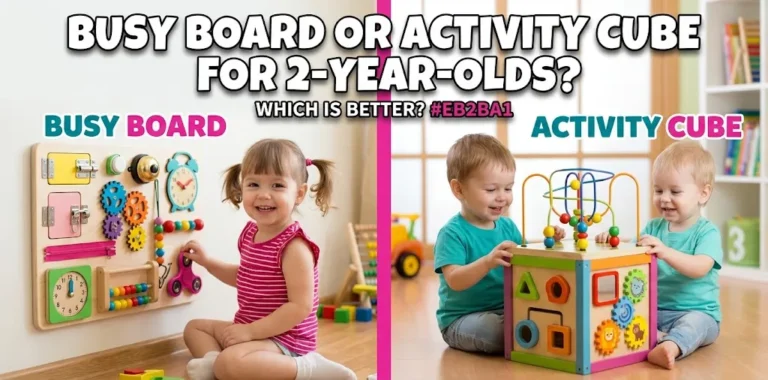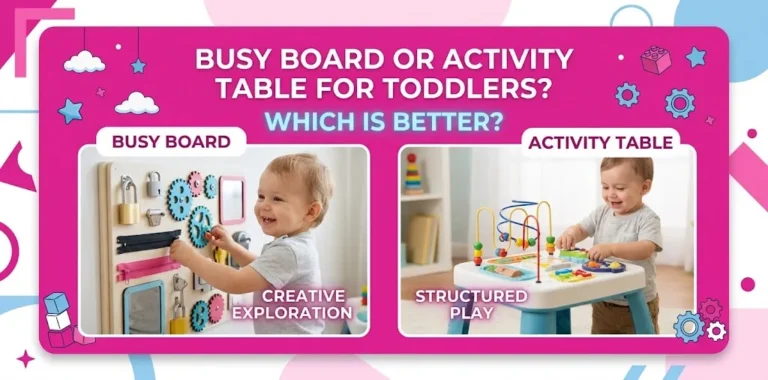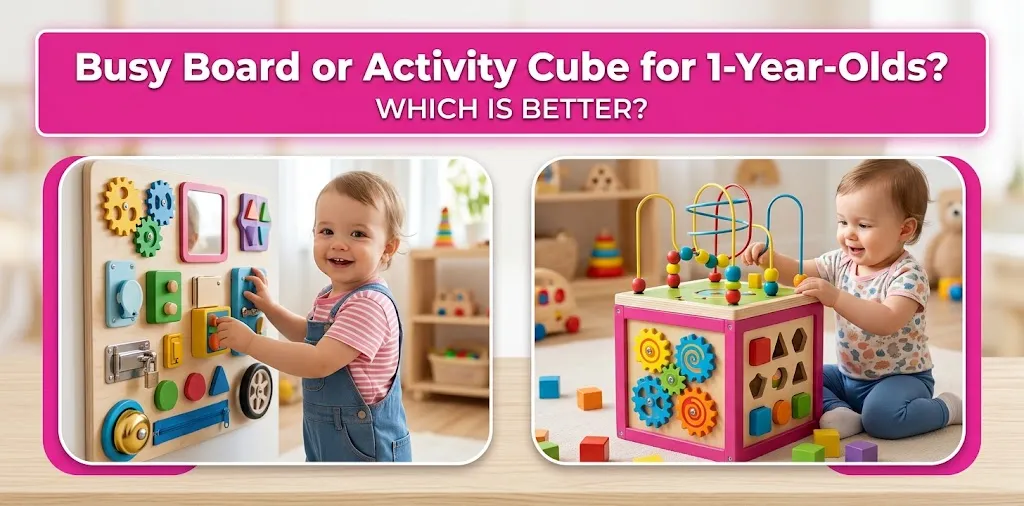
Busy Board or Activity Cube for 1-Year-Olds? Which Is Better?

For most 1-year-olds, an activity cube is the better choice for everyday play, especially at home, because it offers several simple activities in one stable toy. A busy board can be better for travel or focused hands-on play. The key is choosing a toy with age-appropriate activities, securely attached parts, and no accessible small pieces.
Busy Board vs. Activity Cube for a 1-Year-Old
A busy board is usually a flat board with hands-on features such as large switches, sliders, wheels, doors, or simple latches. An activity cube puts similar activities on several sides of a compact, three-dimensional toy.
Both can encourage hands-on exploration. At around age one, children often enjoy repeating simple actions such as turning, pushing, opening, and closing. The American Academy of Pediatrics notes that 1-year-olds are naturally interested in buttons, switches, knobs, and other mechanical features that match their developmental level.
| Feature | Busy Board | Activity Cube |
|---|---|---|
| Best use | Focused hands-on play | General everyday play |
| Portability | Usually good | Good, especially smaller cubes |
| Variety | Depends on board size | Often several sides of activities |
| Floor play | Good | Excellent |
| Table or lap play | Good | Good |
| Stability | Depends on design | Usually stable when properly designed |
| Space needed | Often wider | More compact footprint |
| Best for | Toddlers who like specific actions | Toddlers who enjoy exploring different activities |
The biggest difference
The main difference is how the child interacts with the toy.
A busy board tends to keep activities in one place. A cube gives the child several surfaces to explore, which can make it easier to move from one activity to another.
For a newly turned 1-year-old, however, more activities do not automatically mean a better toy. A simple activity that the child can understand and repeat may be more useful than a complicated toy filled with features.
Why an Activity Cube May Be Better at Age 1
An activity cube can be a strong choice for a 1-year-old because it offers variety without requiring a large play area.
A child might turn a wheel, push a button, move a large slider, or open a simple door. These actions give the child a chance to experiment with cause and effect while practicing hand movements.
An activity cube also works well when a parent wants one toy that can be used during short periods of independent exploration.
However, supervision is still important. A young toddler may pull, shake, mouth, or drop a toy rather than use every feature exactly as intended.
When a Busy Board Makes More Sense
A busy board may be the better option if your child enjoys repeating one action over and over.
For example, a hypothetical 1-year-old who loves opening and closing things may get more use from a simple board with large, easy-to-operate features than from a cube with many different activities.
Busy boards can also be convenient when you want something relatively flat for a play area, table, or supervised travel situation.
The important part is to choose a board specifically suitable for the child’s age rather than assuming that every product labeled “busy board” is appropriate for a 1-year-old.
Which One Is Better for Fine Motor Practice?
Both can help with hands-on motor practice, but the specific activities matter more than the format.
Look for large, easy-to-grasp controls that encourage actions such as:
- Turning
- Pushing
- Pulling
- Sliding
- Opening
- Closing
- Grasping
At this age, the goal should not be to make the toy extremely difficult. A good activity gives the child a small challenge that they can work out with practice.
A 1-year-old who cannot operate a complicated latch yet may simply move on to another activity. That’s normal. The toy should offer choices rather than require the child to complete every feature.
Safety Matters More Than the Number of Activities
For a 1-year-old, safety should come before the number of buttons, gears, zippers, or switches.
Check the manufacturer’s recommended age range before buying. Then inspect the toy for loose, broken, or detachable components.
This matters because safety problems have occurred with activity toys when small components detached and created choking hazards. The CPSC also has specific safety requirements for certain stationary activity centers, including concerns related to stability and product disassembly.
For a young toddler, look for:
- Securely attached components
- Smooth edges and surfaces
- No easily detachable small parts
- A stable design
- A securely closed battery compartment if batteries are used
- Clear manufacturer age guidance
- Durable construction
Inspect the toy regularly. A toy that was secure when new can become less safe if a part loosens or breaks during repeated play.
Busy Board or Activity Cube for Travel?
For travel, the answer depends on size.
A small activity cube can be convenient because it gives a child several activities without taking up much space. A compact busy board can also work well, particularly when it is lightweight and easy to pack.
For a car trip, restaurant wait, or doctor’s office, portability may matter more than having the greatest number of activities.
Avoid choosing a toy simply because it has many features. A smaller toy that your child can easily handle may be more useful than a large toy that is difficult to pack.
Which One Should You Choose?
Use your child’s play style and your family’s routine as the deciding factors.
| If your priority is… | Better choice |
|---|---|
| Everyday home play | Activity cube |
| Several activities in one toy | Activity cube |
| Compact floor play | Activity cube |
| Focused hands-on activities | Busy board |
| A flatter toy for a play area | Busy board |
| Travel-friendly play | Either, depending on size |
| A child who loves repeating simple actions | Either |
| A first hands-on activity toy | Simple activity cube or busy board |
For many families, the activity cube gets the slight edge for a 1-year-old because it combines several types of play in a compact format. But a well-designed busy board can be the better personal fit if the child strongly prefers its activities.
Two Simple Examples
Imagine a 12-month-old who is just starting to explore buttons, wheels, and doors. A simple activity cube may work well because the child can try one feature, move around the cube, and discover another.
Now consider a 1-year-old who spends a lot of time trying to open cabinets and move switches. A simple busy board with large, secure mechanisms may hold their attention better because it matches what already interests them.
Neither example means one toy is universally better. Age, developmental level, interests, and the specific toy design all matter.
What to Look for When Buying
Instead of counting the number of activities, check whether the toy is a good match for a young toddler.
Choose simple activities
Large knobs, wheels, sliders, buttons, and easy-moving parts are generally easier for young toddlers to explore than complex mechanisms.
Check construction
Look closely at joints, moving parts, edges, and attached pieces. Avoid toys with components that appear loose or fragile.
Follow the age rating
A toy marketed for older toddlers may contain activities or components that are not appropriate for a newly turned 1-year-old.
Think about where it will be used
A larger wooden board may be fine for a dedicated play space but less convenient for travel. A compact cube may be easier to move between rooms or take on outings.
Don’t confuse more features with more value
A toy does not need dozens of activities to be useful. For a 1-year-old, a few understandable activities may provide plenty of exploration.
Common Mistakes Parents Should Avoid
One common mistake is buying the most complicated board or cube because it appears more educational. At age one, a child may get more value from a simpler toy that they can actually operate.
Another mistake is ignoring wear and tear. Moving parts should be checked regularly, especially when a toddler pulls and mouths objects.
Finally, don’t assume that a product is safe just because its listing uses words such as “Montessori,” “educational,” or “sensory.” Those labels alone do not replace checking the manufacturer’s age guidance and the toy’s actual construction.
Frequently Asked Questions
If you’re still deciding between a busy board and an activity cube for your 1-year-old, these common questions can help you choose the right option based on safety, play style, and your child’s current skills.
Is an activity cube good for a 1-year-old?
Yes, an age-appropriate activity cube can be a good hands-on toy for a 1-year-old. Choose one with simple activities, securely attached parts, and no accessible small pieces.
Are busy boards safe for 1-year-olds?
Some are, but not every busy board is suitable for this age. Check the manufacturer’s age recommendation and inspect the board for loose parts, accessible batteries, sharp edges, or other hazards before allowing your child to play with it.
Should I buy a busy board or activity cube for a first birthday?
An activity cube is often the easier all-around choice because it provides several types of hands-on play in one compact toy. A busy board may be better if you already know the child enjoys simple actions such as turning, pushing, sliding, or opening.
The Bottom Line
For most 1-year-olds, an activity cube is the better all-around choice, while a busy board can win for focused play or certain travel setups. Don’t choose based only on the number of features—choose the option that matches the child’s current abilities, interests, and play environment.
Expert tip: Before buying, look at the simplest activities first. If your 1-year-old can safely grasp, push, turn, or slide them without frustration, you’re much more likely to have a toy they will actually use.