Play Tunnel or Foam Climber for Toddlers? Which Is Better?

If your toddler mainly enjoys crawling, hiding, and exploring enclosed spaces, a play tunnel is usually the better choice. If your child enjoys climbing, stepping, balancing, and trying different obstacles, a foam climber offers more variety. For toddlers who enjoy both, a foam climber with a tunnel can provide the most flexible indoor play setup.
Both toys encourage active movement, but they create very different play experiences. The better option depends less on which toy looks more exciting and more on how your toddler naturally likes to move, how much space you have, and how long you want the toy to remain useful.
The American Academy of Pediatrics encourages toddlers to have regular opportunities for active play, including movements such as walking, climbing, and exploring.
Play Tunnel vs. Foam Climber at a Glance
| Feature | Play Tunnel | Foam Climber |
|---|---|---|
| Main movement | Crawling through | Climbing, stepping, crawling, balancing |
| Play style | Exploration and pretend play | Active challenges and obstacle play |
| Best for | Crawlers and explorers | Climbers and active toddlers |
| Setup | Usually simple | Often requires arranging pieces |
| Variety | Moderate | High, especially with modular pieces |
| Storage | Often folds or collapses | Some sets stack or separate |
| Space needed | Usually less | Depends on the number of pieces |
| Best long-term flexibility | Moderate | Often higher |
| Main advantage | Easy, low-effort active play | More ways to move and play |
The biggest difference is simple: a tunnel encourages your child to move through a space, while a foam climber encourages them to move over, around, and across obstacles.
What Does a Play Tunnel Offer Toddlers?
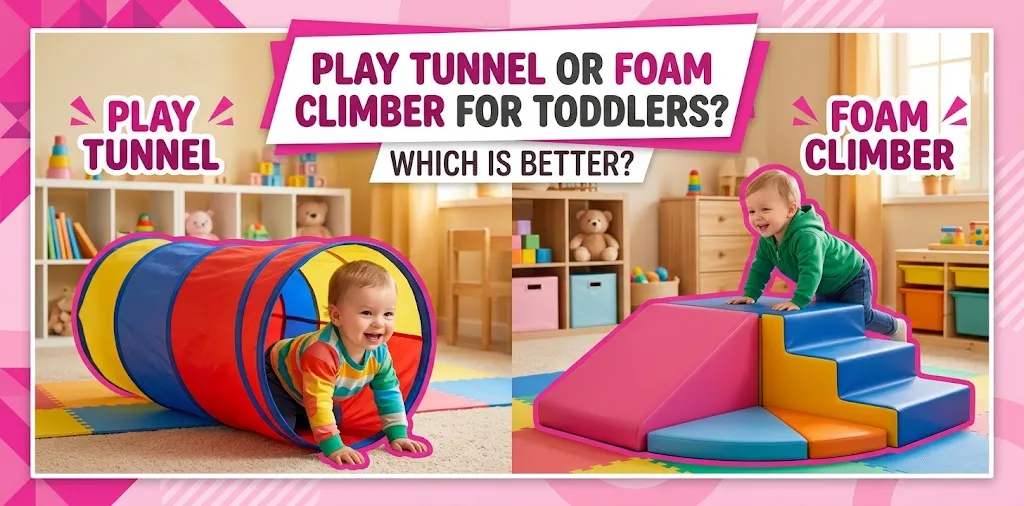
A play tunnel creates a simple path that invites a toddler to crawl from one end to the other.
That sounds basic, but toddlers can turn a tunnel into many different types of play. They may crawl through it, peek out of the opening, hide inside, follow a parent through it, or use it as part of a pretend adventure.
A play tunnel can work well for:
- Crawling practice
- Hide-and-seek
- Peekaboo
- Indoor obstacle courses
- Pretend play
- Exploring enclosed spaces
- Moving toys from one side to another
The CPSC’s age-based toy guidance specifically lists tunnels for crawling among active-play equipment for young toddlers.
Why a Tunnel Can Be a Good First Active Toy
A tunnel does not require a toddler to understand a complicated play structure.
You can simply place it on the floor and let your child investigate it.
For a younger toddler who is becoming more mobile, that simplicity can be useful. The child can decide how to interact with it rather than having to learn a particular sequence of steps.
A tunnel can also be appealing to children who naturally like small spaces, hiding, and exploring what is on the other side.
What Does a Foam Climber Offer Toddlers?
A foam climber provides a more open-ended movement experience.
Depending on its design, a toddler may climb onto a low platform, crawl through an opening, walk across a piece, climb over an obstacle, or move down a ramp.
Some foam climbers are made from several separate pieces, allowing parents to rearrange the setup as the child becomes more confident.
For example, a three-piece climber might be arranged as a small climbing route one day and separated into individual pieces for simpler play another day.
This gives foam climbers an advantage when your goal is variety rather than one specific type of movement.
AAP guidance also recognizes climbing and other active movements as part of normal physical activity for toddlers.
Foam Climbers Can Grow With Changing Play Skills
A toddler who is just learning to climb may use a foam climber very differently from a more confident 2- or 3-year-old.
At first, the child may simply crawl over a low piece.
Later, the same setup might become part of an indoor obstacle course.
Some current toddler foam climbers are specifically designed with movable pieces, ramps, stairs, or tunnels so parents can change the arrangement.
That flexibility can make a foam climber more useful for families who want one active toy that can support several types of play.
The Main Decision: Crawl Through or Climb Over?
This is probably the easiest way to choose.
Choose a Play Tunnel If Your Toddler Loves Crawling and Exploring
A play tunnel may be the better match if your child frequently:
- Crawls under tables or chairs
- Enjoys hiding
- Likes peekaboo
- Crawls toward people or toys
- Enjoys exploring small spaces
- Likes simple pretend games
Imagine your toddler crawling through a tunnel while you sit at the other end and call their name. There is no complicated setup, but the child is still moving, exploring, and interacting with you.
Choose a Foam Climber If Your Toddler Loves Climbing and Movement Challenges
A foam climber may be a better choice if your child:
- Climbs onto low furniture
- Enjoys stepping up and down
- Likes balancing
- Tries to climb over cushions
- Enjoys obstacle-style play
- Likes changing how toys are arranged
For example, a toddler who repeatedly climbs onto a sofa cushion may get more interesting play from a low foam climbing structure than from a basic tunnel.
Which Is Better for a 1-Year-Old?
For a younger toddler who is mainly crawling and beginning to walk, a simple play tunnel can be an excellent starting point.
A low foam climber can also work, but the specific design matters. Choose equipment that is appropriate for the child’s age, size, and abilities rather than buying a larger structure simply because it may last longer.
The CPSC recommends age-appropriate toys and identifies low, soft climbing platforms and crawling tunnels as suitable types of active-play equipment for young toddlers, with adult supervision.
For a newly mobile child, you generally want the play environment to encourage exploration without creating a challenging climbing situation the child is not ready to handle.
Which Is Better for a 2-Year-Old?
For many 2-year-olds, the choice becomes closer.
A child who still loves crawling and pretend play may get plenty of use from a tunnel. A more physically adventurous toddler may get more variety from a foam climber.
At this age, a modular foam climber can have a strong advantage because it can provide several movement patterns instead of only crawling through one opening.
That does not mean a foam climber is automatically better. If your child ignores climbing toys and immediately heads for every tunnel they see, the tunnel may be the smarter purchase.
Which Is Better for Small Spaces?
A play tunnel usually wins for storage, especially if it is a collapsible fabric tunnel.
Many tunnels can be folded or compressed when playtime is over.
Foam climbers can take up more floor space, although some modular sets separate into smaller pieces or stack for storage. Current products range from compact three-piece toddler climbers to larger multi-piece indoor structures, so dimensions can vary significantly.
If your living room has limited open floor space, measure the available area before buying.
Don’t look only at the assembled dimensions. Also consider:
- Where the toy will be stored
- Whether your child needs space around it
- Whether pieces can be separated
- Whether furniture creates obstacles around the play area
For a very small apartment or shared living room, a simple tunnel may be easier to live with.
Which One Offers More Types of Play?
If variety is the main priority, foam climbers generally have the edge.
A tunnel is primarily designed around crawling and moving through.
A modular foam climber can potentially be used for:
- Climbing
- Crawling
- Stepping
- Balancing
- Obstacle courses
- Pretend play
- Building different layouts
Some foam climbers also include tunnels, ramps, and stairs, combining several movement options in one setup.
However, more features are not automatically better. A complicated playset may take up more space and cost more than a tunnel that your child would actually use every day.
What About Safety?
Safety should be part of the decision, especially because toddlers are still developing balance and coordination.
First, follow the manufacturer’s age and weight recommendations. A toy designed for older children may not be appropriate simply because a younger toddler can physically reach it.
For climbing equipment, look for stable construction, smooth surfaces, secure connections, and a setup that matches your child’s abilities. The American Academy of Pediatrics recommends choosing play equipment based on a child’s age, developmental level, size, and abilities.
Also:
- Place the equipment on an appropriate play surface.
- Keep hard or sharp objects away from the play area.
- Check the toy regularly for damage.
- Follow the manufacturer’s assembly instructions.
- Avoid clothing or accessories that could become caught.
- Supervise your toddler during active play.
Soft foam does not mean risk-free. A toddler can still fall, climb incorrectly, or collide with furniture.
The AAP emphasizes active supervision around climbing and other playground equipment.
Play Tunnel or Foam Climber: Which Is the Better Buy?
The answer depends on what you want from the toy.
| If your priority is… | Better choice |
|---|---|
| Crawling | Play tunnel |
| Hiding and peekaboo | Play tunnel |
| Pretend adventures | Play tunnel |
| Easy storage | Play tunnel |
| Climbing | Foam climber |
| Balance practice through play | Foam climber |
| Obstacle courses | Foam climber |
| Multiple configurations | Foam climber |
| Maximum movement variety | Foam climber |
| Combining crawling and climbing | Foam climber with tunnel |
For a family that wants a simple, affordable active toy, a play tunnel can make a lot of sense.
For a family that wants a more versatile indoor movement setup, a foam climber is usually the stronger choice.
Should You Buy Both?
If your space and budget allow it, combining a tunnel and foam climber can create a more interesting play route.
For example:
Crawl through the tunnel → climb over a low foam block → walk around the block → crawl through the tunnel again.
You can change the arrangement as your toddler’s interests change.
This type of unstructured movement fits well with the AAP’s broader recommendation to give young children opportunities for active, child-led play.
You don’t need a large playroom to do this. Even a small setup can work if there is enough clear floor space for the child to move safely.
The Better Choice for Different Toddlers
There isn’t one winner for every family.
For the tunnel-loving toddler: Choose a play tunnel if your child naturally crawls, hides, explores, and enjoys enclosed spaces.
For the little climber: Choose a foam climber if your child is constantly trying to climb, step over things, balance, and create physical challenges.
For the growing play space: Choose a modular foam climber if you want to change the layout as your toddler’s play skills develop.
For a small home: A collapsible tunnel may be easier to store and bring out when needed.
For maximum variety: A foam climber with multiple pieces—or a climber that includes a tunnel—can provide more ways to move.
Frequently Asked Questions
Is a play tunnel or foam climber better for a 2-year-old?
Both can be appropriate for a 2-year-old when the product matches the child’s age and abilities. A tunnel is usually better for crawling and exploration, while a foam climber offers more opportunities for climbing, balancing, and obstacle-style play.
Are foam climbers safe for toddlers?
Foam climbers can be designed for toddler use, but the material alone does not make a product safe. Check the manufacturer’s age guidance, stability, construction, and safety instructions, and supervise your child during active play.
Can a toddler use a play tunnel and foam climber together?
Yes. A tunnel and low foam climber can be combined to create a simple indoor movement course, as long as each product is age-appropriate and the area around the equipment is clear and safe. This combination can give toddlers different ways to crawl, climb, and explore.
The Bottom Line
For most toddlers, the better choice comes down to how they like to move.
Choose a play tunnel if crawling, hiding, and exploring are the main attractions. Choose a foam climber if your toddler is more interested in climbing, balancing, and navigating obstacles.
If you’re unsure, watch what your child already does around the house. If they crawl under furniture and love peekaboo, start with a tunnel. If they are always climbing over cushions and trying to get onto low furniture, a foam climber may offer more useful play.
The best toy is not necessarily the one with the most features. Choose the one your toddler will actually want to use, then make safety and available space part of the final decision.