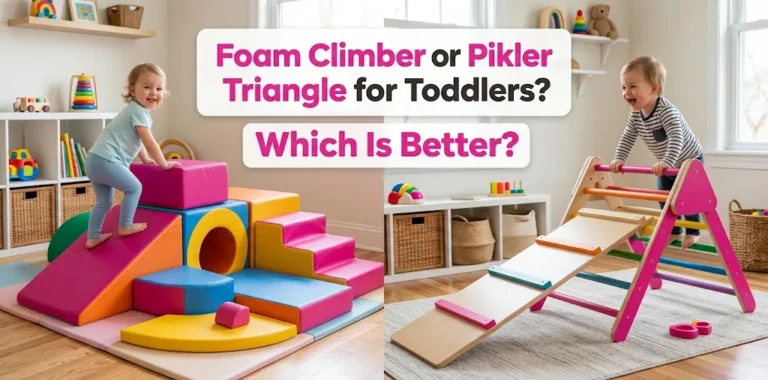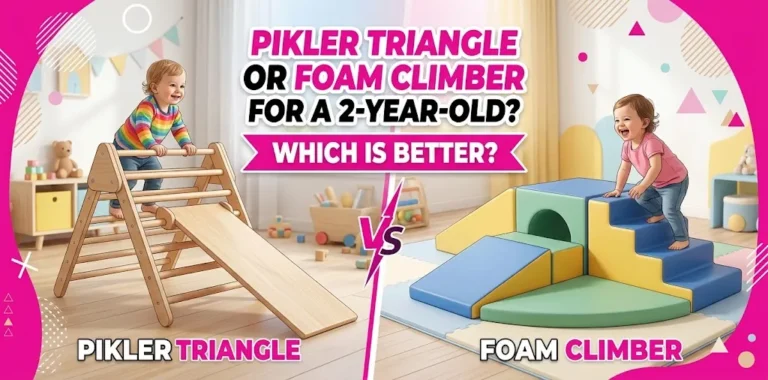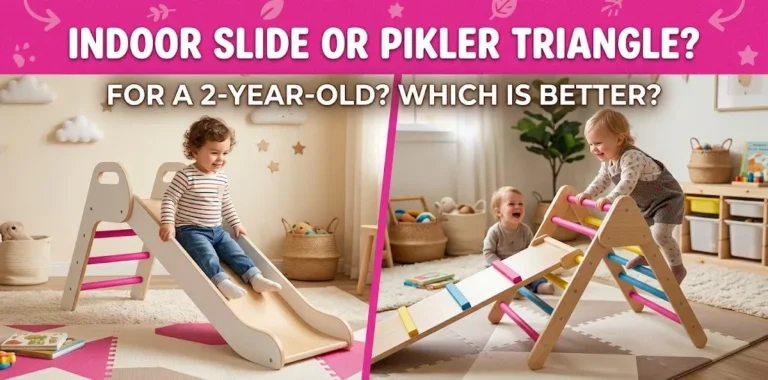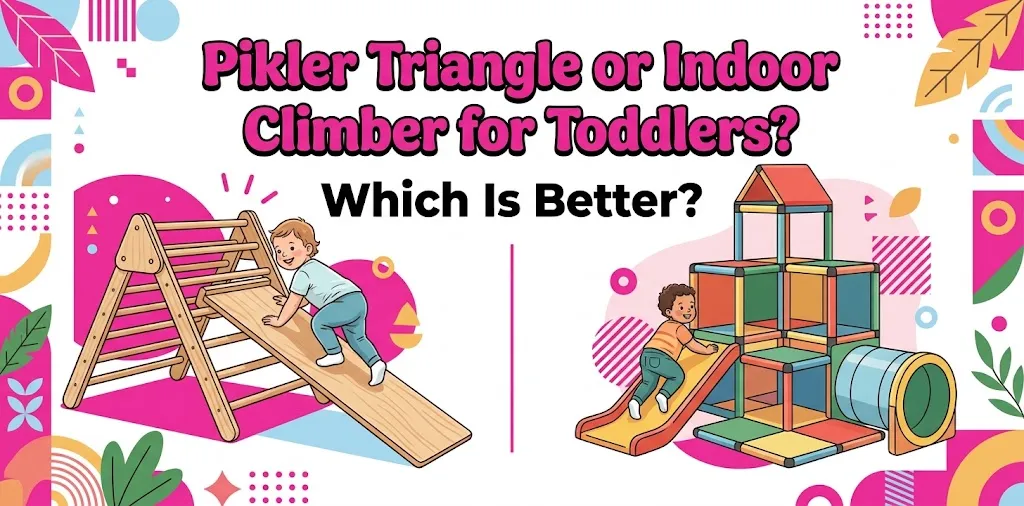
Pikler Triangle or Indoor Climber for Toddlers? Which Is Better?

For most toddlers, a Pikler triangle is the better choice for simple, child-led climbing in a smaller indoor space, while a larger indoor climber is better for families who want more activities, such as climbing, sliding, crawling, and obstacle-course play. The right choice depends mainly on your toddler’s abilities, available space, storage needs, and how much variety you want.
One important point: a Pikler triangle is technically a type of indoor climber. When parents compare the two, they usually mean a traditional wooden Pikler-style triangle versus a larger indoor climbing gym with several play features.
| Feature | Pikler Triangle | Larger Indoor Climber |
|---|---|---|
| Best for | Simple climbing and independent movement | More varied active play |
| Typical design | Triangle with evenly spaced rungs | Multi-part climbing structure |
| Space needed | Usually less | Usually more |
| Storage | Foldable models are common | Often harder to store |
| Play variety | Moderate alone; greater with a ramp | Usually high |
| Setup | Usually simple | May require more assembly |
| Good for small homes | Often | Depends on model |
| Best choice for | Families wanting a focused climbing toy | Families wanting an indoor mini playground |
What Is the Main Difference?
A Pikler triangle has a simple A-frame shape with wooden rungs on both sides. It gives toddlers a predictable structure where they can practice climbing up, moving across the top, and climbing down at their own pace.
Many models can also connect to a ramp or slide, which adds another way to climb and move.
The design is associated with pediatrician Emmi Pikler’s approach to allowing children opportunities for self-directed movement rather than constantly positioning or directing them.
An indoor climber is a much broader category.
It may include:
- Climbing ladders
- Slides
- Rock-wall-style ramps
- Arches
- Platforms
- Tunnels
- Monkey bars on some larger models
- Multiple structures connected together
Some indoor climbing sets even include a Pikler triangle as one part of the system.
So the real decision is usually between a simple climbing structure and a more complex indoor play setup.
When a Pikler Triangle Makes More Sense
A Pikler triangle is especially appealing when you want your toddler to have a dedicated climbing activity without turning an entire room into a play gym.
Its simplicity is one of its biggest advantages.
Instead of pressing buttons or following one specific activity, toddlers decide how they want to use the structure. They may climb only one or two rungs at first. Later, they may climb higher or combine the triangle with a ramp.
That makes it useful for children whose climbing ability is still developing.
A Pikler triangle may be the better choice if:
- Your play area is fairly small.
- You want something that may fold for storage.
- Your toddler mainly wants to climb rather than use several activities.
- You prefer a simple, open-ended toy.
- You plan to add a ramp or other compatible piece later.
- You want to keep the play area visually simple.
Foldability matters more than it may seem. A climber that works well during play but takes over your living room afterward can quickly become inconvenient.
Check the folded dimensions before buying because even a folding triangle can still require a fairly large storage space.
A Small-Space Example
Imagine a family living in a two-bedroom apartment with one corner of the living room available for active play.
A large climbing gym with a slide, arch, and several platforms may technically fit, but it could make the room difficult to use.
A folding Pikler triangle with one reversible ramp would probably make more sense. The child still gets climbing and sliding opportunities, while the parents can reduce the footprint when playtime is over.
When a Larger Indoor Climber Is Better
A larger indoor climber makes more sense when play variety is a bigger priority than compact size.
For an energetic toddler, simply climbing the same triangle may not provide as many ways to play as a multi-piece climbing system.
Depending on the design, a larger climber can let a child climb one side, crawl underneath, cross a bridge, move down a slide, and create simple obstacle courses.
That extra variety can become more useful as a child becomes stronger and more confident.
Consider a larger indoor climber if:
- You have a dedicated playroom or large open area.
- Your toddler frequently seeks active movement.
- More than one type of movement activity matters to you.
- You want something that can become part of obstacle-course play.
- Storage space is not a major concern.
- You have more than one child who may use the equipment, provided the manufacturer allows it.
The trade-off is footprint.
A large climber may need considerably more usable space than its listed dimensions suggest because children also need clear space around it to climb, slide, and get on and off safely.
An Active-Toddler Example
Suppose your toddler already spends much of the day climbing onto couches, crawling over cushions, and looking for new physical challenges.
If you also have a dedicated playroom, a larger indoor climbing system may provide more value than a basic triangle alone. A setup with a climbing section, ramp, and arch gives the child several ways to move without needing you to redesign the activity every few minutes.
Which Is Better for Physical Play?
Both can support active play.
For children ages 3 to 5, the CDC recommends being physically active throughout the day and encourages caregivers to provide opportunities for active play.
Climbing can involve balance, coordination, body awareness, grip, leg strength, and planning how to move from one position to another.
A Pikler triangle provides these experiences through a relatively simple climbing pattern.
A multi-feature indoor climber can add more movement variety because a child may need to crawl, step, climb, slide, and move between differently shaped surfaces.
Neither option automatically provides better development simply because it has more pieces.
The better climber is the one that:
- Matches your child’s current abilities.
- Is appropriate for their age and size according to the manufacturer.
- Fits safely in your home.
- Is used regularly rather than becoming oversized playroom furniture.
Which Is Better for Independent Play?
The Pikler triangle has an advantage here because its purpose is easy for toddlers to understand.
They can approach it, choose how high to climb, and come back down without needing complicated instructions.
A larger climber can also support independent play, but additional features can sometimes create situations that require more supervision or help, especially when a child is learning to move between different sections.
That does not mean a toddler should be left unattended on either structure.
Young children often develop new physical abilities before they understand the risks those abilities create. The American Academy of Pediatrics notes that toddlers can climb and explore but may not recognize danger reliably.
Think of independent play here as child-directed play with an adult supervising, not unsupervised climbing.
Safety Matters More Than the Style of Climber
There is no useful answer to “Which climber is safer?” based only on whether something is called a Pikler triangle or an indoor climber.
Safety depends heavily on the specific product, its construction, how it is assembled, your child’s abilities, and where you put it.
The U.S. Consumer Product Safety Commission warns against placing children’s climbing gyms on hard surfaces such as wood flooring, cement, or asphalt because falls can cause injuries.
The American Academy of Pediatrics also emphasizes that falls are a major concern around climbing equipment and recommends appropriate impact-absorbing surfaces under play equipment.
Before allowing your toddler to climb:
- Follow the manufacturer’s stated age, height, and weight limits.
- Assemble and lock the climber exactly as instructed.
- Make sure folding mechanisms cannot collapse during use.
- Check screws, bolts, hinges, and connecting pieces regularly.
- Keep the structure on a stable surface.
- Use appropriate impact-absorbing flooring or mats as recommended for the equipment.
- Leave space between the climber and walls, windows, stairs, tables, or sharp furniture.
- Remove necklaces, drawstrings, cords, or other items that could catch on the equipment.
- Stay close enough to respond if your toddler gets into trouble.
Also inspect wooden climbers periodically for splinters, cracks, loose rungs, rough edges, or damaged hardware.
A more expensive climber is not automatically safer. Construction quality and correct setup matter more than the number of accessories.
Which One Takes Up Less Space?
A Pikler triangle usually wins for families trying to control the amount of space dedicated to toys.
Many triangles fold relatively flat, although dimensions vary significantly by manufacturer.
A larger climber can become surprisingly demanding because you must account for both the equipment footprint and the surrounding play area.
A slide illustrates the problem well.
A climber might fit against one wall, but once a slide extends outward, you need open space at the bottom for your toddler to land and move away.
Before buying either option, measure:
- The fully opened dimensions
- The play space needed around it
- The height of the structure
- The folded dimensions, if applicable
- Doorways it may need to pass through
- The storage location
Use the fully assembled dimensions, not just the shipping box measurements.
Does a Bigger Indoor Climber Offer Better Long-Term Value?
Sometimes, but not automatically.
A multi-piece indoor climber can provide more possible configurations as your toddler becomes more capable. A ramp that begins as a gentle climbing surface might later become part of an obstacle course.
But larger systems usually require more room and may contain features your child rarely uses.
A Pikler triangle can also have good long-term play value when compatible accessories are available. Adding a reversible ramp, for example, can create climbing, sliding, bridging, and pretend-play possibilities without replacing the original structure.
When comparing value, look beyond the number of pieces.
Ask:
- Can the difficulty change as my child develops?
- Can accessories be added later?
- Will my child realistically use the extra pieces?
- Can I store it easily?
- Is the structure built for repeated use?
- What are the manufacturer’s age and weight limits?
- Will it still fit our home a year from now?
A five-piece system is poor value if three pieces remain stored in a closet.
What Should You Look for Before Buying?
Start with the structure itself rather than labels such as “Montessori,” “developmental,” or “7-in-1.”
Those marketing terms tell you less than the actual design.
Look for a stable base and a structure that does not rock unexpectedly during normal climbing. The rungs and climbing surfaces should feel secure, with smooth edges and no exposed sharp hardware.
For folding models, examine how the locking system works. You do not want a climber that can accidentally fold while a child is using it.
Also check exactly what comes in the box.
“Indoor climber” can describe everything from one small wooden ladder to a large modular play gym. Two products with similar titles may offer very different experiences.
Finally, check the manufacturer’s instructions before assuming a product is appropriate for your toddler. Age and weight recommendations vary widely among climbing products, so a general age recommendation from another parent or website should not override the specifications for the model you buy.
Pikler Triangle vs. Indoor Climber: Which Should You Choose?
Choose a Pikler triangle if your main priorities are climbing, a simpler setup, a smaller footprint, and the possibility of folding or adding a ramp later.
Choose a larger indoor climber if your toddler wants lots of physical variety and you have enough room for climbing, sliding, crawling, and obstacle-style play.
For many families buying their toddler’s first dedicated climbing toy, the Pikler triangle is the more practical starting point. It provides the core climbing experience without requiring a large permanent play area.
For families with an especially active child and a dedicated playroom, a multi-feature indoor climber can offer more ways to move and play.
Neither option needs to be the biggest available model. A well-made climber that fits your child and your room is usually more useful than a complicated system that overwhelms the space.
Frequently Asked Questions
Is a Pikler triangle worth it for a toddler?
It can be worth it if your toddler enjoys climbing and you have a safe place to use it regularly. A foldable model or one that accepts a ramp can be especially practical when you want active indoor play without committing to a large play gym.
What age can a toddler use an indoor climber?
There is no single age that applies to every indoor climber because designs, heights, weight limits, and manufacturer recommendations differ. Follow the age and developmental guidance provided for the specific product rather than assuming all toddler climbers are appropriate at the same age.
Is a Pikler triangle better than a climbing set with a slide?
A Pikler triangle is usually better when you want simplicity and easier storage, while a climbing set with a slide provides more movement variety. If you want both, a triangle that accepts a reversible climbing ramp or slide can offer a useful middle ground.
The Bottom Line
A Pikler triangle is usually the stronger choice for families who want a compact, focused climbing toy that encourages child-directed movement. A larger indoor climber makes more sense when you have extra room and want several types of active play in one setup.
Before choosing, measure the space where the climber will actually be used—not just where it will be stored. Then compare the manufacturer’s age and weight limits, construction, locking system, and required safety area. The climber that fits your toddler and your home is more likely to get regular use.