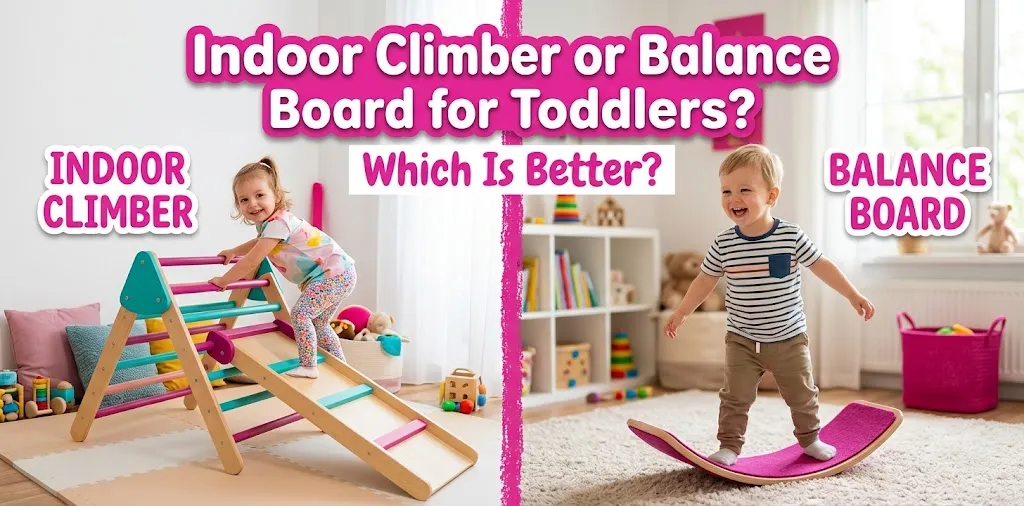
Indoor Climber or Balance Board for Toddlers? Which Is Better?

If your toddler loves climbing, an indoor climber is usually the better choice for active gross-motor play because it gives children opportunities to climb up, down, reach, and coordinate their hands and feet. A balance board is often better for families who want a lower-profile toy focused on rocking, balance, and open-ended floor play. The right choice depends on your child’s interests, age, available space, and supervision.
The two toys can look similar in a playroom, but they create very different play experiences. An indoor climber adds height and climbing routes, while a balance board keeps movement closer to the floor and challenges weight shifting and balance.
Indoor Climber vs. Balance Board at a Glance
| Feature | Indoor Climber | Balance Board |
|---|---|---|
| Main activity | Climbing and whole-body movement | Rocking, balancing, and movement |
| Height | Usually raised | Low to the floor |
| Best for | Toddlers who love to climb | Toddlers who enjoy rocking and balancing |
| Gross-motor challenge | High | Moderate |
| Balance practice | Yes | Strong focus |
| Hand-and-foot coordination | Strong | Moderate |
| Space needed | Usually more | Usually less |
| Fall potential | Higher because of height | Lower, but falls are still possible |
| Open-ended play | Moderate to high | High |
| Easy to store | Depends on design | Usually easier |
| Best for small homes | Sometimes difficult | Often easier |
| Adult supervision | Especially important | Still important |
Neither toy is automatically better for every toddler. The better choice is the one that matches how your child naturally likes to move.
What Is the Difference Between an Indoor Climber and a Balance Board?
An indoor climber is a small play structure designed for children to climb over, under, or across. Common examples include toddler climbing triangles, low climbing arches, and compact indoor climbing structures.
A balance board is a curved or rocker-style board that moves as a child shifts their weight. Depending on the design, children may stand, rock, sit, crawl, or use it as part of imaginative play.
The biggest difference is movement direction. A climber encourages children to move vertically and use their arms and legs together, while a balance board mainly challenges stability and controlled weight shifting.
That difference matters when choosing one for your home.
When an Indoor Climber Is the Better Choice
An indoor climber makes more sense if your toddler is constantly trying to climb the couch, chairs, or other furniture.
Climbing naturally gives children opportunities to practice movements such as:
- Pulling themselves upward
- Stepping onto different surfaces
- Reaching while maintaining balance
- Moving hands and feet together
- Climbing up and finding a way back down
- Adjusting their body position
Indoor climbing can also give an energetic toddler a more appropriate place to move when outdoor play is not practical.
Current safety guidance for indoor climbing emphasizes using age-appropriate equipment, keeping the structure low, choosing a stable setup, and staying close enough to intervene when needed.
Choose a climber if your toddler…
An indoor climber may be the stronger option if your child:
- Climbs furniture whenever possible
- Enjoys playground climbing equipment
- Has lots of physical energy indoors
- Likes crawling, climbing, and reaching
- Enjoys physical challenges
- Has enough floor space for a stable setup
For example, imagine a 2-year-old who spends most of the day trying to climb onto the sofa. A low indoor climber could give that child a designated place for climbing instead of encouraging furniture climbing.
That does not make the climber risk-free. It simply gives the child a play structure designed for that type of movement.
When a Balance Board Is the Better Choice
A balance board may be the better option if you want something smaller, simpler, and more flexible.
Because it stays close to the floor, a balance board can be used for rocking and balance activities without requiring the same type of climbing route as a larger structure. Some children also turn the board into a bridge, tunnel, ramp, seat, or pretend-play prop.
Balance boards are associated with practicing balance, coordination, and body-position awareness, although the exact benefits depend on the child’s age, the board design, and how it is used.
Choose a balance board if your toddler…
A balance board may make more sense if your child:
- Enjoys rocking or swaying
- Likes standing and balancing on objects
- Has limited playroom space
- You want a toy that is easy to move
- Enjoys imaginative play
- Is interested in movement but is not a strong climber yet
For example, a toddler who prefers sitting, rocking, crawling, and experimenting with different positions may get more use from a balance board than from a climbing triangle.
Which Is Better for Gross-Motor Play?
For whole-body climbing and gross-motor movement, an indoor climber has the edge.
A climber asks children to coordinate several movements at once. They may need to grip a rung, lift a foot, shift their weight, reach for the next position, and control their body while moving.
A balance board focuses more directly on stability and weight shifting.
That does not mean a balance board is less useful. It simply provides a different type of physical challenge.
| If your main goal is… | Better fit |
|---|---|
| Climbing practice | Indoor climber |
| Hand-and-foot coordination | Indoor climber |
| Balance practice | Balance board |
| Rocking and weight shifting | Balance board |
| Active climbing play | Indoor climber |
| Low-to-the-floor movement | Balance board |
| Open-ended pretend play | Balance board |
| Playground-style movement indoors | Indoor climber |
Which One Takes Less Space?
A balance board generally has an advantage here.
An indoor climber needs enough clear floor area for the structure itself and enough surrounding space for your toddler to move safely. Depending on its design, it may also need to be folded or moved when adults need the room.
A balance board is usually much easier to slide against a wall or move to another room.
This can be a major consideration in an apartment, small playroom, or living room where the toy cannot stay permanently set up.
However, don’t choose based on the toy’s footprint alone. You also need enough clear space around it for safe movement.
Which One Is Safer for Toddlers?
Neither option should be treated as automatically safe simply because it is marketed for toddlers.
The main difference is that an indoor climber introduces height, while a balance board introduces instability.
A climber can create a larger fall if a child loses balance at the top. A balance board can tip or roll unexpectedly if a child is not ready for its movement.
For either toy:
- Follow the manufacturer’s age and weight guidance.
- Use the equipment on a stable, level surface.
- Keep the surrounding area free of sharp furniture and other hazards.
- Stay close during toddler play, particularly when the toy is new.
- Do not place a balance board on a couch, bed, table, or other elevated surface.
- Check the equipment regularly for loose parts, cracks, damaged surfaces, or worn components.
For products sold as children’s toys in the United States, applicable toys are subject to federal requirements tied to ASTM F963, and children’s products covered by those rules require applicable testing and certification.
A safety label or compliance statement is useful, but it does not replace checking whether the specific product is appropriate for your child and your home.
What Should You Consider Before Buying?
The best choice becomes easier when you look beyond the product name.
Your toddler’s personality
Start with what your child actually enjoys.
A child who spends every playground visit climbing ladders may quickly become bored with a simple balance board. Another toddler may love rocking and imaginative play but show little interest in climbing.
Their existing play habits are often more useful than a generic age recommendation.
Your available space
Measure the area where the toy will actually be used.
For an indoor climber, consider the structure’s footprint plus the clear area around it. For a balance board, consider where the board will rock and where your child might move if they step off unexpectedly.
Your supervision routine
Toddlers still need close supervision during challenging movement activities.
This is particularly important with climbing equipment because children can sometimes climb higher or move faster than they can safely get down. Some safety guidance recommends staying within reach during toddler climbing play rather than relying only on verbal instructions.
How the toy will be stored
A toy that takes two adults to move may not be realistic if you need to clear your living room every evening.
A balance board is often easier to pick up and move. Some indoor climbers fold, while others are designed to stay assembled.
Think about your actual routine, not just how attractive the toy looks in a product photo.
The manufacturer’s instructions
Don’t assume that all toddler climbers or balance boards have the same age range.
One balance board may be designed for children 3 and older, while another product may have a different intended age range. Manufacturer instructions should take priority over general internet advice. Current products vary considerably in shape, movement, size, and safety design.
Indoor Climber or Balance Board for a 1-Year-Old?
For a 1-year-old, the specific product and the child’s walking and movement skills matter more than choosing based on the label alone.
A young toddler who is newly walking may not be ready for a challenging climbing structure or an unstable balance board. A very low, stable product designed specifically for that developmental stage may be more appropriate.
Don’t buy a product intended for an older child simply because it looks small.
At this age, the goal should be simple, controlled movement rather than difficult balancing or climbing challenges.
Indoor Climber or Balance Board for a 2-Year-Old?
At age 2, the choice often comes down to the child’s interests.
If your 2-year-old is a confident climber and constantly seeks physical challenges, an appropriately sized indoor climber may provide more engaging play.
If your toddler prefers rocking, standing, crawling, and imaginative activities, a balance board may provide more variety in a smaller package.
A 2-year-old does not necessarily need the more complicated toy. The better toy is the one they can use appropriately and safely.
What About a Toddler Who Wants Both?
If you have enough space and your budget allows it, the two toys can complement each other.
The climber provides a more vertical challenge, while the board provides a low-to-the-floor movement option. Some balance boards are also designed for imaginative play or can be incorporated into climbing setups, but they should only be combined in ways approved by the manufacturer.
You do not need both to give a toddler plenty of active play. Outdoor playgrounds, walking, dancing, crawling games, and ordinary household movement can also provide opportunities for physical activity.
One well-used toy is often more useful than two toys that spend most of their time stored away.
Common Mistakes to Avoid
One of the biggest mistakes is buying based only on age.
Age ranges are helpful, but toddlers develop movement skills at different rates. A child may be old enough according to a package but still lack the coordination needed for a particular product.
Another mistake is using the equipment in an unsafe location.
For example, a balance board should not be placed on a table or bed to create a “bigger challenge.” That changes a low-level movement activity into a fall hazard. Likewise, an indoor climber should not be positioned close to windows, sharp furniture, or other dangerous surfaces.
It’s also easy to underestimate how quickly toddlers change. A child who uses a toy appropriately today may discover a new way to climb on it tomorrow.
Regularly watch how your toddler actually uses the equipment and adjust the setup when their behavior changes.
The Better Choice for Different Families
| Family situation | Better choice |
|---|---|
| Toddler constantly climbs furniture | Indoor climber |
| Small apartment or limited floor space | Balance board |
| Child loves playground climbing | Indoor climber |
| Child enjoys rocking and balancing | Balance board |
| Parent wants a simple, portable toy | Balance board |
| Family wants more vertical movement | Indoor climber |
| Toddler enjoys imaginative movement play | Balance board |
| Child needs a bigger physical challenge | Indoor climber, if age-appropriate |
| Family wants both types of movement | Consider both if space allows |
The decision does not have to be based on which product has more “benefits.” It should be based on which type of movement your toddler is most likely to use safely and repeatedly.
Which Should You Buy?
For most families, choose an indoor climber if climbing is your toddler’s main interest and you have enough space for a stable setup. It provides a broader climbing challenge and more opportunities for hand-and-foot coordination.
Choose a balance board if space, portability, balance practice, or open-ended play matters more. It is particularly appealing when you want a simpler piece of active-play equipment that can be used in several ways.
Before buying either one, check the manufacturer’s age and weight limits, inspect the construction, and plan where your child will use it. The right toy is not simply the one with the most features; it is the one that fits your child’s abilities and your home.
Frequently Asked Questions
Is an indoor climber or balance board better for a 2-year-old?
An indoor climber is usually better for a 2-year-old who loves climbing and needs a place to practice whole-body movement. A balance board may be better for a child who enjoys rocking, balancing, and imaginative floor play.
Are balance boards safe for toddlers?
Balance boards can be appropriate for toddlers when the specific product is designed for their age and used according to the manufacturer’s instructions. Because the board can move underneath a child, use it on a stable surface and supervise young children closely.
Does a toddler need both an indoor climber and a balance board?
No. One well-chosen toy can provide plenty of active play. If your child enjoys both climbing and balance activities and you have enough space, having both can add variety, but it is not necessary for healthy movement development.
The Bottom Line
An indoor climber is the better pick for climbing-focused toddlers, while a balance board is the better fit for balance, rocking, compact storage, and open-ended play.
If you’re unsure, watch what your toddler already does during free play. If they are always climbing, start with a climber. If they are more interested in rocking, balancing, and experimenting with movement close to the floor, a balance board may get more use.