Peg Puzzle or Shape Sorter for a 2-Year-Old? Which Is Better?

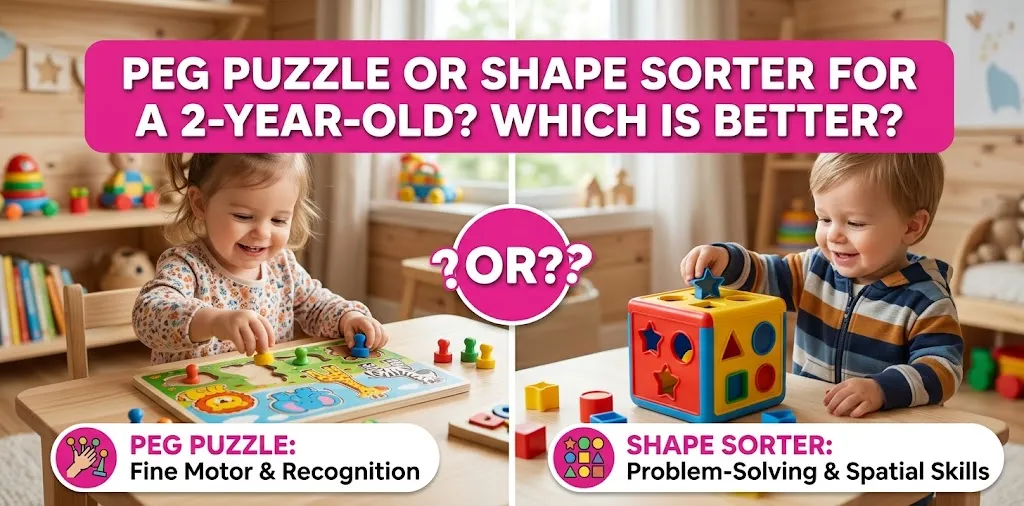
If you are choosing between a peg puzzle and a shape sorter for a 2-year-old, a peg puzzle is usually the better choice for building early matching, fine-motor, and visual skills, while a shape sorter offers more practice with spatial reasoning, rotation, and problem-solving. For a child who is new to these toys, a simple peg puzzle is often easier to start with; for a child who already enjoys matching, a shape sorter can provide a bigger challenge.
How Peg Puzzles and Shape Sorters Are Different
The two toys can look similar, but they ask a toddler to solve different kinds of problems.
A peg puzzle typically has wooden pieces with knobs or pegs that fit into matching spaces on a board. The child identifies the correct picture or shape and places the piece into its matching spot.
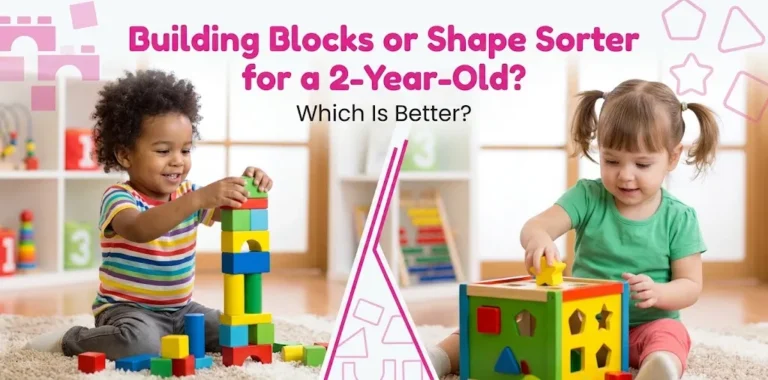
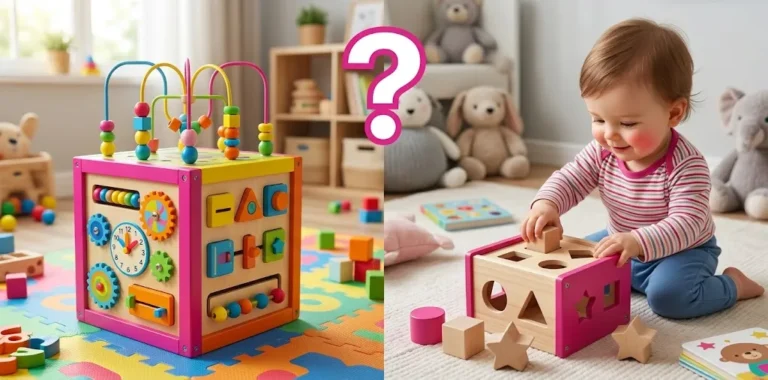
A shape sorter usually has several geometric pieces and matching openings. The child may need to identify the correct shape and then rotate or position it correctly before it will fit.
The difference becomes clearer when you watch how a child solves each toy:
| Feature | Peg Puzzle | Shape Sorter |
|---|---|---|
| Main challenge | Matching a piece to a picture or outline | Matching and fitting shapes into openings |
| Fine-motor practice | Excellent | Excellent |
| Hand-eye coordination | Excellent | Excellent |
| Shape recognition | Good | Excellent |
| Spatial reasoning | Good | Stronger |
| Rotation skills | Usually limited | Often important |
| Visual matching | Strong | Strong |
| Difficulty for beginners | Usually easier | Can be more challenging |
| Open-ended play | Limited to puzzle pieces | Often allows sorting by shape or color |
| Best for | Matching and early puzzle practice | Shape, spatial, and sorting practice |
Both can be appropriate for a 2-year-old. The better choice depends on what your child is ready to do and what kind of challenge keeps them interested.
Why a Peg Puzzle May Be Better for a 2-Year-Old
A peg puzzle gives a toddler a clear visual target: find the piece that belongs in this spot.
That simple goal can make the toy easier to understand than a shape sorter with openings that require more trial and error.
It supports matching skills
A child may look at a picture of a dog on the board, find the matching dog piece, and place it over the outline. With repeated play, the child practices noticing similarities in shape, color, and image.
Peg puzzles can also introduce simple categories. You might say, “Where does the cat go?” or “Can you find the circle?”
It gives children an easy-to-understand challenge
For a toddler who becomes frustrated when a toy is too difficult, a peg puzzle can be a gentler starting point.
The large knob or peg also gives the child something obvious to grasp and move. The U.S. Consumer Product Safety Commission’s toy age-determination research notes that children around 19–35 months develop the fine-motor and visual discrimination abilities needed for inset puzzles.
It works well for picture-based learning
An animal, vehicle, or familiar-object peg puzzle can combine physical play with language.
For example, while a child places a cow piece into the board, a parent can say “cow,” “moo,” or “Where is the cow?” The puzzle itself does not teach language automatically, but the interaction creates an easy opportunity for talking.
When a Shape Sorter Is the Better Choice
A shape sorter may be the better pick if your 2-year-old already handles simple puzzles comfortably and wants something that requires more experimentation.
It adds spatial problem-solving
With a shape sorter, knowing that a piece is a triangle is only part of the task. The child may also need to figure out which opening accepts the triangle and how to position it.
That extra step makes shape sorters useful for practicing spatial relationships.
It encourages sorting
Many shape sorters allow children to group pieces by shape or color before fitting them into the toy.
For example, you could place the red pieces together and the blue pieces together, then ask the child to find all the circles. Peg activities and sorting games can support color recognition, counting, and fine-motor practice in this age range.
It can grow with the child’s ability
A simple shape sorter can start with basic matching. Later, you can make the activity more challenging by asking your child to:
- Find all the circles.
- Match pieces by color.
- Name a shape.
- Count the pieces.
- Try fitting a piece without immediately showing where it goes.
This gives one toy several levels of play without requiring a different activity every time.
Which One Is Easier for a 2-Year-Old?
For most beginners, a simple peg puzzle is easier to understand.
The child can see the outline or picture and use the large knob to pick up and replace the piece. A shape sorter may require more visual discrimination and spatial adjustment because the child has to work out how the piece relates to the opening.
However, “easier” is not always “better.” If your child quickly completes simple peg puzzles, a shape sorter may provide a more interesting challenge.
The CPSC’s research specifically identifies peg-style shape sorters and inset shape puzzles as activities that become suitable around the 19–35-month period, while noting that children’s abilities develop at different rates.
Which One Builds Better Fine-Motor Skills?
Both are good choices, but they practice those skills in slightly different ways.
With a peg puzzle, the child grasps a piece, moves it toward the board, lines it up, and places it down. That requires controlled hand movements and visual guidance.
With a shape sorter, the child may need to grasp, position, rotate, and push a piece through an opening. That can add another layer of hand-eye coordination and spatial control.
So if fine-motor development is your main reason for buying the toy, you do not necessarily need to choose one based on that factor alone. The design and size of the pieces matter more than the label “peg puzzle” or “shape sorter.”
Which One Is Better for Problem-Solving?
If the two toys are similarly well designed, a shape sorter usually creates the harder problem-solving task.
A peg puzzle often gives the child strong visual clues. The picture or outline tells them where a piece belongs.
A shape sorter may require the child to test an idea:
“This piece looks like it might fit here. Do I need to turn it?”
That trial-and-error process can make the toy more challenging.
Still, a peg puzzle should not be dismissed as “too easy.” For a child who is just beginning to understand matching, finding the correct piece and aligning it with the board is already a meaningful problem to solve.
What If Your 2-Year-Old Gets Frustrated?
The best developmental toy is one your child can attempt without becoming overwhelmed.
If your toddler repeatedly throws the shape sorter pieces because they cannot figure out the openings, start with a simpler puzzle. You can also reduce the number of pieces available at one time.
For example, instead of giving six or eight pieces, give your child two or three and say, “Let’s find where these go.”
If your child already completes a basic peg puzzle without much effort, introduce a shape sorter or a more challenging puzzle rather than repeatedly offering the same easy task.
The goal is not to make the activity difficult. It is to give the child just enough challenge to encourage another attempt.
Two Simple Ways to Use These Toys
You do not have to sit down and turn every toy session into a lesson.
With a peg puzzle
Suppose your child has an animal peg puzzle. Start by letting them explore it independently.
Then you can ask:
- “Where is the dog?”
- “Can you find the elephant?”
- “What sound does the cow make?”
If the child struggles, point toward the correct area rather than immediately doing it for them.
With a shape sorter
Suppose your child has a sorter containing circles, squares, and triangles.
Start by letting the child try freely. Then give a small hint:
“Can you find the round one?”
Once the child finds the circle, let them work out where it belongs. If they try the wrong opening, allow them to test it rather than correcting them immediately.
This turns the toy into a small problem-solving activity instead of simply a matching exercise.
What Should You Look for When Buying One?
For a 2-year-old, the exact toy design matters more than whether the package says “peg puzzle” or “shape sorter.”
Look for:
- Age-appropriate design: Follow the manufacturer’s recommended age range.
- Large, easy-to-grip pieces: They should be comfortable for small hands.
- Sturdy construction: Wooden or thick plastic pieces can handle repeated use.
- Clear matching cues: Simple pictures and shapes are easier for beginners.
- No unnecessary complexity: A toy with too many pieces can make early play frustrating.
- Secure construction: Avoid loose parts that can break off during normal play.
- Safe piece size: Avoid toys containing pieces that could create a choking hazard.
Always inspect toys periodically for broken pieces, loose components, cracks, or damaged surfaces. The CPSC’s age guidance is useful when considering whether a particular puzzle or sorter matches the developmental abilities expected for the intended age, but parents should also follow the specific product’s safety and age instructions.
So, Which Should You Buy?
If you are buying just one toy for a 2-year-old who is new to puzzles, I would lean toward a simple peg puzzle.
It offers an approachable introduction to matching, grasping, visual discrimination, and placing pieces. Once your child becomes comfortable with that type of activity, a shape sorter can add more spatial challenge.
If your child already enjoys puzzles, matching games, and sorting, choose the shape sorter. It can provide more opportunities to experiment with shapes, orientation, and spatial relationships.
The best choice can also be different for two children of exactly the same age. A 24-month-old who loves matching pictures may enjoy a peg puzzle more, while another child may prefer the trial-and-error challenge of a shape sorter.
FAQ
Is a peg puzzle good for a 2-year-old?
Yes. A simple, age-appropriate peg puzzle can give a 2-year-old practice with grasping, matching, hand-eye coordination, and visual discrimination. Choose one with pieces that are easy to handle and follow the manufacturer’s age recommendation.
Are shape sorters too hard for 2-year-olds?
Not necessarily. Many shape sorters are specifically designed for toddlers, and shape-sorting abilities develop during this age range. If a particular sorter is frustrating, start with fewer shapes or a simpler design rather than assuming your child is too young.
Should I buy a peg puzzle and a shape sorter?
If your budget allows, having both can be useful because they offer somewhat different challenges. A peg puzzle can provide an easier matching activity, while a shape sorter can give a 2-year-old more practice with sorting and spatial problem-solving.
The Bottom Line
For a 2-year-old who is just starting with puzzles, a peg puzzle is usually the better first choice because its visual matching task is simple and easy to understand. A shape sorter becomes especially appealing when the child is ready for more trial-and-error and spatial challenges.
One practical tip: choose based on your child’s current ability, not just their age. A toy that is slightly challenging but still manageable will usually offer more useful play than one that is either frustratingly difficult or instantly boring.