Activity Cube or Shape Sorter for a 1-Year-Old? Which Is Better?

For most 1-year-olds, an activity cube is the better choice if you want one toy that offers several ways to play, while a shape sorter is better if your main goal is matching, hand-eye coordination, and early problem-solving. The right choice depends less on which toy is “more educational” and more on your child’s current interests, skills, and ability to use the toy safely.
Activity Cube vs. Shape Sorter at a Glance
| Feature | Activity Cube | Shape Sorter |
|---|---|---|
| Best for | Variety and exploration | Matching and simple problem-solving |
| Typical play | Beads, gears, sliders, spinners, doors, sorting | Putting shapes into matching openings |
| Fine motor practice | High | High |
| Hand-eye coordination | High | High |
| Shape recognition | Depends on the model | Strong focus |
| Cause-and-effect play | Often strong | Moderate |
| Variety | High | Lower |
| Easier to understand | Usually | Usually |
| Best for a child who gets bored quickly | Yes | Not always |
| Best for focused matching practice | Good | Yes |
| Can grow with the child | Often | Sometimes |
The biggest difference is variety versus focus. An activity cube may combine several activities on different sides, while a traditional shape sorter gives a child one main challenge: matching a piece to the correct opening.
When an Activity Cube Is Better for a 1-Year-Old
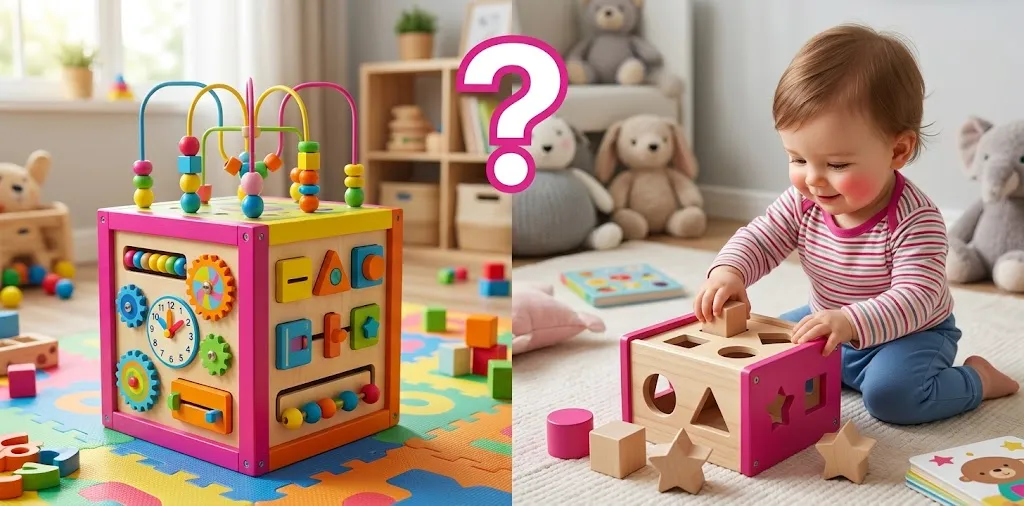
An activity cube can be a strong choice for a 1-year-old who likes touching, moving, opening, spinning, and experimenting with different objects.
Many activity cubes include features such as:
- Bead mazes
- Spinning gears
- Sliding pieces
- Doors or flaps
- Knobs
- Tracks
- Shape-sorting sections
- Simple cause-and-effect activities
That variety can make the toy more interesting because your child does not have to play the same way every time. Current activity-cube products commonly combine several interactive functions into one toy, sometimes including a shape sorter itself.
Choose an activity cube if your child likes to explore
Suppose your 1-year-old keeps moving from one toy to another after a few minutes. A multi-activity cube may make more sense because there are several things to investigate.
For example, your child might spend a few minutes moving beads, then spin a gear, then try a shape piece, and later return to the bead maze.
You are not buying several separate toys, but you are giving the child several different play options.
The downside of an activity cube
More activities do not automatically make a toy better.
A cube with too many complicated features can be distracting for a young toddler. Some children may also use only one side of the cube and ignore everything else.
That is not necessarily a problem. If your child enjoys one activity, let them explore it rather than trying to make them use every part of the toy.
When a Shape Sorter Is Better
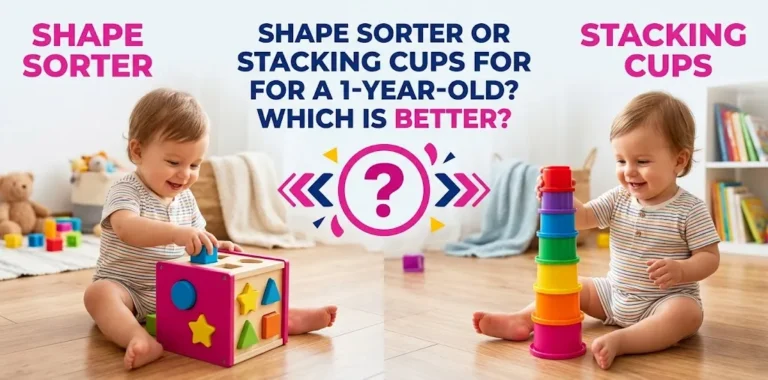
A shape sorter is a better choice when you want a simpler toy with a clear challenge.
The basic activity is easy to understand:
Pick up a shape → find the matching opening → try to fit it through.
A child may not successfully match every shape at first. That is normal. The important part is the process of looking, trying, turning the piece, and learning from what happens.
Shape-sorter products commonly focus on shape and color recognition, fine motor practice, hand-eye coordination, and simple problem-solving.
Choose a shape sorter if your child likes putting things in and taking them out
Some 1-year-olds naturally enjoy containers, blocks, cups, and objects that can be placed inside something.
For that type of child, a shape sorter can provide a simple activity that they can repeat many times.
You can also make the activity more interactive by saying things such as:
“Where does the circle go?”
or
“Try turning the triangle.”
The goal is not to test the child. It is to give them a chance to experiment.
Which Toy Is More Educational?
Neither toy is automatically more educational.
They simply encourage different types of play.
An activity cube provides more variety, while a shape sorter provides more focused practice.
For a 1-year-old, both can support hands-on exploration and fine motor practice. The better toy is the one that matches what the child is ready to do and actually wants to play with.
It is also worth remembering that a toy does not need to teach letters, numbers, or advanced concepts to be useful. Simple actions such as grasping, turning, pushing, pulling, and fitting objects together are meaningful forms of play at this age.
Activity Cube vs. Shape Sorter for Different Types of 1-Year-Olds
| If your child… | Better choice |
|---|---|
| Gets bored with one activity quickly | Activity cube |
| Loves putting objects into containers | Shape sorter |
| Enjoys spinning and moving parts | Activity cube |
| Is beginning to recognize basic shapes | Shape sorter |
| Likes exploring everything they can touch | Activity cube |
| Prefers simple, repeatable activities | Shape sorter |
| Is already interested in puzzles and matching | Shape sorter |
| Needs more variety from one toy | Activity cube |
| Enjoys cause-and-effect activities | Activity cube |
These are not strict developmental rules. A child can enjoy either toy at 12 months, 15 months, or later depending on their individual interests and abilities.
What Should You Look for in an Activity Cube?
For a 1-year-old, avoid choosing a cube simply because it has the highest number of activities.
Look for features that are easy for small hands to use.
A good activity cube should have:
- Smooth, well-finished surfaces
- Sturdy construction
- Parts that do not easily detach
- Age guidance that matches your child
- Simple activities that do not require advanced skills
- Large enough components for the intended age
- No obvious sharp edges or damaged pieces
Some activity cubes include beads, strings, or other movable components, so inspect the individual design rather than assuming every cube is appropriate for every 1-year-old.
The U.S. Consumer Product Safety Commission recommends following the age guidance and safety information on toy packaging and keeping small parts away from children younger than 3.
What Should You Look for in a Shape Sorter?
For a first shape sorter, simplicity can be an advantage.
Look for:
- Large, easy-to-grip pieces
- Clearly different shapes
- Smooth edges
- Sturdy construction
- Pieces that are appropriate for the stated age
- Openings that are easy enough for a beginner to experiment with
- A design that does not have loose or detachable small components
You do not need a shape sorter with dozens of pieces. A young toddler may get more value from a simple design that lets them repeatedly practice the same basic action.
Safety Matters More Than the Toy Type
For a 1-year-old, safety should come before the number of activities or the material used.
The CPSC states that products intended for children under 3 can present a choking hazard when they contain small parts, and its toy-safety guidance recommends keeping small parts and small toys away from children under 3.
Before giving a new toy to a 1-year-old:
- Check the manufacturer’s age recommendation.
- Inspect the toy for loose or broken pieces.
- Make sure movable parts are securely attached.
- Check wooden toys for cracks, splinters, or damaged finishes.
- Keep any unsuitable small pieces away from younger siblings.
- Supervise play when the toy contains components your child may try to mouth.
Do not assume that a toy labeled “Montessori,” “educational,” or “sensory” is automatically appropriate for every young child. The actual design and age recommendation matter more.
Which One Should You Buy First?
If you are buying only one toy, an activity cube is usually the more flexible option for a 1-year-old because it can offer several types of play in one product.
However, I would choose a shape sorter instead if your child already enjoys putting objects into holes, matching pieces, or solving simple “where does this go?” challenges.
A simple way to decide is:
Choose an activity cube for variety. Choose a shape sorter for focused matching and problem-solving.
If your budget allows both, they do not need to compete with each other. A child can use the activity cube for open-ended exploration and the shape sorter for more focused matching practice.
Two Simple Ways to Use These Toys
With an activity cube
Instead of showing your child every feature at once, let them explore one side first.
For example, if they discover the bead maze, let them move the beads around. Later, you can point out another feature without taking over the play.
This keeps the activity child-led while giving them opportunities to discover how different parts work.
With a shape sorter
Start with only a few pieces if the full set seems overwhelming.
Hand your child one shape and let them try. If they struggle, you can rotate the piece slowly or point toward the matching opening rather than immediately doing it for them.
The goal is to encourage experimentation, not to see how quickly they can finish the sorter.
Activity Cube or Shape Sorter: The Final Choice
For a 1-year-old who enjoys variety and exploring different moving parts, I would lean toward an activity cube.
For a 1-year-old who enjoys matching, putting things in containers, and repeating the same challenge, I would choose a shape sorter.
Neither toy needs to be treated as a formal learning tool. At this age, the most useful toy is often the one that gives the child a safe, manageable challenge and makes them want to keep exploring.
If you are unsure, start with the toy that matches your child’s current play style rather than choosing based only on the number of activities listed on the box.
Frequently Asked Questions
Is an activity cube good for a 1-year-old?
Yes, an activity cube can be a good choice for a 1-year-old when its design and age recommendation are appropriate. The multiple activities can give a young toddler different ways to practice grasping, pushing, pulling, turning, and exploring.
Is a shape sorter too difficult for a 1-year-old?
Not necessarily. A 1-year-old may be able to explore a shape sorter even if they cannot correctly match every piece yet. Early attempts, including turning and trying different openings, are part of learning how the toy works.
Should I buy an activity cube or shape sorter first?
Choose an activity cube if you want more variety from one toy, and choose a shape sorter if you want a simpler matching activity. If your child already shows interest in putting objects into openings or matching pieces, the shape sorter may be the better first choice.
conclusion
For most 1-year-olds, the better choice depends on how they like to play. Choose an activity cube if your child enjoys variety, moving parts, and exploring different activities. Choose a shape sorter if they enjoy matching, putting objects into openings, and practicing simple problem-solving.
If you are buying just one, start with the toy that matches your child’s current interests. The best choice is not the toy with the most features—it is the one your child can safely explore and enjoys using again and again.