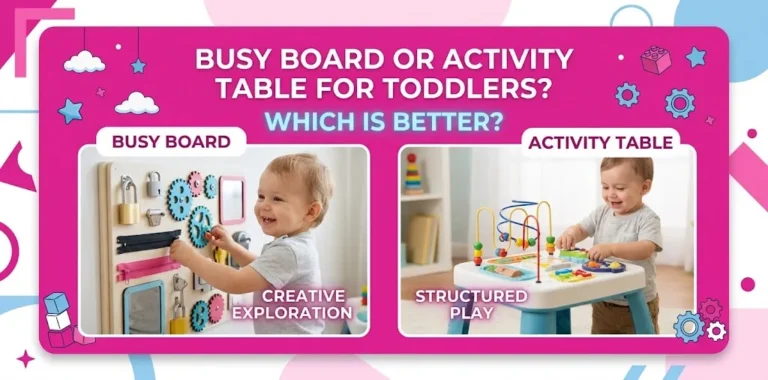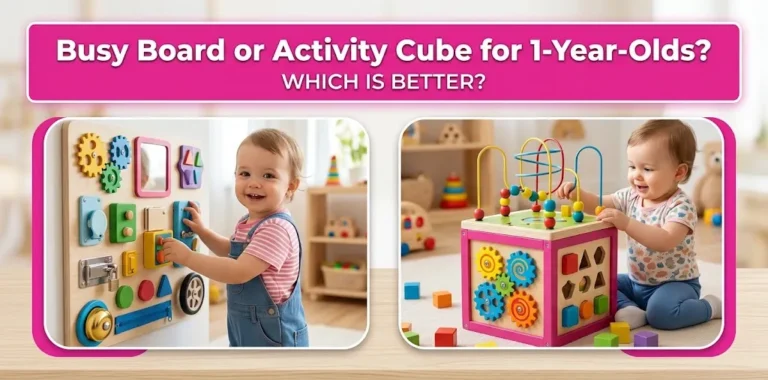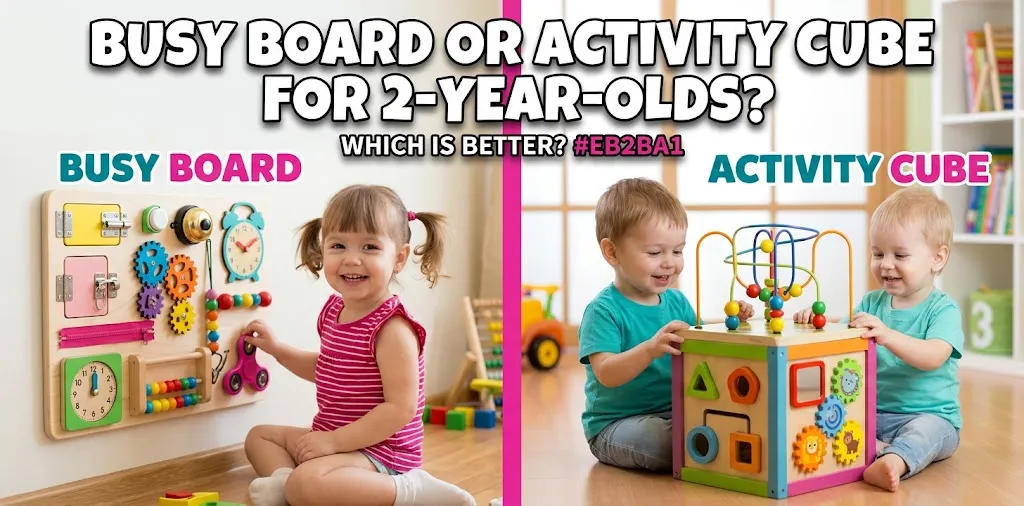
Busy Board or Activity Cube for 2-Year-Olds? Which Is Better?

For most 2-year-olds, an activity cube is better for active home play, while a busy board is better for focused, hands-on activities and portability. At this age, both can offer useful fine-motor practice, but the better choice depends on your child’s interests, available space, and where you plan to use the toy.
Busy Board vs. Activity Cube: At a Glance
| Feature | Busy Board | Activity Cube |
|---|---|---|
| Best use | Focused hands-on play | Varied home play |
| Typical design | Flat panel | Multiple sides |
| Fine-motor activities | Excellent | Excellent |
| Movement around the toy | Limited | More movement |
| Portability | Usually better | Usually worse |
| Space needed | Less | More |
| Variety | Depends on board | Usually several sides |
| Best setting | Home or travel | Playroom or living room |
| Good for 2-year-olds | Yes, with age-appropriate features | Yes, with age-appropriate features |
The important difference is not simply the number of activities. It is how your 2-year-old interacts with the toy.
When a Busy Board Is Better for a 2-Year-Old
A busy board is a flat toy with hands-on features such as zippers, buckles, switches, sliders, latches, wheels, or other simple mechanisms.
At age 2, children can often handle more challenging actions than younger toddlers. A well-designed board can give them opportunities to practice several movements repeatedly.
A busy board may be the better choice if your child:
- Enjoys opening and closing things
- Likes buttons, switches, and sliders
- Enjoys repeating the same action
- Likes figuring out how simple mechanisms work
- Has limited play space
- Needs a toy that is easier to move
- Travels frequently with the family
One advantage is that the child can focus on one activity at a time. That can make a busy board feel less overwhelming than a toy covered with many different features.
A current comparison of toddler activity toys also notes that busy boards tend to work well when parents want a compact toy for travel, restaurants, waiting rooms, or other small spaces.
What makes a busy board good for age 2?
Look for activities that are challenging but still possible for a 2-year-old to operate independently.
Useful features can include:
- Large zippers
- Simple buckles
- Easy latches
- Large switches
- Spinners
- Sliders
- Turning wheels
- Simple matching activities
- Large, securely attached knobs
A board does not need dozens of activities. Too many features can make the surface crowded and harder for a young child to use.
When an Activity Cube Is Better
An activity cube places different activities on several sides of a three-dimensional toy. A child can move around it and discover something different on each surface.
For a 2-year-old who likes to explore, this can be more engaging than a flat board.
An activity cube may be the better choice if:
- The toy will stay mostly at home
- You have enough floor space
- Your child likes moving around while playing
- You want several activities in one toy
- Your toddler enjoys exploring different sides
- You want a more substantial playroom toy
Some activity cubes combine bead tracks, spinners, shape activities, gears, doors, sliders, or other hands-on features. This gives a child more variety without requiring several separate toys.
The trade-off is size. An activity cube is generally less convenient to carry to a restaurant, airplane, or waiting room than a compact busy board.
Which Is Better for Fine-Motor Skills?
Both can be good choices. The difference is in the type of hand movements they encourage.
A busy board often focuses heavily on actions such as:
- Pulling
- Turning
- Sliding
- Zipping
- Fastening
- Pressing
- Opening and closing
An activity cube can include these actions while also encouraging the child to reach across, move around, and explore different surfaces.
So, if your main goal is focused manipulation, a busy board has an advantage. If you want variety combined with movement around the toy, an activity cube may be the better fit.
The American Academy of Pediatrics recommends choosing toys that match a child’s developmental abilities and interests rather than assuming one particular toy is necessary for development.
Which One Is Better for Independent Play?
A busy board can be excellent for independent exploration because the activities are usually straightforward and repeatable.
For example, a 2-year-old might spend several minutes repeatedly opening a latch, closing it, and trying again. There does not have to be a specific end point.
An activity cube can also support independent play, especially when the child enjoys moving from one side to another. However, the larger number of activities may sometimes make the play experience more scattered.
Neither toy guarantees long periods of independent play. Toddlers have short and changing attention spans, and it is normal for them to move between toys.
Which Is Better for Travel?
Busy board wins.
A compact busy board is generally easier to place in a diaper bag, backpack, or carry-on. It can be useful during:
- Road trips
- Flights
- Restaurant visits
- Waiting rooms
- Hotel stays
- Visits with relatives
- Other situations where floor space is limited
An activity cube is much better suited to a permanent play area.
If your main reason for buying the toy is to make travel easier, there is little reason to choose a bulky cube simply because it has more activities.
Which Is Better for a Small Home?
A busy board usually makes more sense when space is limited.
You can store it on a shelf or in a closet when it is not being used. Some designs are also easy to carry between rooms.
An activity cube has a larger footprint, although it can still be a practical choice if you have a dedicated play area.
For an apartment, smaller playroom, or shared living space, the compact design of a busy board can be a real advantage.
Safety Matters More Than the Number of Activities
Because a 2-year-old is still in the age range where choking hazards are a major concern, parents should check the toy carefully rather than judging it only by appearance or the word “Montessori.”
The U.S. Consumer Product Safety Commission says toys should be selected according to a child’s age, interests, and abilities. Products intended for children under 3 also have specific requirements concerning small parts because of choking risks.
Before giving a busy board or activity cube to a 2-year-old, check:
- The manufacturer’s age recommendation
- Whether any parts can come loose
- Screws, bolts, beads, and other attached components
- Sharp or rough edges
- Hinges and moving parts
- Battery compartments, if applicable
- Magnets, especially high-powered magnets
- Strings or cords
- The overall stability of the toy
The AAP also advises parents to avoid toys with small or detachable parts and to pay particular attention to button and lithium coin batteries.
A toy should also be inspected regularly. A component that was secure when new can become loose after repeated pulling, twisting, or dropping.
Two Real-Life Examples
Example 1: A toddler who loves household mechanisms
Suppose your 2-year-old constantly wants to open cabinet doors, zip bags, turn knobs, and play with buckles. A busy board may be the better match because it gives those interests a dedicated, controlled place for hands-on exploration.
Example 2: A toddler who is always moving
Suppose your child quickly loses interest in flat toys and likes walking around furniture, touching different objects, and switching between activities. An activity cube may be more engaging because each side offers something different and the child can move around it.
These examples are hypothetical, but they show why the child’s play style matters as much as age.
The Better Choice Depends on Your Main Need
| If your priority is… | Better choice |
|---|---|
| Travel | Busy board |
| Small living space | Busy board |
| Focused hand activities | Busy board |
| Restaurant or waiting-room use | Busy board |
| Playroom use | Activity cube |
| More variety in one toy | Activity cube |
| Moving around while playing | Activity cube |
| A larger home activity toy | Activity cube |
| One toy for home and occasional travel | Busy board |
If you’re buying only one, start with where the toy will actually be used. That usually makes the decision much easier.
What Should You Look for in a 2-Year-Old’s Toy?
Don’t choose based only on the number of activities.
A better checklist is:
- Age fit: Make sure the manufacturer’s age guidance includes your child.
- Appropriate challenge: The activities should be interesting without being impossibly difficult.
- Secure construction: Parts should remain firmly attached during normal play.
- Simple layout: A crowded toy is not automatically a better toy.
- Durability: Look for materials and hardware that can handle repeated use.
- Easy cleaning: This matters especially if the toy will travel.
- Your child’s interests: Choose activities your toddler actually enjoys.
- Your available space: Consider where the toy will be stored and used.
The AAP notes that age recommendations help parents judge both safety and whether a toy is appropriate for a child’s abilities and interests.
So, Is a Busy Board or Activity Cube Better for 2-Year-Olds?
For a 2-year-old who needs a compact, focused, hands-on toy, choose a busy board.
For a 2-year-old who mainly plays at home and enjoys exploring several activities, choose an activity cube.
There is no universal winner. A busy board is usually the more practical choice for portability and focused fine-motor activities, while an activity cube offers more three-dimensional exploration and works especially well as a home playroom toy.
Frequently Asked Questions
Here are answers to the most common questions parents ask when choosing between a busy board and an activity cube for a 2-year-old.
Is a busy board good for a 2-year-old?
Yes, provided the board is designed for the child’s age and has securely attached, appropriately sized components. At age 2, many children can enjoy simple zippers, buckles, switches, sliders, and other hands-on mechanisms.
Is an activity cube better than a busy board for toddlers?
Not necessarily. An activity cube is often better for home play and children who enjoy moving between different sides, while a busy board is usually better for focused activities, smaller spaces, and travel.
What should I avoid when buying a busy board for a 2-year-old?
Avoid products with loose or detachable small parts, accessible button batteries, high-powered magnets, sharp edges, or features that are clearly intended for older children. Always follow the manufacturer’s age guidance and inspect the toy regularly for worn or loose components.
Final Takeaway
For most families, the decision comes down to home play versus portability. Choose an activity cube if your 2-year-old needs a larger, multi-sided toy for the playroom; choose a busy board if you want focused hands-on play in a compact format.
One practical tip: watch what your child naturally reaches for during everyday play. If they love zippers, switches, and latches, a busy board is likely the better match. If they prefer moving around and exploring different activities, an activity cube may get more use.