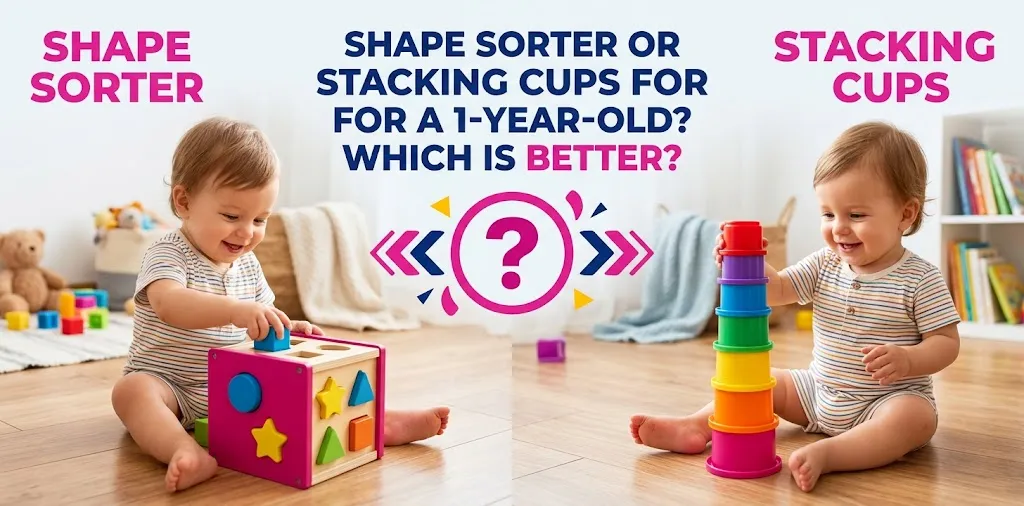
Shape Sorter or Stacking Cups for a 1-Year-Old? Which Is Better?

If you are choosing between a shape sorter and stacking cups for a 1-year-old, stacking cups are usually the better first choice. They are simple to grasp, stack, nest, fill, empty, and knock down, which fits the kinds of hands-on exploration common around 12 months. A shape sorter can be a better choice if your child already enjoys matching, fitting objects into openings, or solving simple problems.
Shape Sorter vs. Stacking Cups at 1 Year
Both toys can support early learning, but they ask a child to play in different ways. Stacking cups are open-ended, while a shape sorter usually has a more specific goal: figuring out which piece belongs in which opening.
| Feature | Shape Sorter | Stacking Cups |
|---|---|---|
| Best for | Matching and fitting | Exploring, stacking, nesting, and filling |
| Difficulty at 12 months | Moderate | Easy to start |
| Fine-motor practice | Strong | Strong |
| Problem-solving | Strong | Moderate |
| Open-ended play | Moderate | Excellent |
| Parent-child play | Good | Excellent |
| Easy to use independently | Depends on design | Usually yes |
| Grows with the child | Good | Excellent |
| Travel-friendly | Depends on design | Usually excellent |
| Best first choice for many 1-year-olds | Good | Often better |
The biggest difference is how much freedom the toy gives the child. With cups, there is no single correct way to play. A 1-year-old can pick them up, bang them together, put one inside another, fill them with toys, turn them upside down, or try to build a small tower.
A shape sorter has more built-in structure. The child has to understand that a particular piece belongs in a particular opening.
Why Stacking Cups Often Work Better at 12 Months
At around 1 year, children are actively learning through putting objects in and taking them out of containers. The CDC lists putting something into a container, such as a block into a cup, as a cognitive milestone by 1 year.
That makes stacking cups a natural match for this stage.
A toddler can start with very simple actions:
- Pick up a cup.
- Turn it over.
- Put a toy inside.
- Take the toy back out.
- Put one cup inside another.
- Knock down a short tower.
- Try to stack two cups.
- Watch you build a taller tower.
The child does not need to understand colors, shapes, or matching rules before the toy becomes useful.
That matters because a 12-month-old may be interested in a toy without being ready to complete its intended activity.
Stacking Cups Grow With Your Child
One of the strongest reasons to choose cups is that the same basic toy can become more challenging as the child develops.
At first, your child may simply hold and bang the cups. Later, they may nest them, stack them, use them as containers, or try to arrange them by size.
By around 15 months, stacking at least two small objects, such as blocks, is a CDC developmental milestone.
So stacking cups can remain interesting as your child’s coordination improves.
When a Shape Sorter Is the Better Choice
A shape sorter may be the better buy if your 1-year-old already likes putting objects into holes or openings.
For example, suppose your child repeatedly tries to put a ball through a container opening, enjoys dropping objects into boxes, or spends time figuring out how things fit together. A simple shape sorter can build on that interest.
A shape sorter can encourage children to explore:
- Shape matching
- Spatial relationships
- Hand-eye coordination
- Fine-motor control
- Early problem-solving
- Cause and effect
However, not every shape sorter is equally suitable for a 1-year-old. Some have complicated pieces or openings that may be frustrating for a young toddler.
Look for a simple design with large, easy-to-hold pieces and an age recommendation that includes your child’s age. Toy age recommendations are based partly on choking risks as well as children’s physical and developmental abilities.
Shape Sorter vs. Stacking Cups for Different Types of Play
The better toy depends partly on what your child enjoys doing.
| If your child likes to… | Consider |
|---|---|
| Put things inside containers | Stacking cups |
| Take things apart | Stacking cups |
| Knock things down | Stacking cups |
| Build simple towers | Stacking cups |
| Match objects | Shape sorter |
| Figure out where something fits | Shape sorter |
| Explore shapes | Shape sorter |
| Play independently in different ways | Stacking cups |
| Practice simple problem-solving | Shape sorter |
This is why there is no universal winner. A toy that matches a child’s current interests can be more useful than a toy that looks more educational on the package.
Which Toy Is Easier for a 1-Year-Old?
Stacking cups are generally easier to start with.
A child does not have to follow instructions or identify the correct shape. Almost anything the child does with the cups becomes a form of exploration.
A shape sorter can have a steeper learning curve. Your child may put a triangle into a square opening, turn it around several times, become frustrated, and move on to another toy.
That does not mean the shape sorter is inappropriate. It simply means the parent may need to make the activity easier.
For example, instead of giving a toddler six or eight different shapes at once, offer one or two pieces and show how one fits. Let the child try rather than completing the puzzle for them.
Which Toy Builds More Problem-Solving Skills?
Shape sorters have the stronger problem-solving focus.
The child has to notice differences between pieces and openings and work out how they relate to each other.
But stacking cups also involve problem-solving. A toddler may discover that one cup fits inside another, that a larger cup needs to go underneath a smaller one, or that a tower falls when the pieces are placed unevenly.
The difference is that shape sorters provide a clearer right-or-wrong outcome, while cups allow more experimentation.
For a 1-year-old, that open-ended experimentation can be valuable because the child can use the same toy at different skill levels.
Which Toy Is Better for Fine-Motor Development?
Both can provide fine-motor practice.
With a shape sorter, the child picks up a piece, rotates it, positions it over an opening, and tries to push it through.
With stacking cups, the child grasps, releases, nests, separates, and stacks the cups.
The exact design matters more than the label on the box. A toy with pieces that are easy for small hands to grasp is generally more practical than one with tiny or awkward pieces.
What About Colors and Shapes?
A shape sorter naturally creates more opportunities to talk about shapes.
You can say:
“Here is the circle. Can you find the circle hole?”
With cups, you can introduce colors and size differences:
“Here is the blue cup. Can you find the big cup?”
But there is no need to turn play into a lesson every time.
At 1 year, simple language and interaction can be enough. The child can explore while you casually name what they are holding, doing, or seeing.
Two Simple Ways to Use These Toys
Imagine a 12-month-old who is just beginning to experiment with containers.
With stacking cups, a parent can place a small soft toy inside one cup and let the child discover it. Then the parent can put two cups together and let the child pull them apart.
With a shape sorter, the parent can start with one large, simple shape. Instead of expecting the child to complete the entire sorter, the parent can demonstrate putting the piece through the matching opening and then hand it back.
These activities do not need to last a long time. The goal is exploration, not getting through a specific number of pieces.
What Should You Look for When Buying Either Toy?
For a 1-year-old, focus less on how many features a toy has and more on whether the child can actually use it comfortably.
Look for:
- A recommended age that includes your child’s age
- Pieces large enough to reduce choking risk
- Easy-to-grip shapes and cups
- Smooth, sturdy construction
- No loose or easily detachable small parts
- Simple designs that do not overwhelm the child
- Materials and finishes appropriate for toddler use
The American Academy of Pediatrics advises avoiding toys with small or detachable parts for young children and following the age recommendations on toy packaging.
Also remember that an age label is not a guarantee that every child will enjoy the toy at exactly that age. Development and interests vary.
Should You Buy Both?
If your budget allows it, both can make a useful combination.
Stacking cups offer highly open-ended play, while a shape sorter provides a more structured matching challenge. They also give you different ways to interact with your child.
You do not need a large collection of educational toys, though. A few simple toys that your child actually uses can be more useful than a shelf full of toys that are rarely touched.
FAQs
Are stacking cups good for a 1-year-old?
Yes. Stacking cups are well suited to the kind of container play many children explore around 1 year. They can be stacked, nested, filled, emptied, and used in simple parent-child games.
Is a shape sorter too hard for a 1-year-old?
Not necessarily. Some simple shape sorters are designed for children around 12 months, while others are intended for older toddlers. Choose a simple, age-appropriate model and let your child explore it without expecting them to solve every shape immediately.
Which should I buy first: a shape sorter or stacking cups?
For most families, stacking cups are the easier first choice because they allow many kinds of play without requiring the child to understand matching. A shape sorter is a good next choice when your toddler starts showing more interest in fitting and matching objects.
The Bottom Line
For most 1-year-olds, stacking cups are the better first purchase because they are easier to use, support many types of play, and can remain useful as the child develops. Choose a shape sorter instead if your toddler already enjoys matching, fitting, and figuring out where objects belong.
If you can afford both, they complement each other well: use cups for open-ended exploration and the shape sorter for more focused matching and problem-solving. Most importantly, choose age-appropriate pieces and supervise play when there is any choking risk.