Building Blocks or Puzzles for a 2-Year-Old? Which Is Better?

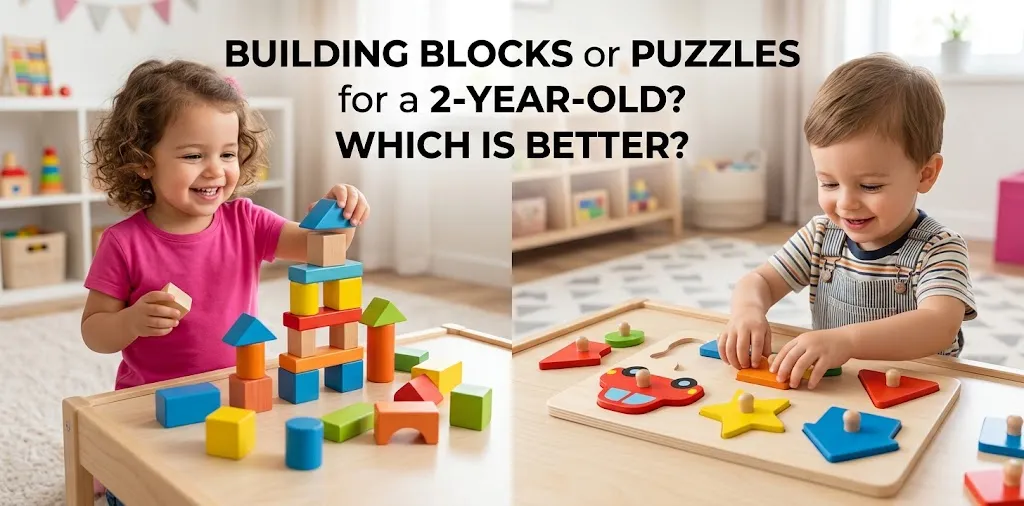
If you’re choosing between building blocks and puzzles for a 2-year-old, building blocks are usually the better all-around choice because they offer open-ended play, fine-motor practice, creativity, and early spatial problem-solving. Puzzles are also valuable, especially for matching and problem-solving. For many toddlers, having both provides a better mix than choosing only one.
At age 2, children are becoming more interested in building, sorting, matching, and figuring out how objects work. The right toy can support those skills without turning play into a formal learning exercise.
So which should you buy: building blocks or puzzles? The answer depends on how your child likes to play and which skills you want the toy to encourage.
Building Blocks vs. Puzzles for a 2-Year-Old
| Feature | Building Blocks | Puzzles |
|---|---|---|
| Open-ended play | Excellent | Limited |
| Fine-motor practice | Excellent | Excellent |
| Creativity | Excellent | Moderate |
| Spatial skills | Excellent | Good |
| Problem-solving | Good | Excellent |
| Matching skills | Moderate | Excellent |
| Pretend play | Excellent | Limited |
| Independent play | Good | Good |
| Variety of play | Very high | Moderate |
| Best for | Building, creating, experimenting | Matching, fitting, solving |
Both can be useful, but they encourage somewhat different types of play.
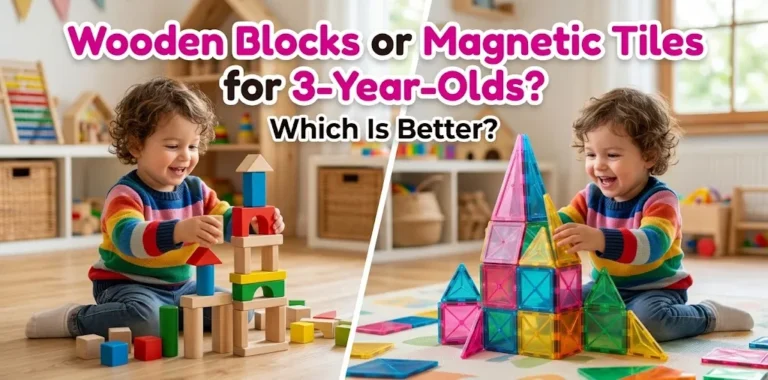
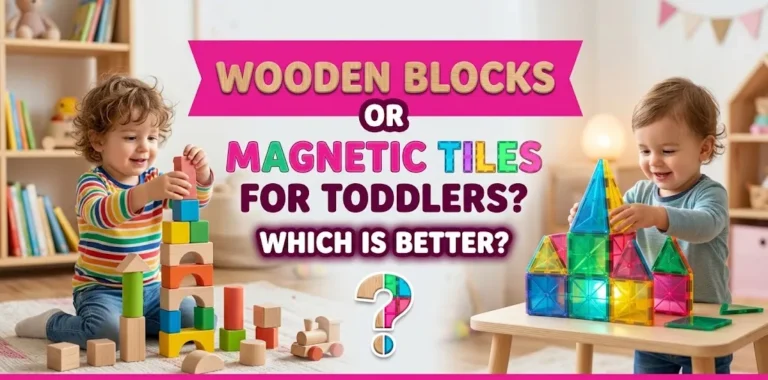
Building blocks let a toddler decide what to make. A child can stack them into a tower, knock it down, build a road, or use a block as part of pretend play.
Puzzles have a clearer goal: figure out where each piece belongs. That makes them particularly useful for matching, shape recognition, and simple problem-solving. The CDC specifically recommends helping 2-year-olds with simple puzzles involving shapes, colors, or animals and also encourages block play.
Why Building Blocks Are Often Better for a 2-Year-Old
The biggest advantage of blocks is freedom.
A toddler does not need to follow one correct solution. They can experiment with different ways to stack, balance, connect, and arrange the pieces.
At around age 2, building also fits naturally with developing hand and finger control. The American Academy of Pediatrics notes that 2-year-olds are interested in activities such as building and manipulating objects, while blocks and construction sets can provide engaging quiet play.
Blocks encourage creativity
With a puzzle, there is normally one correct place for each piece. With blocks, there may be dozens of possibilities.
For example, a toddler might:
- Build a short tower
- Make a row of blocks like a train
- Build a simple house
- Knock down a tower and rebuild it
- Pretend a block is food, a phone, or another object
This type of open-ended play gives parents more opportunities to talk, pretend, and build alongside their child.
Blocks support early spatial thinking
When toddlers stack blocks, they begin experimenting with concepts such as size, position, balance, and space.
They may discover that a tall tower falls when the pieces are not balanced or that a wider base can support more blocks. These discoveries happen naturally through play rather than through formal instruction.
The AAP also describes blocks as toys that can support problem-solving and other developing skills, while noting that the way children use blocks can become more complex as they grow.
Why Puzzles Are Also a Great Choice at Age 2
Puzzles have a different strength: they give toddlers a simple problem to solve.
A toddler looks at a piece, considers its shape or picture, tries a location, and adjusts when it does not fit.
That process can encourage matching, visual recognition, and early problem-solving.
The CDC specifically suggests helping 2-year-olds complete simple puzzles involving shapes, colors, or animals and naming each piece as the child places it.
Puzzles help with matching and recognition
Simple toddler puzzles can introduce concepts such as:
- Shapes
- Colors
- Animals
- Vehicles
- Familiar objects
- Basic picture matching
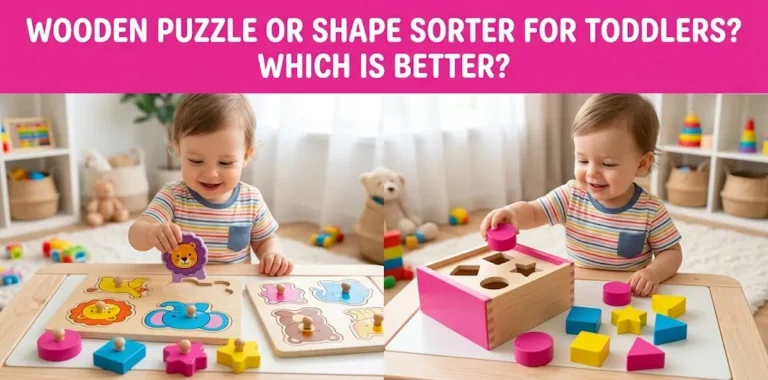
A wooden puzzle with large knobs, for example, can let a child practice picking up a piece, turning it, and placing it into the matching space.
Puzzles provide a clear goal
Some children enjoy having a task with a definite finish.
A toddler who likes figuring things out may stay interested in a simple puzzle because there is a satisfying moment when the final piece fits.
This can be especially useful for a child who becomes frustrated by open-ended activities and prefers knowing what they are trying to accomplish.
Which One Builds Better Fine-Motor Skills?
Both can help, but they do it in different ways.
Blocks involve grasping, lifting, stacking, connecting, separating, and positioning pieces. Puzzles involve picking up pieces, rotating them, lining them up, and fitting them into spaces.
At age 2, these activities fit well with developing hand and finger control. The AAP lists building a tower of blocks among the hand and finger skills associated with this age.
If fine-motor development is your main reason for buying a toy, you do not need to choose based on a simple winner. A well-designed block set and an age-appropriate puzzle can both provide useful practice.
Which Is Better for Problem-Solving?
Puzzles have a slight advantage for direct problem-solving practice.
The child has to work out which piece belongs where. They may need to rotate a piece, compare shapes, or look at the picture to find a match.
Blocks also involve problem-solving, but the process is more open-ended. A child might experiment with how many blocks can be stacked before the tower falls or how to make a structure stand.
So the difference is mainly this:
- Puzzles: “Where does this piece go?”
- Blocks: “What can I make with these pieces?”
Both questions are useful for a 2-year-old.
Which Is Better for Creativity and Pretend Play?
Building blocks win here.
A puzzle generally has a predetermined result. Blocks can become almost anything the child imagines.
A toddler might use blocks to build a pretend house, make a bridge for toy animals, or create a tower for a toy car.
The AAP encourages simple toys such as blocks and puzzles and emphasizes that children benefit from play that allows creativity, exploration, and interaction with caregivers.
If your child already enjoys pretend play, building blocks can be especially versatile.
What Type of Puzzle Is Best for a 2-Year-Old?
Not every puzzle is equally suitable for a toddler.
For a 2-year-old, start with simple puzzles designed specifically for that age range. Large pieces and familiar pictures are generally easier for young children to handle than complicated puzzles with many small pieces.
Good options may include:
- Large wooden peg puzzles
- Simple shape puzzles
- Animal puzzles
- Vehicle puzzles
- Basic color or object-matching puzzles
Avoid choosing a difficult puzzle simply because it looks more educational. If the child cannot understand how the pieces fit, the activity may become frustrating instead of enjoyable.
The goal is to provide a small challenge that the child can work through with some support.
What Type of Building Blocks Are Best for a 2-Year-Old?
For this age, look for blocks that are large enough to handle easily and specifically labeled as appropriate for the child’s age.
Simple wooden blocks, large plastic construction blocks, and other toddler-friendly building sets can work well.
A good starter set should allow the child to:
- Stack pieces
- Knock them down
- Build simple structures
- Combine pieces in different ways
- Play with a parent or caregiver
The CDC recommends encouraging 2-year-olds to play with blocks, including taking turns building towers and knocking them down.
Building Blocks or Puzzles: Which Is Better for Different Toddlers?
There is no single winner for every 2-year-old.
| If your child tends to… | Better starting choice |
|---|---|
| Love stacking and knocking things down | Building blocks |
| Enjoy making things | Building blocks |
| Like pretend play | Building blocks |
| Enjoy matching objects | Puzzles |
| Like finding where things fit | Puzzles |
| Prefer a clear goal | Puzzles |
| Get frustrated with open-ended activities | Simple puzzles |
| Enjoy experimenting | Building blocks |
| Like both creating and solving | Both |
For example, imagine a 2-year-old who immediately starts stacking cups, boxes, or household containers. Blocks are probably the more natural choice.
Another child may spend a lot of time matching shapes and trying to put objects into the correct openings. A simple puzzle may hold that child’s attention better.
The best toy is often the one that matches the child’s current interests while offering a small amount of challenge.
Are Building Blocks or Puzzles Better for Independent Play?
Both can support independent play, but neither needs to be used completely alone.
A toddler may spend several minutes stacking blocks independently or trying to complete a puzzle. However, adult interaction can add another layer of learning.
Instead of solving the puzzle for your child, you can ask:
“Where do you think this piece goes?”
With blocks, you could say:
“Can we make the tower taller?”
This keeps the child involved while giving them room to solve the problem themselves.
The AAP emphasizes that caregiver involvement during play is important for supporting children’s development, while independent exploration also has a role.
What About Safety for a 2-Year-Old?
Safety should be one of the first things you check when buying either type of toy.
A 2-year-old is still within the age group for which small parts can create a choking risk. The U.S. Consumer Product Safety Commission advises parents to follow age guidance and keep small parts and small-part toys away from children under 3.
When shopping, check:
- The recommended age range
- Whether the toy contains small pieces
- Whether pieces can break off
- Whether the construction is sturdy
- Whether there are sharp edges or points
- Whether the toy has been damaged or cracked
This matters particularly with building sets intended for older children. A set marketed for ages 3+ may contain pieces that are not appropriate for a 2-year-old.
Also check the toy regularly. If a piece breaks and becomes small enough to create a choking hazard, remove the toy from play.
Should You Buy Blocks or a Puzzle First?
If you can buy only one, building blocks are the better general-purpose choice for many 2-year-olds.
They offer more ways to play and can remain useful as the child develops. The same blocks that are used for simple towers at age 2 can later become part of more complex structures and pretend-play activities.
Choose a puzzle first if your child already shows a strong interest in matching, shapes, pictures, or fitting objects into spaces.
If your budget allows both, you do not need expensive sets. A simple block set and a basic toddler puzzle can provide two different types of play.
Frequently Asked Questions
Are building blocks good for a 2-year-old?
Yes. Building blocks can support fine-motor practice, creativity, spatial exploration, and simple problem-solving. The CDC specifically recommends encouraging block play for children around age 2.
How many puzzle pieces should a 2-year-old use?
There is no single piece count that works for every 2-year-old. Start with simple, age-appropriate puzzles with large pieces and a familiar picture, then increase the difficulty as your child becomes more comfortable.
Can a 2-year-old play with both blocks and puzzles?
Yes. In fact, offering both gives a toddler different ways to practice skills. Blocks provide open-ended building and creative play, while puzzles provide matching, fitting, and more structured problem-solving.
The Bottom Line
For most 2-year-olds, building blocks are the better first choice if you want one versatile toy. They encourage children to build, experiment, create, and use the same pieces in many different ways.
Puzzles are still an excellent choice when your child enjoys matching and figuring out where pieces belong. If possible, keep both in the play area and let your child’s interests guide which one gets used more.
The most useful tip is simple: choose age-appropriate toys that your child can explore without being overwhelmed, and play alongside them when you can.