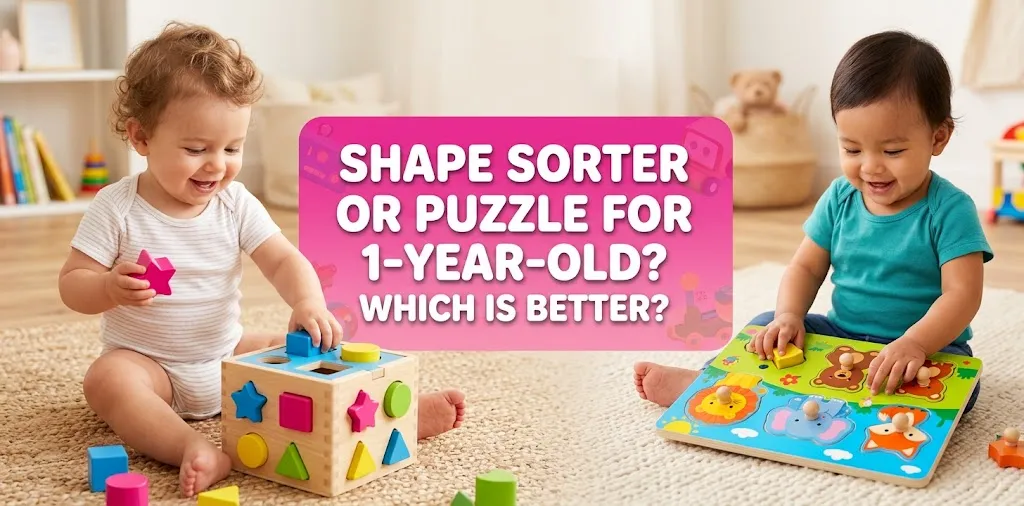
Shape Sorter or Puzzle for a 1-Year-Old? Which Is Better?

Choosing toys for a 1-year-old can feel surprisingly difficult. You want something fun, safe, and useful—but you also do not want to buy a toy your child is too young to enjoy.
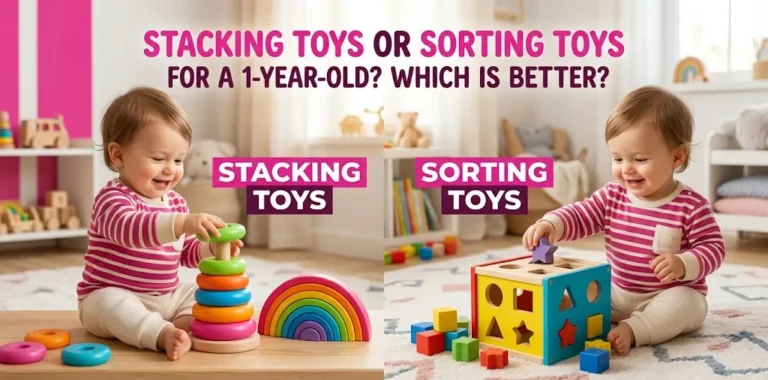
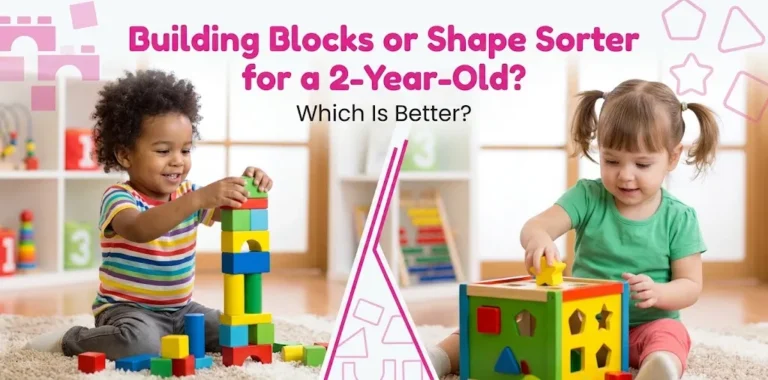
If you are deciding between a shape sorter and a puzzle, the short answer is simple: a shape sorter is usually the better first choice for most 1-year-olds.
That does not mean puzzles are bad for this age. The right puzzle can also be helpful, especially for an older toddler. The best choice depends on your child’s current skills, interest, and ability to handle small challenges.
Shape Sorter or Puzzle: Which Is Better for a 1-Year-Old?
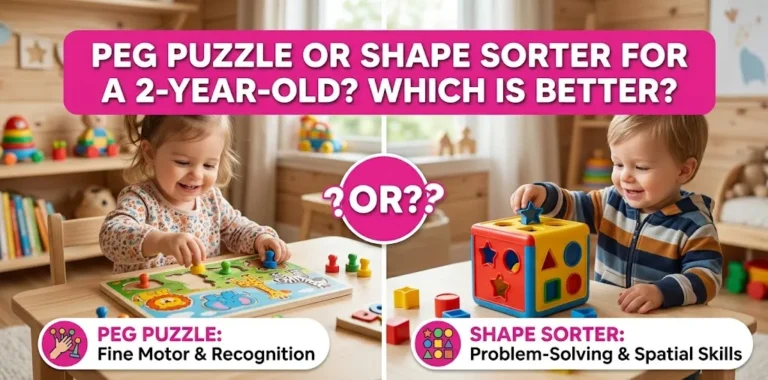
For most children who have recently turned 1, a simple shape sorter is the better option because it is easier to explore and encourages trial and error. A chunky, simple puzzle can also work, but puzzles often require more precise hand control and matching skills that some younger toddlers are still developing.
The easiest way to choose is to look at what your child enjoys doing right now.
| Feature | Shape Sorter | Simple Puzzle |
|---|---|---|
| Easy for a young 1-year-old | Usually easier | Can be harder |
| Fine motor skills | Builds early hand control | Requires more precise control |
| Problem-solving | Trial and error | Matching and positioning |
| Frustration level | Often lower | Can be higher |
| Best for beginners | Yes | Sometimes |
| Good for older toddlers | Yes | Yes |
Why a Shape Sorter Is Often the Better First Toy
A shape sorter gives a child a simple challenge: Which shape goes where?
The child can pick up a piece, look at the openings, turn the shape around, and try again. Even when they do not get it right immediately, they are still learning.
This type of play helps children practice several early skills at the same time.
They learn how to:
- Hold and move objects
- Turn objects in different directions
- Notice differences between shapes
- Try different solutions
- Use their hands and eyes together
- Learn through repetition
The best part is that children do not need to understand the whole activity immediately.
A 12-month-old might first enjoy simply holding the shapes, dropping them, or putting them into the sorter randomly. Over time, they may begin noticing that certain shapes fit into certain holes.
That gradual learning process is completely normal.
Why Some 1-Year-Olds May Struggle With Puzzles
A puzzle can look simple to an adult, but it may be surprisingly challenging for a young toddler.
To complete even a basic puzzle, a child often needs to:
- Recognize the correct piece
- Understand where it belongs
- Turn the piece in the right direction
- Place it accurately into the opening
That requires more precise control.
For example, imagine giving a newly turned 1-year-old a puzzle with several animal pieces. The child may recognize the pictures and enjoy holding the pieces but still have trouble placing them into the correct spaces.
That does not mean the child is not learning.
They may simply need more time before the puzzle becomes enjoyable instead of frustrating.
When Is a Puzzle a Good Choice for a 1-Year-Old?
A puzzle can be a great choice when it matches the child’s developmental stage.
For a young toddler, look for a puzzle with:
- Large, chunky pieces
- Only a few pieces
- Easy-to-recognize pictures
- Large knobs or handles
- Clearly marked spaces
- Strong and durable construction
A simple wooden knob puzzle can be easier for a child to hold than a traditional jigsaw puzzle.
Older 1-year-olds may also be more interested in puzzles than children who have just reached their first birthday.
A 12-Month-Old and an 18-Month-Old May Need Different Toys
This is something many parents forget.
Both children may technically be described as 1 year old, but there can be a big difference between a child who is 12 months old and one who is almost 2.
For example:
A 12-month-old may enjoy putting objects into containers, taking them out, dropping them, and exploring different textures and shapes.
An 18- to 22-month-old may be more interested in matching pictures, fitting pieces into spaces, and solving simple problems.
That is why the age printed on a toy box should be used as guidance—not as a perfect rule.
Choose a Shape Sorter If Your Child…
A shape sorter is probably the better choice if your child:
- Has recently turned 1
- Enjoys putting objects into containers
- Likes picking up and moving objects
- Is still developing hand control
- Has not used matching toys before
- Gets frustrated with difficult tasks
A simple shape sorter gives them room to explore without requiring perfect accuracy right away.
Choose a Simple Puzzle If Your Child…
A puzzle may be a good choice if your child:
- Is closer to 18 months or older
- Enjoys matching objects
- Can focus on one activity for longer
- Has good control when picking up objects
- Already enjoys shape-matching activities
- Finds a basic shape sorter too easy
The goal is to give your child a challenge—but not one that feels impossible.
The Best Toy Depends on What Your Child Can Do Now
There is no single toy that is perfect for every 1-year-old.
One child may love sitting quietly and trying to match shapes. Another may lose interest after 30 seconds and prefer toys they can move, stack, or carry around.
Watch how your child plays.
If they enjoy putting objects into openings or containers, a shape sorter may be a natural next step.
If they already enjoy matching objects and carefully placing things in the right spot, a simple puzzle may keep them interested.
Following your child’s interest is often more useful than choosing a toy based only on age.
What Happens If Your Child Does Not Use the Toy Correctly?
Nothing is wrong.
A common mistake is expecting a 1-year-old to immediately understand how an educational toy is supposed to work.
Your child may use a shape sorter by:
- Throwing the shapes
- Carrying them around
- Putting them in their mouth
- Knocking them together
- Taking them out repeatedly
- Watching you use the toy
This is still part of exploration.
Young children learn by touching, moving, repeating, and experimenting.
You can show your child how the toy works, but try not to complete the activity for them every time. Give them a chance to explore and solve small problems on their own.
Start Simple Instead of Buying the Most Complicated Toy
More pieces do not automatically mean more learning.
In fact, a complicated shape sorter or puzzle can sometimes create unnecessary frustration.
For a 1-year-old, simple is usually better.
A good beginner toy should have:
- Large pieces
- Easy-to-hold shapes
- A small number of choices
- Strong construction
- No complicated instructions
As your child becomes more confident, you can introduce toys with more shapes, pieces, and challenges.
A Simple Progression That Works Well
Many toddlers naturally move through activities in stages.
A simple progression might look like this:
Putting objects into containers → Simple shape sorter → More shape matching → Chunky knob puzzle → Simple multi-piece puzzle
Your child does not need to follow this exact order or reach each stage at a specific age.
Some children may become interested in puzzles earlier, while others may spend more time enjoying sorting activities.
The important thing is that the toy feels interesting and achievable.
Should You Buy Both?
If your budget allows, having both can be a good idea.
The two toys encourage slightly different types of learning.
A shape sorter may be the better starting point, while a simple puzzle can provide a new challenge later.
For example, you could introduce a shape sorter first. Once your child begins understanding how matching works, you could add a chunky puzzle with just a few pieces.
This gives your child something new to explore without making the first toy useless.
Safety Matters When Choosing Toddler Toys
Before buying a shape sorter or puzzle, always check that the toy is appropriate for your child’s age.
Look for:
- Large pieces that are not choking hazards
- Smooth edges
- Strong construction
- Secure parts
- Durable materials
- A manufacturer-recommended age range
Also inspect toys regularly. If a piece becomes cracked, broken, or loose, stop using the toy until it can be safely replaced or repaired.
Young toddlers often explore toys with their mouths, so damaged pieces can become a safety concern.
So, Which One Should You Buy?
If you are buying one toy for a child who has just turned 1, choose a simple shape sorter.
It is usually easier to explore, gives the child more opportunities for trial and error, and can grow with their developing skills.
A simple puzzle can be an excellent next step, especially when your child becomes more interested in matching and can handle pieces with greater control.
The best toy is not necessarily the one with the most features. It is the one that gives your child a challenge they can enjoy.
Frequently Asked Questions
Parents often have a few questions before choosing between a shape sorter and a puzzle. Here are clear answers to the most common questions that can help you pick the right toy based on your child’s age, skills, and interests.
Is a shape sorter good for a 1-year-old?
Yes. A simple shape sorter can help a young child explore shapes, practice hand-eye coordination, and begin learning through trial and error. Choose large, easy-to-handle pieces rather than a complicated sorter with many difficult shapes.
Can a 1-year-old complete a puzzle?
Some older 1-year-olds can enjoy very simple chunky or knob puzzles. However, many children who have just turned 1 may need more time to develop the hand control and matching skills needed for puzzles.
What should I buy first: a shape sorter or a puzzle?
For most children who have recently turned 1, start with a simple shape sorter. Once your child becomes comfortable with matching activities and shows more interest in placing objects precisely, introduce a simple puzzle.
The Bottom Line
For most 1-year-olds, a shape sorter is the better first choice. It gives young toddlers an easier way to explore shapes, practice using their hands, and begin solving simple problems.
One practical tip: watch your child for a few minutes while they play before buying the next developmental toy. Their current interests and abilities will tell you far more than the age printed on the package.