Building Blocks or Shape Sorter for a 2-Year-Old? Which Is Better?

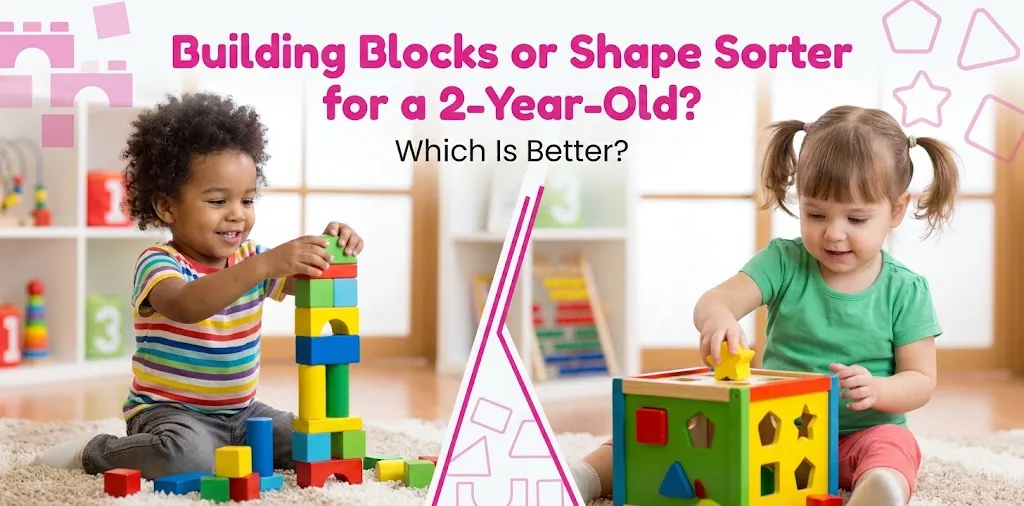
For most 2-year-olds, building blocks are the better overall choice because they offer more open-ended play and usually stay useful longer. A shape sorter is better for a child who is currently interested in matching shapes, solving simple problems, and practicing more focused hand movements.
The right choice depends less on the number printed on the toy box and more on how your toddler likes to play.
A child who loves stacking, knocking things down, and making new creations may get more from building blocks. A child who enjoys figuring out where objects belong may spend more time with a shape sorter.
| Factor | Building Blocks | Shape Sorter |
|---|---|---|
| Best for | Open-ended play | Matching and problem-solving |
| Play style | Creative and flexible | More structured |
| Main challenge | Building and balancing | Matching and rotating shapes |
| Replay value | Usually very high | Can become easier after mastery |
| Independent play | Often good | Good once the child understands it |
| Grows with the child | Usually longer | Depends on the sorter |
| Best overall for most 2-year-olds | Yes | Sometimes |
Why Building Blocks Are Often the Better Long-Term Choice
Building blocks do not have just one correct way to play.
A 2-year-old might stack three blocks into a tower today. Tomorrow, those same blocks might become a house, a road, or simply something fun to knock down.
That flexibility is the biggest advantage.
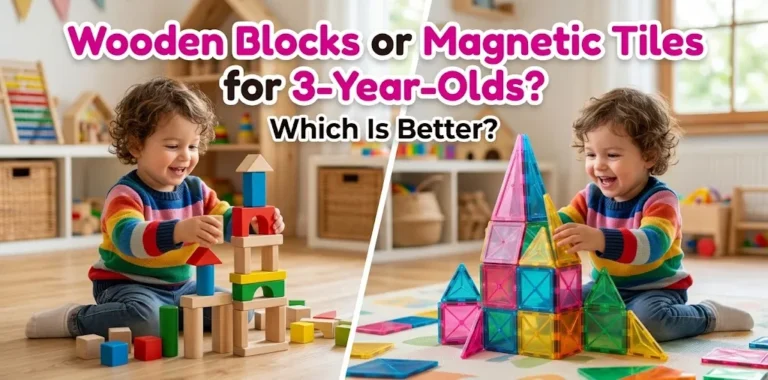
At age two, children are still learning by touching, moving, stacking, experimenting, and repeating actions. Appropriate construction blocks can support this kind of play, especially when the pieces are designed for young children and are large enough to handle safely.
Blocks encourage experimentation
With building blocks, a toddler can learn through trial and error without needing to find one exact answer.
For example:
- A tower falls, so the child tries again.
- A larger block may work better at the bottom.
- Two blocks can become a bridge.
- Different arrangements can create something new.
This makes block play especially useful for children who enjoy active, creative play.
Building blocks can stay interesting longer
A simple shape sorter may eventually become easy for a child who has mastered all the openings.
Blocks can continue changing with the child’s abilities.
A younger toddler may stack them. Later, the child may build larger structures, copy simple designs, sort by color, or use blocks during pretend play.
That longer lifespan can make blocks a better value for many families.
When a Shape Sorter Is the Better Choice
A shape sorter gives a child a clearer challenge.
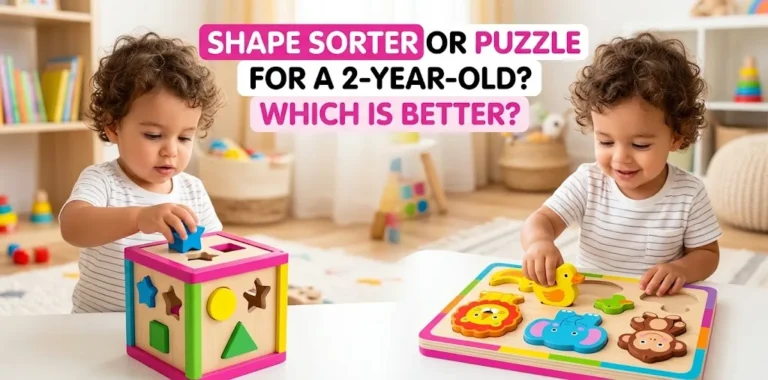
The toddler has to look at a piece, compare it with an opening, turn it, and figure out how it fits. Two-year-olds are beginning to understand relationships between objects and can practice matching similar shapes with toys such as shape sorters.
Shape sorters provide focused problem-solving
Unlike open-ended block play, a classic shape sorter has a specific goal.
The circle goes into one opening. The square goes into another.
That structure can work well for a child who enjoys repeating a challenge until they succeed.
A shape sorter may be the better choice if your toddler:
- Enjoys matching activities
- Likes putting objects into containers
- Is interested in basic shapes
- Has patience for trying again when something does not fit
- Enjoys simple puzzles
A shape sorter can reveal what your child is ready to learn
Imagine two different toddlers.
Toddler A quickly loses interest in matching toys but happily spends 20 minutes stacking and rebuilding towers. Building blocks are probably the better choice.
Toddler B repeatedly tries to place shapes into the correct openings and seems excited when a piece finally fits. A shape sorter may provide more engaging play.
The best educational toy is often the one your child actually wants to use.
The Biggest Difference: Open-Ended Play vs. One Clear Challenge
This is the easiest way to decide between them.
Building blocks ask: What can I make?
A shape sorter asks: How can I make this piece fit?
Neither approach is better for every child.
Building blocks give children more freedom. A shape sorter gives them a more focused task.
Both types of toys can involve hand use, coordination, spatial thinking, and problem-solving, but they encourage those skills in different ways.
Choose Building Blocks if Your 2-Year-Old Likes Active Play
Building blocks are usually the stronger choice when your child enjoys movement and experimentation.
They may be especially suitable if your toddler likes:
- Stacking objects
- Knocking towers down
- Moving toys around the room
- Creating different arrangements
- Playing without strict rules
For example, a child might build a small tower with you, knock it down, and immediately start again. That same activity can change naturally as the child’s skills improve.
For a 2-year-old, this kind of flexible play can keep a toy interesting longer than an activity with only one solution.
Choose a Shape Sorter if Your Child Enjoys Matching and Repetition
A shape sorter may be the better option if your toddler likes working toward a clear result.
For example, your child might spend several minutes turning a square block, trying different angles, and eventually placing it through the correct opening.
That process is the point of the toy.
The child is observing, trying, adjusting, and trying again.
A simple shape sorter can be especially useful when your toddler is interested in basic shape matching but is not yet ready for more complicated puzzles.
What About a Child Who Already Has One of These Toys?
You do not necessarily need to buy the other one immediately.
Look at how your child currently uses the toy.
If your toddler has blocks but only throws them around, you can try sitting together and building a very small tower. Keep it simple and let the child take over.
If your toddler has a shape sorter and completes it easily every time, you may get more value from adding blocks or another open-ended toy rather than buying a more complicated version of the same activity.
The goal is not to collect every educational toy. It is to offer play that matches your child’s current interests and abilities.
Safety Matters More Than the Toy Type
For a 2-year-old, always check the manufacturer’s recommended age and inspect the individual pieces.
The U.S. Consumer Product Safety Commission’s age-related guidance emphasizes age-appropriate toy characteristics and appropriate piece sizes for young children.
Before buying, check for:
- Pieces appropriate for your child’s age
- No damaged or broken parts
- Secure construction
- Smooth surfaces and edges
- A design that matches the manufacturer’s age guidance
Be especially careful with construction toys containing very small pieces or components that are not intended for children under age three.
Can You Buy Both?
Yes—and for many families, the two toys work well together.
They encourage different types of play.
A shape sorter can provide a focused matching activity, while building blocks offer more freedom and creative experimentation.
If your budget allows for only one toy, though, building blocks are usually the more versatile choice for most 2-year-olds.
Which Type of Building Blocks Should You Choose?
Not every building set is equally suitable for a toddler.
Look for blocks designed specifically for young children and follow the manufacturer’s age recommendation.
Good toddler-friendly options generally focus on pieces that are easy for small hands to grasp and use.
You may want:
- Large stacking blocks for simple building
- Lightweight blocks for easy handling
- Durable blocks that can handle repeated play
- A set with enough pieces for simple structures without overwhelming the child
A large number of pieces is not automatically better. A manageable set that your toddler can comfortably explore may provide more enjoyable play.
Building Blocks or Shape Sorter: Our Final Recommendation
If you are choosing one toy for most 2-year-olds, choose building blocks.
They provide more ways to play, can adapt as your child develops, and often remain useful for a longer period.
Choose a shape sorter instead if your child is especially interested in matching, fitting objects into spaces, and solving small, structured challenges.
The simplest expert tip is to watch what your toddler already does with everyday objects. If they stack and build, start with blocks. If they match and try to make things fit, a shape sorter may be the better first choice.
Frequently Asked Questions
Are building blocks educational for a 2-year-old?
Yes. Building blocks can support hands-on learning through stacking, balancing, experimenting, and spatial play. The best choice is an age-appropriate set that your child can safely handle and enjoy.
Is a shape sorter too easy for a 2-year-old?
Not necessarily. Some 2-year-olds are still learning to match and rotate shapes, while others may already complete a simple sorter easily. If your child has mastered it, a more open-ended activity such as building blocks may provide a new challenge.
Which toy will my child use for longer?
Building blocks will often have a longer useful life because the ways children play with them can become more complex over time. A shape sorter can still provide good repeat play, but a simple version may become less challenging once the child fully understands it.
conclusion
For most 2-year-olds, building blocks are the better overall choice because they offer more freedom to build, stack, experiment, and create as your child grows. A shape sorter is a better pick if your toddler especially enjoys matching shapes and solving simple, hands-on challenges.
If you can buy only one, start with building blocks. Choose a shape sorter instead if your child is clearly more interested in fitting and matching activities.