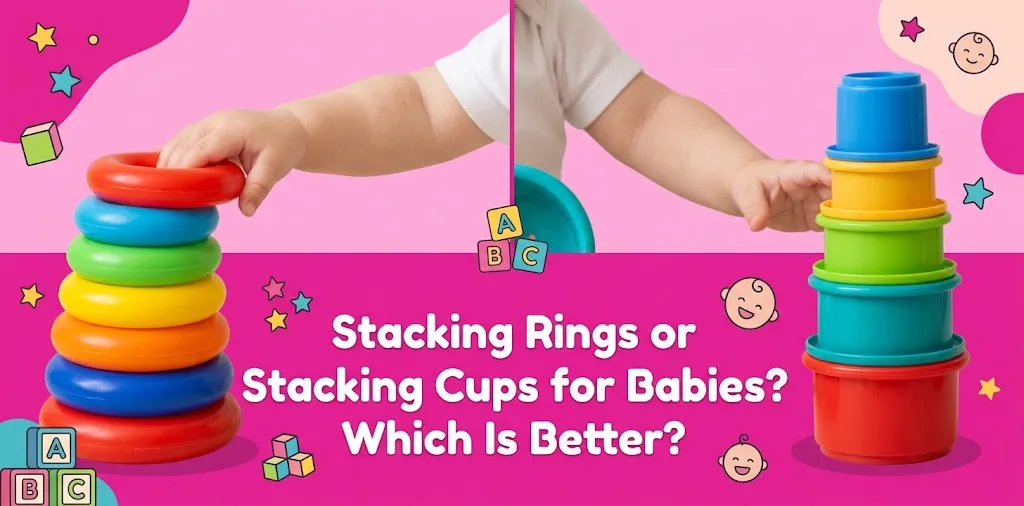
Stacking Rings or Stacking Cups for Babies? Which Is Better?

If you’re choosing between stacking rings and stacking cups for a baby, stacking cups are usually the more versatile choice, especially if you want one toy that can stay useful as your child grows. Cups can be stacked, nested, filled, emptied, and used in simple water or sensory play. Stacking rings are better when you want a more focused activity involving grasping, placing, and exploring size order. Both can support hands-on practice, but neither toy is necessary for normal development.
Stacking Rings vs. Stacking Cups at a Glance
The biggest difference is how each toy invites a baby to play.
| Feature | Stacking Rings | Stacking Cups |
|---|---|---|
| Main action | Place rings onto a post | Stack or nest cups |
| Fine motor practice | Excellent | Excellent |
| Hand-eye coordination | Strong | Strong |
| Size-order practice | More direct | More flexible |
| Open-ended play | Moderate | High |
| Nesting | Usually no | Yes |
| Fill and dump play | Limited | Yes |
| Water or bath play | Usually no | Often yes |
| Easy to use in different ways | Moderate | High |
| Best for | Focused stacking practice | Flexible, open-ended play |
A traditional ring stacker has several rings of different sizes that fit onto a central post. A cup set uses open containers that can be nested inside one another or built into a tower. That difference gives cups more ways to be used as a child becomes more capable.
What Stacking Rings Are Good For
Stacking rings give babies a simple physical problem: pick up a ring and figure out how to place it on the post.
For a young baby, the rings may be more interesting as objects to grab, hold, shake, or explore. Later, the child may start trying to put them onto the post. A classic ring stacker can therefore change as the baby’s abilities develop.
Rings provide a clear stacking goal
The center post gives the child an obvious target. That can make the activity easier to understand than a completely open-ended toy.
A baby may first put a ring on the post without caring about size. With practice, the child may begin noticing that some rings are larger or smaller and experimenting with different orders.
That does not mean the toy automatically teaches advanced math or guarantees a particular developmental milestone. It simply gives the child a hands-on way to explore objects, movement, and relationships between pieces.
Rings can be good for focused practice
If your baby tends to enjoy putting objects into specific places, a ring stacker can be a good match.
For example, imagine a baby sitting on the floor with five large rings. You hand over one ring at a time and show how it can slide down the post. The child may miss the post several times before getting it. That repeated reaching, aiming, grasping, and releasing is the useful part of the activity.
What Stacking Cups Are Good For
Stacking cups offer a different kind of play. A baby can stack them, knock them down, put one inside another, turn them over, fill them, empty them, or use them in other simple games.
That flexibility is one of their biggest advantages. Stacking cups can remain interesting even after a child has figured out how to make a basic tower.
Cups allow more open-ended play
A cup does not have only one job.
A baby might:
- Hold and shake a cup
- Turn it upside down
- Put one cup inside another
- Build a small tower
- Knock the tower down
- Hide a toy underneath a cup
- Fill and dump objects
- Use cups during supervised water play
As children become toddlers, these different uses can make cups useful for longer than a simple stacking activity.
Cups offer more room for experimentation
With rings, the central post largely determines how the toy works.
With cups, the child can experiment with space in several ways. A larger cup may hold a smaller one. Several cups can form a tower. A cup can cover another object.
This makes stacking cups a particularly good choice if you want a toy that encourages exploration rather than one specific action.
Which Toy Is Better for a Younger Baby?
For a younger baby who is mainly grabbing, holding, mouthing, and exploring objects, the individual design matters more than whether it is technically a ring or a cup.
Some stacking-ring toys are designed for babies as young as 6 months, while age recommendations vary by product. For example, Fisher-Price lists its Rock-a-Stack for ages 6 months and older.
At this stage, don’t expect a baby to correctly stack everything.
The useful play may simply be:
- Reaching toward a piece
- Grabbing it
- Moving it from one hand to another
- Dropping or banging it
- Exploring its shape and texture
A baby does not need to complete the adult version of the activity for the toy to be useful.
Which Is Better for a 1-Year-Old?
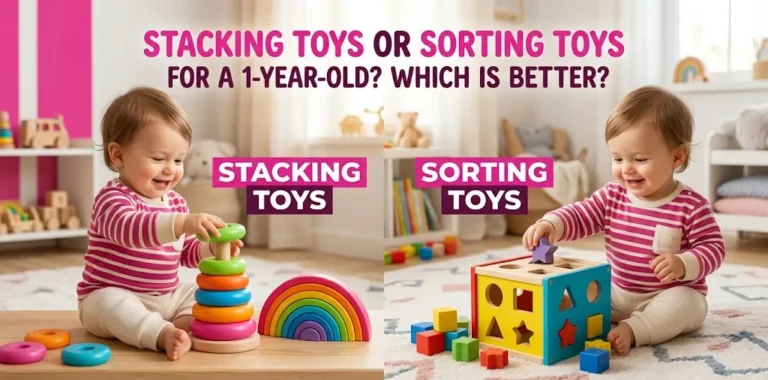
For many 1-year-olds, stacking cups have the edge because they offer more ways to play.
A one-year-old may be starting to experiment with nesting, putting objects into containers, dumping them out, and building simple towers. Cups work well with all of those activities.
Stacking rings are still a good option if the child enjoys placing objects onto a post or seems interested in size and order.
So if you are buying only one:
Choose stacking cups for versatility. Choose stacking rings for a more focused stacking activity.
Which Is Better for Fine Motor Skills?
Both can provide fine motor practice.
Stacking rings require the child to grasp a ring, control its movement, aim it toward the post, and release it. Purdue’s early-learning curriculum, for example, uses stacking rings as objects for infants to reach for, touch, and hold.
Cups involve many of the same basic hand movements. A child has to pick up, position, release, nest, or stack the cups.
The difference is not that one toy develops fine motor skills while the other does not. Both give children opportunities to practice controlled hand movements.
Which Is Better for Learning Size and Order?
Stacking rings have a clearer advantage here.
Traditional ring stackers are deliberately arranged with rings of different sizes. The child can explore what happens when a larger or smaller ring is placed on the post.
Cups can also introduce size differences, especially when a child nests smaller cups inside larger ones. But their design usually allows more freedom instead of directing the child toward one specific order.
That makes rings a better choice if your main reason for buying the toy is to give your child repeated practice with size and sequence.
Which Is Better for Open-Ended Play?
Stacking cups win.
The same set can be used in several different ways as your child grows. A baby may first bang the cups together. Later, the child may nest them. After that, they may build towers or use them during supervised water or sensory play.
This broader range of play is one reason stacking cups often have strong long-term value as a simple baby toy.
A ring stacker can also be used creatively, but the central post limits some of those possibilities.
What About Bath Time?
Stacking cups are much more useful for bath or water play.
Their open shape makes them naturally suited to scooping, pouring, filling, and dumping water. They can turn an ordinary bath into a simple cause-and-effect activity.
Just remember that bath toys need to be cleaned and dried properly. Water trapped inside poorly designed toys can create hygiene problems over time.
Stacking rings generally don’t offer the same range of water-play activities.
Are Stacking Rings or Cups Safer?
Neither category is automatically safer. The individual toy’s design, construction, age recommendation, and condition matter.
For U.S. families, the Consumer Product Safety Commission advises parents to follow the age guidance and safety information on toy packaging. Toys with small parts can create choking hazards for children under 3, and the CPSC has specific rules concerning small parts and choking-hazard labeling.
The American Academy of Pediatrics also recommends avoiding toys with small or detachable parts for babies and young children and choosing toys and parts that are larger than the child’s mouth.
Before buying either toy, check:
- The manufacturer’s recommended age
- Whether any piece can break or detach
- Whether the material is sturdy
- Whether the toy has sharp edges or cracks
- Whether the rings or cups are large enough for the intended age
- Whether the product has been recalled
This last point matters. CPSC has issued recent warnings and recalls involving certain stacking toys because of small-part choking hazards, showing why parents should evaluate the actual product rather than assume every stacking toy is safe.
How to Choose Between Them
The easiest way to decide is to think about how you want your baby to play.
Choose stacking rings if:
- Your child enjoys putting objects onto a target
- You want a simple, focused stacking activity
- You like the idea of exploring different ring sizes
- You want a traditional first stacking toy
- Your child enjoys grasping and placing individual pieces
Choose stacking cups if:
- You want one toy with many uses
- Your child enjoys filling and dumping
- You want a toy for nesting and stacking
- You plan to use it during supervised water play
- You want something that can remain useful as your child becomes a toddler
If you’re still unsure, cups are generally the easier one-toy choice because they support more types of play.
What If Your Baby Doesn’t Stack Them?
That’s completely fine.
A baby may spend weeks simply throwing the pieces, chewing on them, banging them together, or taking them apart. Those actions are part of exploring the toy.
Don’t turn stacking into a test. Sit nearby, demonstrate one simple action, and let your child decide what to do next.
For example, place two cups together and say, “in.” Then separate them and say, “out.” Your baby may copy you—or may immediately knock both cups over. Either way, the child is interacting with the objects and learning through play.
The same approach works with rings. Put one ring onto the post, then offer another ring and let your baby experiment.
Do You Need Both Stacking Rings and Stacking Cups?
No. Most babies do not need both.
If you already have stacking rings and your baby enjoys them, there is no urgent reason to replace them with cups. If you are buying a first stacking toy and want maximum versatility, cups are probably the better starting point.
If your child loves stacking toys, adding the other type later can provide a different way to explore the same basic ideas.
The goal is not to collect every educational toy. It is to give children safe opportunities to move, explore, repeat, and figure things out.
Stacking Rings or Stacking Cups: The Bottom Line
Stacking cups are the better overall choice for most families who want versatility, while stacking rings are better for focused practice with grasping, placing, and size-based stacking.
If your baby is younger or still mainly exploring objects, either can work as long as the toy is appropriate for the child’s age and safely constructed. If your child is around 1 year old and you want a toy that can support many different types of play, stacking cups are the stronger all-around pick.
The best choice is not necessarily the toy with the longest list of claimed developmental benefits. It is the one your child can safely explore and actually enjoys using.
Frequently Asked Questions
Are stacking cups or stacking rings better for a 6-month-old?
Either can be appropriate if the specific toy is labeled for that age, but a 6-month-old may mainly grasp, hold, shake, and explore the pieces rather than stack them correctly. Always follow the product’s age recommendation and avoid toys with small or detachable parts.
Do stacking cups help babies learn to stack?
Yes, stacking cups give babies an opportunity to practice placing objects on top of one another and later nesting or arranging them. The exact age at which a child begins stacking varies, so there is no need to expect a particular result on a specific birthday.
Should I buy stacking rings or stacking cups first?
If you want the most versatile option, start with stacking cups. If your main goal is a simple toy that gives your child a clear target for placing different-sized pieces, stacking rings are a strong alternative.
Final Takeaway
For most families, stacking cups are the better first purchase because they offer more ways to play and can remain useful as a child grows. Stacking rings are still an excellent choice when you want a more focused activity involving grasping, placing, and exploring size.
Whichever you choose, focus less on whether your baby stacks perfectly and more on whether the toy is safe, age-appropriate, and giving your child something interesting to explore.