Stacking Toys or Sorting Toys for a 1-Year-Old? Which Is Better?

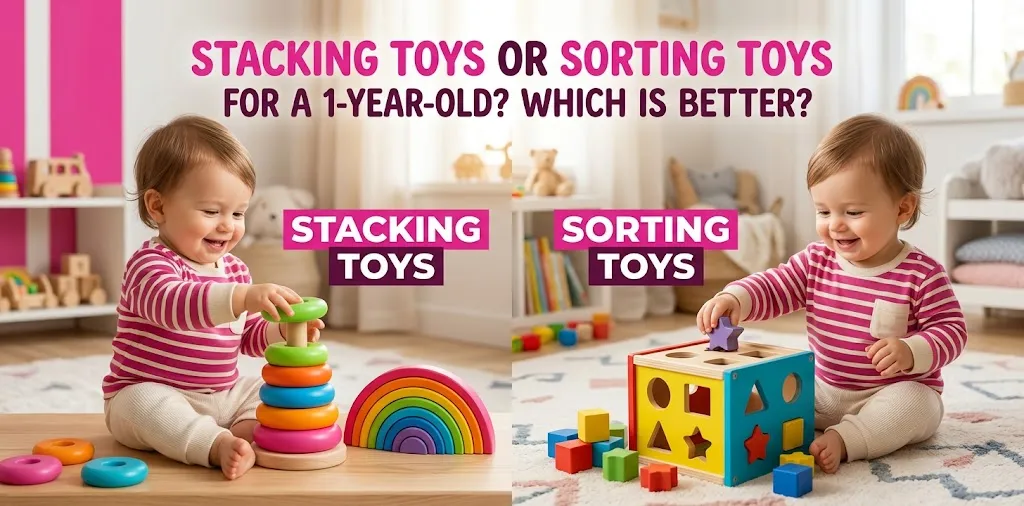
For most 1-year-olds, stacking toys are the better starting choice because they are simple to grasp, move, knock down, and try again. Sorting toys can also be useful, especially simple shape-based ones, but many require more problem-solving. At this age, choose toys based on the child’s abilities rather than expecting perfect stacking or sorting.
Both stacking and sorting toys can be good choices for a 1-year-old. The better option depends on what your child can already do and what kind of play keeps them interested.
A simple stacking toy may be easier for a newly turned 1-year-old, while a basic shape sorter may become more interesting as the child develops better problem-solving skills.
Stacking Toys vs. Sorting Toys for a 1-Year-Old
| Feature | Stacking Toys | Sorting Toys |
|---|---|---|
| Best starting point | Usually easier | Can be more challenging |
| Main play action | Stack, remove, knock down | Match, fit, and place |
| Fine motor practice | Strong | Strong |
| Hand-eye coordination | Strong | Strong |
| Problem-solving | Basic to moderate | Moderate |
| Shape recognition | Some toys teach this | Often a main feature |
| Independent play | Usually easier to start | May require more practice |
| Best for | Children learning to manipulate objects | Children ready for simple matching |
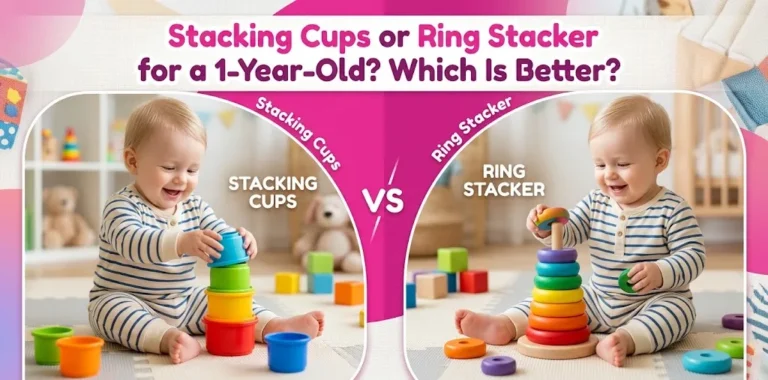
The difference is mostly in the type of challenge. Stacking toys let a child experiment with putting objects on top of one another, while sorting toys ask the child to figure out where an object belongs.
Why Stacking Toys Are Often Better at 1 Year
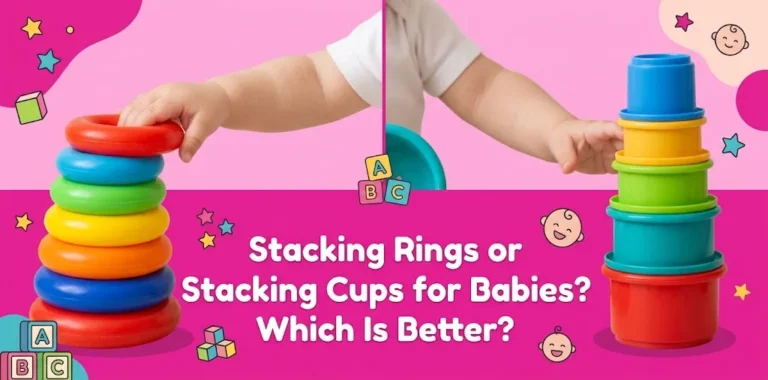
A stacking toy usually has a very simple goal: pick something up, move it, and place it somewhere.
That makes it a good match for the kind of hands-on exploration common around the first birthday. The CDC notes that 1-year-olds commonly put objects into containers and pick up small objects between the thumb and pointer finger.
A child does not need to understand size or color perfectly to enjoy stacking.
They can:
- Pick up a ring or block.
- Try putting it on a post.
- Take it off again.
- Knock the stack down.
- Try another arrangement.
- Repeat the activity.
That repetition is part of the value. The child gets immediate feedback from the toy without needing to complete a complicated puzzle.
Stacking also becomes more challenging with age
A 12-month-old may mostly grab, remove, or knock down the pieces. A slightly older toddler may start placing pieces more deliberately.
By 15 months, the CDC lists stacking at least two small objects, such as blocks, as a developmental milestone for most children.
That does not mean a 1-year-old needs to stack perfectly. Children develop at different rates, and the toy should be used for exploration rather than testing.
When a Sorting Toy May Be the Better Choice
Sorting toys can be a good choice if your 1-year-old already enjoys putting objects into openings, matching simple pieces, or figuring out how things fit together.
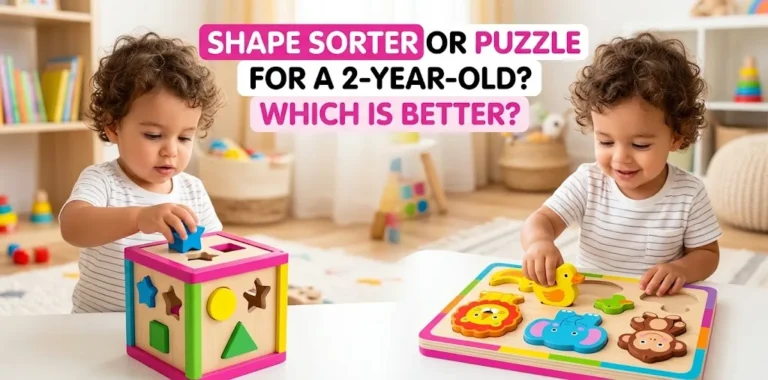
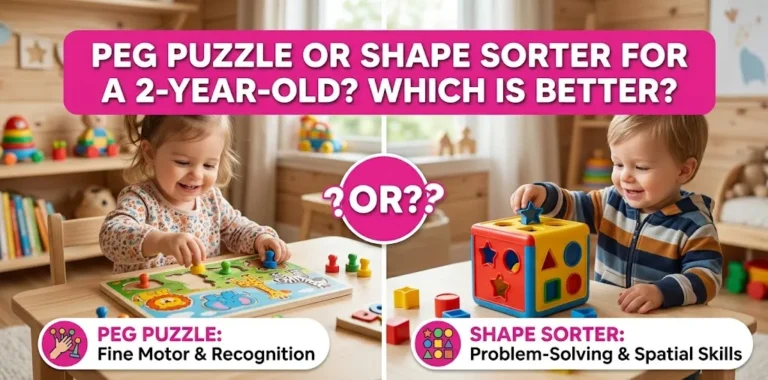
For example, a basic shape sorter might have a few large pieces that fit into matching openings. Your child may first simply remove the pieces or put them into the wrong openings. With practice, they may begin to notice which piece fits where.
The CDC specifically recommends simple matching games such as shape sorting and simple puzzles for toddlers ages 1 to 2.
However, there is an important difference between simple sorting and advanced sorting.
A toy that expects a young toddler to sort many pieces by several colors, shapes, or patterns may be frustrating. A simple sorter with large, easy-to-handle pieces is generally a better starting point.
Which Toy Helps Fine Motor Skills More?
Both can support fine motor development, but they do it in slightly different ways.
Stacking toys involve:
- Grasping pieces
- Releasing objects
- Placing pieces onto a post or surface
- Adjusting hand position
- Coordinating both hands
Sorting toys involve:
- Picking up pieces
- Turning and repositioning objects
- Matching shapes
- Guiding pieces toward an opening
- Adjusting the piece when it does not fit
Neither toy needs to be considered a winner for every child. If your child is still developing basic control over objects, stacking may provide an easier starting point. If your child enjoys figuring out where things go, a simple sorter may hold their attention longer.
Which One Is Better for Problem-Solving?
Sorting toys generally offer more direct problem-solving practice.
A child has to work out why one piece fits into one opening but not another. They may rotate the piece, try a different opening, and eventually discover the correct match.
Stacking toys can also involve problem-solving, but the challenge is often simpler. A child learns through trial and error about placing one object over another and keeping the pieces balanced.
For a newly turned 1-year-old, that simpler challenge can be a benefit rather than a limitation.
What Should You Buy for a Newly Turned 1-Year-Old?
If you are buying only one toy, a simple stacking toy is usually the safer starting recommendation for a newly turned 1-year-old.
Look for:
- Large pieces that are easy to grasp
- A sturdy base
- Simple shapes
- Pieces that cannot easily break apart
- An age recommendation that is appropriate for your child
- No loose small parts
A basic shape sorter can be a good second choice, especially if your child already likes putting objects into containers or trying to fit things into openings.
If your child is closer to 18–24 months and enjoys matching, sorting toys may become increasingly useful as a play option.
Two Simple Ways to Use These Toys
You do not need to use either toy exactly as the manufacturer intended.
For a stacking toy, let your child first explore the pieces freely. You can stack two pieces yourself and then give the pieces to your child. If they knock the tower down, that is still meaningful play.
For a sorting toy, start with only two or three pieces instead of giving your child every piece at once. You can say, “This one goes here,” while showing the matching opening. Then let your child experiment.
The goal is not to make a 1-year-old finish the activity correctly. It is to give them an age-appropriate way to explore objects and solve small problems.
What About a Child Who Gets Frustrated?
Choose the simpler toy.
If a sorting toy repeatedly causes frustration, put it away and try a stacking toy instead. You can return to the sorter later.
Likewise, if your child loses interest in stacking after a few attempts but becomes excited about matching objects, there is no reason to insist on stacking.
At this age, interest is useful information. The CDC encourages toddlers to explore and try new things, and play activities can be adapted to the child’s developing abilities.
Toy Safety Matters More Than the Type of Toy
For a 1-year-old, safety should be considered before choosing between stacking and sorting.
The U.S. Consumer Product Safety Commission recommends following age guidance and safety information on toy packaging. It also warns that small parts can create choking hazards for children under 3.
This is especially important with stacking and sorting toys because some products contain small beads, pieces, or detachable components.
In 2026, the CPSC warned about a wooden bead toy marketed for children under 3 because its small beads posed a choking hazard.
Before giving a toy to a 1-year-old, check the age label and inspect the pieces for anything loose, broken, or small enough to create a choking risk.
Stacking Toys or Sorting Toys: Which Should You Choose?
If your child has just turned 1, choose a simple stacking toy first if you want the easier, more open-ended option. It matches many of the basic ways young toddlers explore objects with their hands.
Choose a simple sorting toy if your child already enjoys putting objects into openings, matching pieces, or working out how objects fit together.
There is also no need to treat the decision as permanent. A child can benefit from both types of play as their skills change.
Frequently Asked Questions
Are stacking toys good for 1-year-olds?
Yes. Simple stacking toys can give 1-year-olds opportunities to grasp, move, place, remove, and repeat actions with objects. Stacking also becomes a more defined skill as toddlers get older; the CDC lists stacking at least two small objects as a milestone by 15 months.
Can a 1-year-old use a shape sorter?
Yes, as long as the toy is designed for the child’s age and has appropriately sized pieces. A simple shape sorter can introduce matching and problem-solving, but a young 1-year-old may initially explore it by removing pieces or putting them into openings without correctly matching every shape.
Should I buy a stacking toy or sorting toy first?
For a newly turned 1-year-old, a simple stacking toy is usually the easier first purchase. If your child already enjoys matching shapes or figuring out where objects fit, a basic sorting toy can be an equally reasonable choice.
The Bottom Line
For most newly turned 1-year-olds, stacking toys are the better first choice, mainly because the play is simple and easy to explore without requiring a correct answer. Sorting toys become especially useful when a child starts showing more interest in matching and figuring out where objects belong.
The best approach is to choose a sturdy, age-appropriate toy and let your child’s interests guide the next step.