Play Mat or Tummy Time Mat for a 4-Month-Old? Which Is Better?

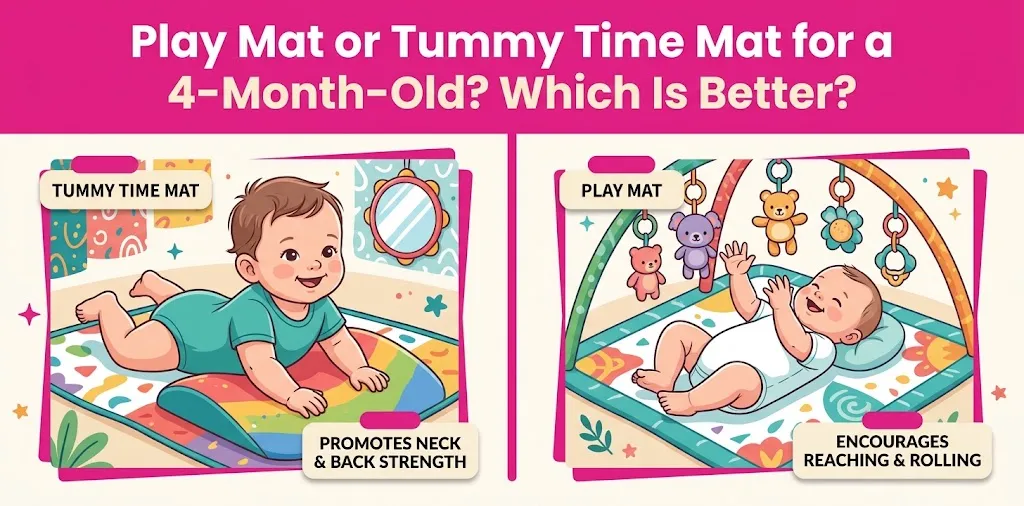
For a 4-month-old, a play mat is usually the better choice if you want one mat for everyday floor play and tummy time. A tummy time mat can be useful when it offers a firm, comfortable, easy-to-clean surface, but “tummy time mat” is often more of a marketing term than a separate type of baby product. At this age, the key is a safe floor surface that lets your baby move, reach, roll, and practice pushing up.
What matters most at 4 months
At 4 months, babies are becoming much more active. The CDC lists supporting themselves on their elbows and wrists during tummy time and rolling from tummy to back among typical 4-month movement milestones.
That makes floor play especially useful. Your baby may spend some play sessions looking at toys, reaching for objects, kicking, practicing tummy time, or trying to roll.
The mat itself does not create these developmental benefits. The opportunity to move and interact with you and safe toys is what matters.
What is the difference between a play mat and a tummy time mat?
The names can be confusing because there is a lot of overlap.
| Feature | Play Mat | Tummy Time Mat |
|---|---|---|
| Main purpose | General floor play | Tummy time and floor practice |
| Tummy time | Yes | Yes |
| Back play | Yes | Usually |
| Reaching for toys | Yes | Yes |
| Rolling practice | Yes | Yes |
| Toy arches | Common on some designs | Sometimes |
| Portability | Depends on design | Often designed to be easy to move |
| Best for | Longer-term everyday play | Families focused on tummy time |
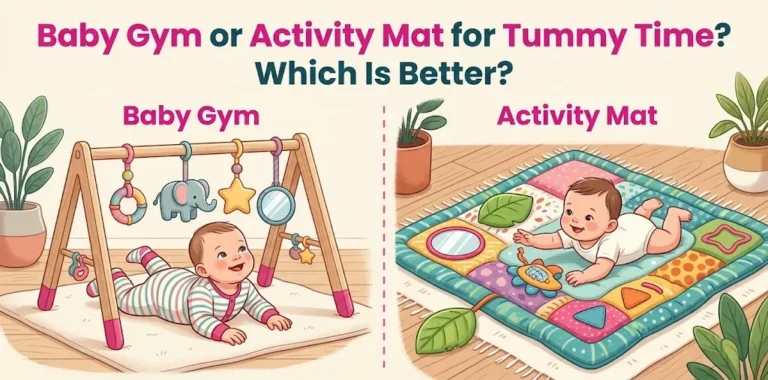
A play mat is generally broader in purpose. It can support tummy time, back play, reaching, grabbing, and early rolling.
A tummy time mat is usually marketed around supervised tummy time. But if both products provide a clean, stable surface for awake floor play, there may not be a major developmental difference between them.
This is why you should look at the actual design and safety features, rather than choosing based only on the product name.
Which one is better for a 4-month-old?
For most families, I would choose a flat play mat that works well for tummy time.
At 4 months, your baby is likely to benefit from having room to move in several positions rather than using a mat for only one activity. The American Academy of Pediatrics recommends supervised tummy time and also encourages babies to have opportunities to stretch, kick, reach, and interact during play.
A good everyday mat can give your baby one consistent place for:
- Tummy time
- Reaching for toys
- Kicking and stretching
- Practicing rolling
- Looking at hanging toys
- Playing with you on the floor
- Exploring different textures
So if you’re buying just one product, a versatile play mat is usually the more practical choice.
Why tummy time is important at 4 months
Tummy time is not simply about keeping a baby entertained. It gives babies a chance to use muscles in their neck, shoulders, arms, and trunk while they are awake and supervised.
By around 4 months, many babies are becoming stronger during tummy time and may push up on their elbows or wrists.
A mat can make this easier by providing a dedicated place for floor activities.
You can place a safe toy just within reach so your baby has a reason to lift their head, look forward, reach, or shift their weight. The AAP also suggests placing toys around a baby during tummy time to encourage reaching in different directions.
The goal isn’t to make your baby stay on their stomach for a long stretch. Short, enjoyable sessions throughout the day can be easier for babies who still become frustrated during tummy time.
What should you look for in a mat for a 4-month-old?
You don’t need a mat packed with features. A few practical characteristics matter more.
A firm, stable surface
The mat should stay reasonably stable on the floor and give your baby a surface they can push against.
An extremely soft or unstable surface can make movement harder. For tummy time, a baby needs to be able to use their arms and legs rather than simply sinking into a cushioned surface.
Enough room to move
At 4 months, your baby may soon become much more mobile.
A small mat can work for early tummy time, but a larger play area can be more useful as your baby starts rolling and moving around.
You don’t necessarily need an enormous mat. Just make sure there is enough space for your baby to stretch, reach, and roll without immediately reaching the edge.
Easy cleaning
Babies spend a lot of time putting their hands and other objects in their mouths.
Spit-up, drool, milk, and diaper-related messes can also end up on the mat. A surface that can be wiped or cleaned easily is much more practical than a beautiful mat that is difficult to maintain.
Simple toys that encourage movement
A few age-appropriate toys can make floor play more interesting.
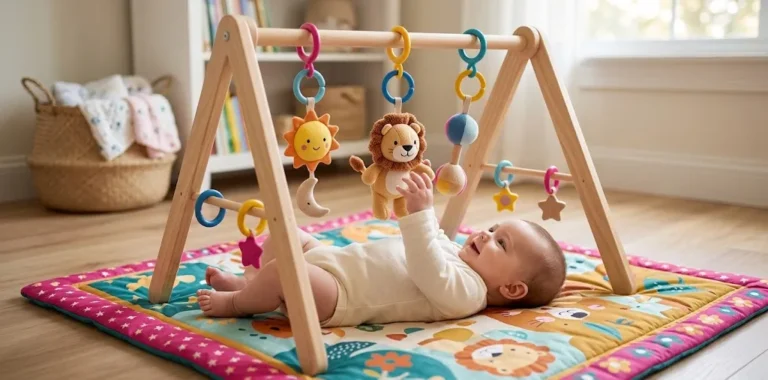
A play gym with toys hanging overhead can encourage your baby to look, reach, kick, and grab. The AAP specifically notes that play mats with suspended toys can give babies opportunities to kick and reach.
You don’t need dozens of toys. Sometimes your face, voice, or a single interesting toy is enough to encourage movement.
A surface without unnecessary raised parts
Be cautious with products that surround the baby with large cushions, pillows, or raised supports.
A tummy time surface should be used for awake, supervised play, not as a place to leave your baby unattended.
Play mat features that are useful at 4 months
If you’re comparing several play mats, prioritize features based on how your baby actually plays.
| Feature | How useful is it? | Why |
|---|---|---|
| Flat play surface | Very useful | Supports different types of floor play |
| Easy-clean material | Very useful | Babies make frequent messes |
| Non-slip design | Useful | Helps keep the mat in place |
| Hanging toys | Useful | Encourages looking, reaching, and grabbing |
| High-contrast patterns | Useful | Gives babies something interesting to look at |
| Very thick cushioning | Not essential | More cushioning isn’t automatically better for movement |
| Many attached toys | Optional | A few engaging toys may be enough |
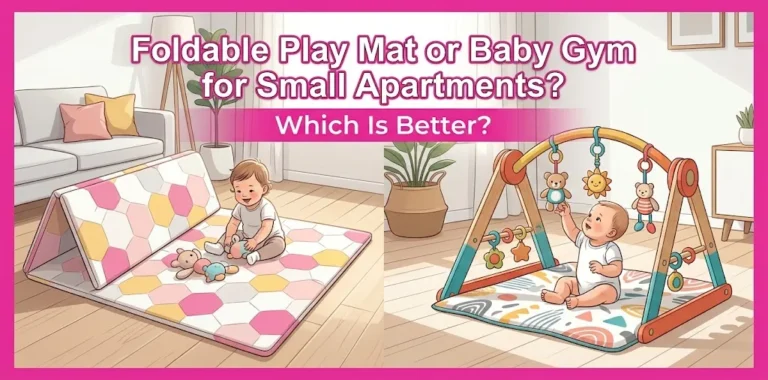
| Foldable design | Convenient | Helpful if you store or move the mat often |
The right choice depends more on surface, size, stability, cleaning, and useful play features than on whether the package calls it a “play mat” or “tummy time mat.”
Two real-life buying situations
Imagine a parent has a 4-month-old who spends several short periods playing on the living-room floor each day. The baby enjoys looking at hanging toys, reaching, and practicing tummy time. A play mat with a flat surface and a small toy arch would probably make more sense than buying a product designed only around tummy time.
Now consider a baby who dislikes tummy time and quickly becomes frustrated. Buying a more specialized mat may not solve the problem by itself. The parent may get better results by getting down at the baby’s level, talking to the baby, placing a favorite safe toy nearby, or using other supervised positions such as tummy-to-tummy play. The AAP recommends several ways to make tummy time more enjoyable.
Do you need a special tummy time mat?
No. A special tummy time mat is not required.
Tummy time can take place on a clean floor, a suitable mat, or another appropriate firm surface while the baby is awake and closely supervised. The AAP specifically describes a clean floor, nap mat, or secured blanket as possible surfaces for tummy time.
That means you shouldn’t feel that you need to buy an expensive product just because it says “tummy time” on the packaging.
If a regular play mat provides a suitable surface and gives your baby enough room to move, it can serve the same basic purpose for tummy time.
Is a soft play mat safe for tummy time?
A cushioned mat can be comfortable, but softer is not automatically better.
Your baby needs a surface that allows them to push with their arms and move their body. More importantly, tummy time should happen while your baby is awake and supervised.
Do not use a play mat as a sleeping surface. The AAP recommends that babies sleep on their backs on a firm, flat sleep surface, and it distinguishes supervised tummy time from safe sleep.
If your baby falls asleep during tummy time, move them to an appropriate sleep surface and place them on their back.
How to use a play mat for tummy time at 4 months
You can make the mat more useful without turning playtime into a complicated routine.
Start by placing your baby on their tummy while they are awake and supervised. Get down near their face and talk or smile at them.
Then try placing a safe toy slightly in front of them. As your baby becomes interested, they may lift their head, push through their arms, or reach toward the toy.
You can also move the toy slightly to one side to encourage your baby to turn and look.
The AAP recommends varying positions during play and suggests activities such as tummy-to-tummy, lap time, and supported side-lying for babies who need alternatives to traditional tummy time.
What should you avoid when choosing a baby mat?
The biggest mistake is focusing on entertainment features while ignoring how the baby will actually use the mat.
Be cautious about:
- Mats with unstable or easily shifting surfaces
- Products with loose pieces within the baby’s reach
- Excessively thick or deeply cushioned surfaces that make movement difficult
- Raised pillows or positioning features that could interfere with safe use
- Products marketed for both play and sleep without clearly meeting the appropriate sleep requirements
Also check the manufacturer’s age recommendations and inspect the mat and attached toys regularly for damage.
A mat should be a place where you can actively interact with your baby, not a product that replaces supervision.
Play mat vs. tummy time mat: the final choice
For a 4-month-old, choose the play mat if you want one versatile surface for tummy time and everyday floor play.
A dedicated tummy time mat can still be a good purchase if you specifically like its size, surface, portability, or design. But you don’t need the “tummy time” label to support tummy time.
The more useful question is: Can my baby safely lie, move, reach, push, and eventually roll on this surface while I supervise?
If the answer is yes, the mat is doing its job.
Frequently Asked Questions
Can a 4-month-old use a play mat for tummy time?
Yes. A suitable play mat can provide a surface for supervised tummy time as well as other floor activities. At 4 months, babies are developing skills such as pushing up on their elbows or wrists and beginning to roll.
Is a tummy time mat better than a regular play mat?
Not necessarily. A tummy time mat may be designed with tummy-time activities in mind, but a good play mat can also support tummy time, reaching, kicking, and rolling. For most families, a versatile mat is the more practical one-mat option.
Can a baby sleep on a play mat after tummy time?
No. A play mat should not be treated as a sleep surface simply because a baby can safely play on it while awake. For sleep, the AAP recommends placing babies on their backs on a firm, flat, appropriate sleep surface.
The Bottom Line
For most 4-month-olds, a good play mat that works well for tummy time is the better overall choice. It gives your baby room to practice tummy time while also supporting reaching, kicking, grabbing, rolling, and interactive floor play.
When choosing one, focus less on the product label and more on the basics: a stable surface, enough room to move, easy cleaning, age-appropriate toys, and safe supervised use.