Baby Play Mat or Activity Gym for Small Spaces? Which Is Better?

For a small home, an activity gym is usually the better choice for very young babies, because it combines a compact play surface with hanging toys and often folds for storage. A baby play mat becomes more useful as your baby starts rolling, reaching, sitting, and crawling because it gives them more open floor space. The best choice depends on your baby’s age and how much floor space you have.
Baby Play Mat vs. Activity Gym: What’s the Difference?
The two products overlap, but they are designed around different types of play.
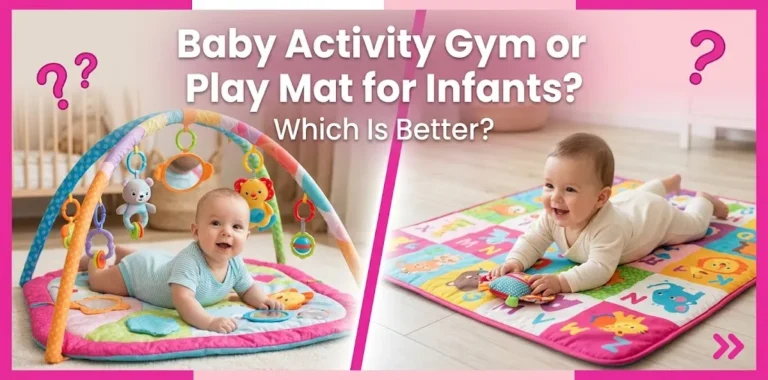
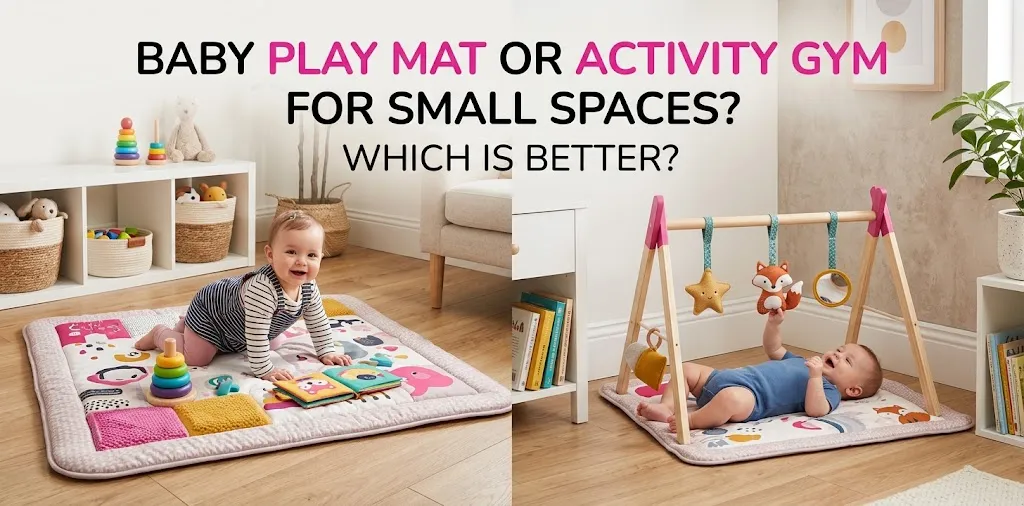
A baby play mat is mainly an open, padded surface where your baby can spend supervised floor-play time. It gives babies room to move their arms and legs, practice tummy time, roll, sit, and eventually crawl.
An activity gym usually has a smaller mat with one or more arches positioned above the baby. Those arches hold toys, mirrors, rattles, or other objects that encourage the baby to look, reach, kick, and interact.
For a small apartment, nursery, or living room, that difference matters. An activity gym uses vertical space for toys, while a play mat uses more horizontal floor space.
| Feature | Baby Play Mat | Activity Gym |
|---|---|---|
| Floor space | Usually needs more open floor area | Usually more compact |
| Best for | Open-ended floor play | Interactive play with hanging toys |
| Tummy time | Excellent | Good, depending on mat size |
| Reaching and kicking | Good | Excellent |
| Rolling practice | More room | More limited |
| Crawling practice | Better | Usually outgrown sooner |
| Storage | Some fold or roll | Many are designed to fold |
| Best for very small spaces | Good if compact | Usually better |
| Long-term usefulness | Often longer | Often strongest during early months |
Neither option is automatically better for every baby. The more useful question is what your baby will be doing during play and how much floor space you can give up.
When an Activity Gym Makes More Sense in a Small Space
An activity gym can be a smart choice when your baby is still in the early stages of floor play.
The hanging toys give your baby something interesting to look at and reach toward without requiring a large play area. A compact gym can also be easier to place beside a sofa, in a bedroom, or in another part of a small living space.
This is especially useful if you want one dedicated play station that can be packed away when adults need the room.
Best for younger babies
For a young baby who mostly lies on their back, kicks, reaches, and begins tummy time, an activity gym can provide plenty of stimulation without taking over the room.
You can place toys at different positions around the baby during supervised play so they have reasons to look and reach in different directions. The American Academy of Pediatrics recommends supervised tummy time while babies are awake, beginning soon after coming home and gradually increasing it as the baby gets stronger.
A good option when storage is limited
Small-space parents often have to think about where a baby product will go when it is not being used.
A foldable activity gym can be easier to store behind a sofa, under suitable furniture, or in a closet than a large play mat. However, check the product’s folded dimensions rather than assuming every gym is compact.
When a Baby Play Mat Is the Better Choice
A play mat becomes more attractive when your baby’s movements start extending beyond the space directly underneath an activity gym.
Rolling, pivoting, sitting, reaching for toys, and eventually crawling all benefit from having open floor space.
Better for growing movement
An open mat lets you place toys around your baby instead of keeping everything above them. You can put a toy slightly to one side to encourage reaching or place toys around the baby during supervised tummy time.
The AAP notes that placing toys around a baby during tummy time can encourage reaching and help babies work the muscles used for rolling, scooting, and crawling.
This makes a play mat particularly useful if you want one surface that can continue supporting different types of floor play as your baby becomes more mobile.
Better if you want one larger play area
If your small room can accommodate a compact mat, it may provide more usable play space than an activity gym.
A simple mat can also be paired with a few favorite toys rather than relying on an attached arch. That can make the setup feel less crowded in a small room.
Which One Uses Less Space?
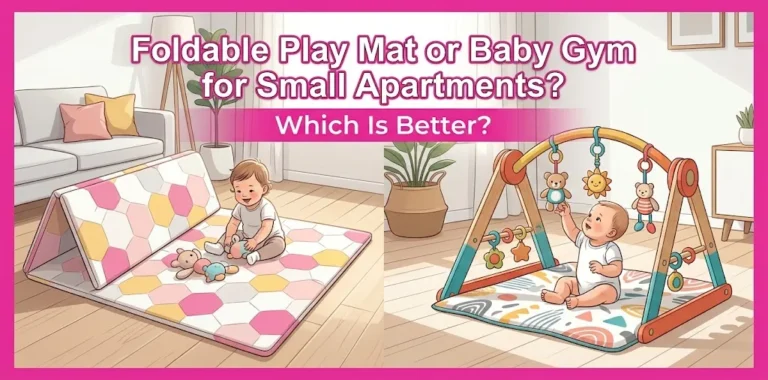
If floor space is your biggest concern, an activity gym will usually have the smaller footprint, but product dimensions vary.
Do not judge the space requirement by the product’s appearance alone. Measure the actual floor area you have available, including enough surrounding space for you to sit beside your baby.
For example, imagine a family living in a small one-bedroom apartment. If the only available play area is a narrow section beside the couch, a compact activity gym may fit better than a large rectangular mat.
On the other hand, if there is a small open area that can stay clear during the day, a foldable play mat may provide more useful room for movement.
The key is to measure both the product’s footprint and its storage size before buying.
What Should You Look for in a Small-Space Baby Play Mat?
A smaller mat does not automatically mean a better mat. Look for features that make the product practical without taking up unnecessary room.
Compact dimensions
Measure the area where the mat will actually be used. A mat that looks small in an online photo may occupy much more floor space than expected.
Easy storage
If you need to clear the room frequently, a mat that rolls or folds can be more practical than one that stays permanently on the floor.
A stable surface
The mat should stay reasonably stable during supervised play rather than sliding around every time your baby moves.
Easy cleaning
Baby play surfaces can quickly become messy. A surface that is easy to wipe or clean can be much more practical than a complicated design with areas that trap dirt.
Room for movement
Do not choose a mat so small that your baby quickly reaches the edge while rolling or practicing tummy time. A compact design is useful, but there is a point where making the mat smaller reduces its value.
What Should You Look for in a Small-Space Activity Gym?
If an activity gym is your preferred option, focus on how much useful play it provides for its footprint.
Removable toys
Removable toys can give you more flexibility. You can change what your baby sees and interacts with without needing another large play product.
Foldable design
A folding frame can make a significant difference in a small home. Check how easily it folds and where you will store it.
A usable play surface
The mat underneath the gym still matters. It should give your baby enough room for comfortable supervised floor play.
Toys that encourage reaching
Hanging toys should be positioned where your baby can safely look toward and reach for them during awake, supervised play.
Simple construction
In a small room, a complicated gym with many permanently attached parts can create more visual and physical clutter than necessary. A simpler design may be easier to use and store.
What About Tummy Time?
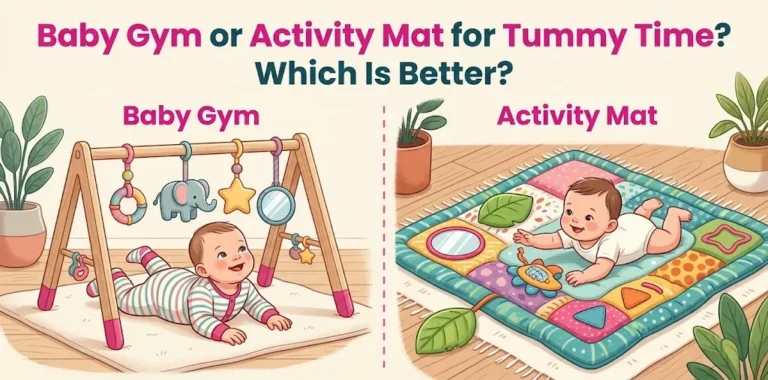
Both products can work for tummy time, but the play surface matters more than whether the product is called a gym or a mat.
Tummy time should take place when your baby is awake and closely supervised. The AAP recommends starting tummy time early and gradually building up the amount as the baby becomes more comfortable and stronger.
A play mat can be especially useful because it gives your baby more room to move during tummy time. An activity gym can also work well, particularly when its toys give your baby something interesting to look toward or reach for.
You do not need an elaborate setup. A clean, suitable floor surface and your interaction with the baby are important parts of play.
What About Safety in a Small Space?
Small rooms can create safety issues that have nothing to do with the product itself.
Keep the play area away from dangling cords, unstable furniture, heaters, stairs, and other hazards. Also check the manufacturer’s instructions for age, assembly, cleaning, and toy attachment.
Most importantly, a play mat or activity gym is a play product, not a sleep surface.
If your baby falls asleep during play, follow safe-sleep guidance rather than treating the mat or gym as a place for routine sleep. The AAP recommends placing babies on their backs for sleep on a firm, flat, non-inclined sleep surface and keeping soft objects and loose bedding out of the sleep area.
Which Is Better for Different Baby Stages?
Your baby’s current movement skills can help settle the decision.
| Baby’s stage | Better fit | Why |
|---|---|---|
| Mostly lying and looking around | Activity gym | Hanging toys provide visual and reaching activities |
| Starting tummy time | Either | Both can provide a suitable supervised play surface |
| Reaching and kicking | Activity gym | Overhead toys encourage interaction |
| Rolling | Play mat | More open floor space gives room to move |
| Sitting | Play mat | More room for toys around the baby |
| Pivoting or scooting | Play mat | Open space becomes more useful |
| Crawling | Larger play mat or open safe floor area | Baby needs room to move |
This does not mean you need to replace an activity gym as soon as your baby develops a new skill. It simply means that its value may change as your baby’s movement becomes more active.
Two Small-Space Setups That Can Work
A practical setup depends on how your home is arranged.
Setup 1: Very limited floor space
Suppose your living room has only a small open section between the couch and a table.
An activity gym may make more sense because it gives a young baby a defined place to play without requiring a large rectangular area. When playtime is over, you can fold it and put it away.
Setup 2: Small room with one open floor area
Suppose you have a modest section of open floor that can remain clear during the day.
A compact play mat may be the better long-term choice. You can start with a few toys and later use the same surface for rolling, sitting, reaching, and crawling activities.
The important difference is not simply the room’s total size. It is how much uninterrupted floor space you can realistically dedicate to baby play.
Do You Need Both?
Not necessarily.
If you have enough room and your budget allows it, using both can be convenient. An activity gym can provide focused early play, while a play mat gives your baby more room as movement develops.
But small-space parents do not need to buy both just because they serve slightly different purposes.
If you must choose one, consider your baby’s current stage and what you expect to use most over the coming months.
For a younger baby with very limited floor space, an activity gym is often the more practical starting point.
For a baby who is already rolling or becoming more mobile, a play mat usually offers more useful space.
Frequently Asked Questions
Is a play mat or activity gym better for a small apartment?
An activity gym is usually easier to fit into a very small area because it combines a compact mat with vertical toys. However, a foldable play mat can be the better choice if your baby is already rolling or becoming mobile and needs more open floor space.
Can a baby use an activity gym for tummy time?
Yes. An activity gym can provide a suitable place for supervised tummy time when the baby is awake and the product is appropriate for the baby’s age and use. A larger open mat may become more useful as the baby starts rolling, scooting, and moving around more.
How do I choose between a baby play mat and activity gym?
Start with your available floor space and your baby’s current movement stage. Choose an activity gym if compact interactive play is your main need; choose a play mat if you want more room for rolling, sitting, tummy time, and later movement.
The Bottom Line
For very small spaces and younger babies, an activity gym is usually the better space-saving choice. It gives a baby opportunities to look, reach, kick, and interact without requiring a large floor area.
A baby play mat is the better choice when movement and usable floor space become more important. If your baby is already rolling or starting to move around, the extra open area can be more valuable than overhead toys.
Before buying, measure your available floor space, check the product’s storage dimensions, and think about what your baby is likely to do during play over the next few months. For most small homes, choosing the product that matches your baby’s current stage is more useful than simply choosing the smallest option.