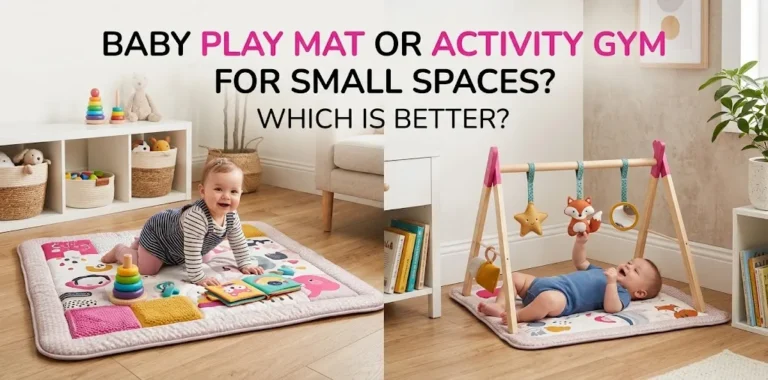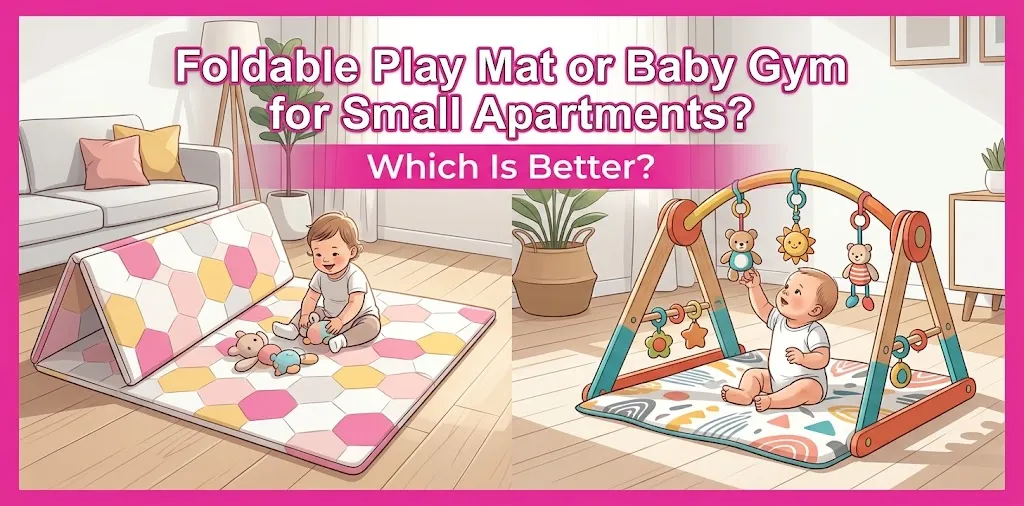
Foldable Play Mat or Baby Gym for Small Apartments? Which Is Better?

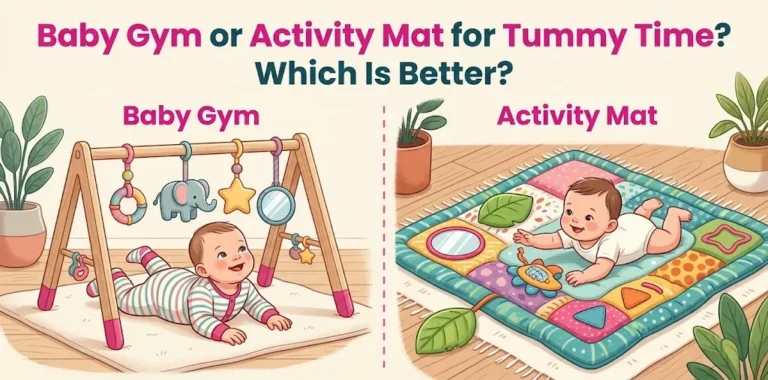
If you live in a small apartment, a foldable play mat is usually the better long-term choice because it gives your baby more usable floor space and can be stored when you need the room back. A baby gym is more compact and engaging for younger infants, but its smaller play area and overhead toys make it less useful as your baby starts rolling, sitting, and crawling.
The right choice depends mostly on your baby’s age, how much floor space you have, and whether you need a product for short, focused play sessions or a larger area that can grow with your baby.
Foldable Play Mat vs. Baby Gym at a Glance
| Feature | Foldable Play Mat | Baby Gym |
|---|---|---|
| Best for | Tummy time, rolling, sitting, crawling | Reaching, kicking, sensory play |
| Floor space | Usually larger | Usually smaller |
| Storage | Folds for storage | Often folds or collapses |
| Small apartment | Very good if storage space is available | Excellent |
| Newborn use | Good with appropriate supervision | Good for supervised play |
| Crawling stage | Better | Usually less useful |
| Toy stimulation | Depends on toys you add | Usually built in |
| Long-term usefulness | Generally longer | Often strongest in early months |
| Cleaning | Depends on material | Usually requires cleaning the mat and toys |
| Best reason to choose it | Flexible play area | Compact activity center |
The key difference is simple: a baby gym is mainly an activity station, while a play mat is a floor space your baby can keep using as mobility increases.
When a Foldable Play Mat Is Better
A foldable play mat makes more sense if your biggest problem is limited floor space but you still want enough room for your baby to move.
Unlike a permanent play surface, a foldable mat can be opened when your baby is playing and stored against a wall, under furniture, or in a closet afterward, depending on its folded size. Parents discussing small homes often point to this ability to reclaim floor space as one of the main reasons they prefer foldable designs.
A mat also becomes more useful as your baby develops.
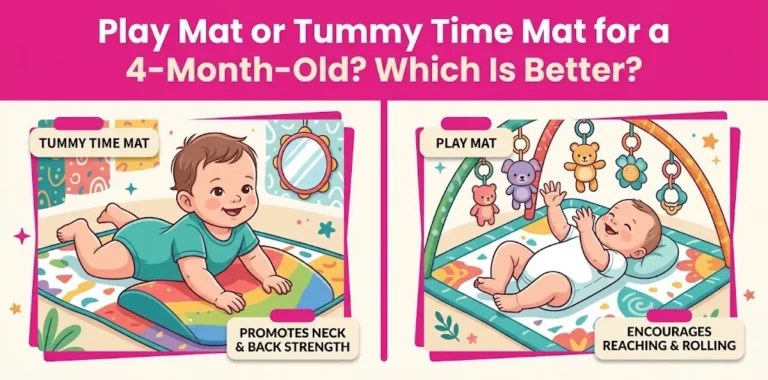
For example, a young baby may use it for tummy time. A few months later, the same space can be used for rolling, sitting, reaching for toys, and eventually crawling.
That makes a foldable mat particularly useful when you do not want to buy several different floor products as your baby’s abilities change.
It gives your baby more room to move
A baby gym generally concentrates play around a central frame or hanging toys. That can be great when a baby is mostly lying on their back.
Once your baby starts rolling and moving toward toys, however, a larger open surface becomes more useful.
A foldable mat can give you a defined play area without requiring you to dedicate an entire room to baby gear.
It works well on hard apartment floors
If your apartment has hardwood, laminate, vinyl, or tile floors, cushioning can make floor play more comfortable.
The important thing is not simply choosing the thickest mat available. Look at how stable it feels, whether it stays reasonably flat, and whether the surface is suitable for your baby’s activities.
A very soft or unstable surface is not automatically better.
It can remain useful beyond the early infant stage
This is one of the biggest advantages of a play mat.
As your baby progresses from tummy time to sitting and crawling, the mat can remain the base for age-appropriate toys and supervised floor play.
That gives it an advantage over a baby gym if you are trying to buy one space-saving item rather than a short-term activity product.
When a Baby Gym Is Better
A baby gym can be the smarter choice when your baby is young and you have very little room for baby gear.
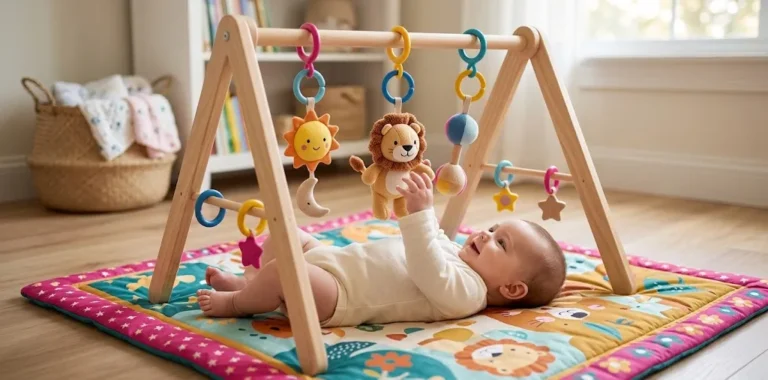
Most baby gyms combine a padded floor area with arches, hanging toys, mirrors, textures, or other activities. That gives a young baby things to look at, reach toward, kick, and explore while lying on the mat.
For a small apartment, the compact footprint can be a major benefit.
You can set it up for supervised play and then fold or move it away when you need the floor for another purpose. Small-space parents frequently mention this type of easy storage when discussing baby gyms and activity mats.
It can provide more stimulation without extra toys
With a plain play mat, you may need to add toys separately.
A baby gym often comes with activities already attached. That can make it convenient for parents who want an all-in-one setup for a young infant.
It is especially useful when your baby enjoys looking at hanging objects or reaching toward toys during floor play.
It takes up less usable floor area
If your apartment is extremely small, even a folded play mat may be awkward to store.
A compact baby gym may be easier to set up temporarily, especially if your baby is still mostly staying in one place.
That is why the smallest apartment does not automatically mean “buy a play mat.” Storage size matters just as much as the unfolded footprint.
Which One Is Better at Different Baby Ages?
Your baby’s developmental stage can change the answer.
| Baby’s stage | Better starting choice | Why |
|---|---|---|
| Young infant | Baby gym or small play mat | Reaching, kicking, looking and supervised tummy time |
| Rolling | Foldable play mat | More open space for movement |
| Sitting | Foldable play mat | Room for toys around the baby |
| Crawling | Foldable play mat | More useful open floor area |
| Highly mobile baby | Larger foldable mat | Baby needs more room to move |
This does not mean a baby gym suddenly becomes unsafe or useless at a particular age. It means its main advantage—stationary, overhead activity—becomes less important as your baby becomes more mobile.
Always follow the product’s age guidance and use it as directed.
What Matters Most in a Small Apartment
When space is tight, do not judge a product only by its unfolded size.
Consider the entire setup.
Measure the storage space first
Before buying, measure the place where you actually plan to store the product.
For a foldable mat, check:
- Folded length
- Folded width
- Folded thickness
- Weight
- Whether it can stand vertically
- Whether it fits under a bed or sofa
- Whether folding it requires removing anything
A mat that fits perfectly on your floor but has nowhere to go afterward is not a great small-apartment solution.
Consider how quickly you can put it away
Small apartments often have rooms serving several purposes.
Your living room might be a play area in the afternoon and a dining or relaxation space later.
A product that takes only a short time to fold and store can therefore be more practical than one that technically takes up little space but requires several steps to disassemble.
Think about the floor underneath
Hard flooring makes cushioning more important for comfort.
Carpeted flooring may change what you need from the mat.
Also consider whether the surface slides when your baby moves around. A play mat should remain stable enough for its intended use.
Look at cleaning
Babies drool, spit up, and eventually make plenty of everyday messes.
A wipe-clean surface can be especially convenient in an apartment because you may not have room to keep a large washable cover or multiple cleaning accessories.
Check the manufacturer’s cleaning instructions rather than assuming a material is machine washable or waterproof.
A Foldable Mat Does Not Have to Stay Fully Open
One useful feature for apartment living is flexibility.
If the mat is designed to fold into several sections, you may be able to use only part of the available floor area in some situations.
For example, a parent might open the mat fully during crawling practice but use a smaller section when the baby is younger.
The exact setup depends on the product, so do not assume every folding mat can be safely used in every partially folded configuration.
Two Small-Apartment Scenarios
Imagine a family living in a one-bedroom apartment where the living room also serves as the main play and relaxation area.
If the baby is three months old and mostly enjoys reaching for hanging toys, a compact baby gym may make sense. It provides stimulation without requiring much floor space.
Now imagine the same family six months later. The baby is rolling, sitting, and trying to crawl. The larger open area of a foldable mat becomes more useful because the baby is no longer staying underneath a toy arch.
Another example is a family with a slightly larger living room but almost no closet space. In that case, a compact baby gym may actually be easier to live with than a large foldable mat, even if the mat offers more play space.
Storage space can matter as much as play space.
What Should You Choose?
For most families trying to make one purchase for a small apartment, I would lean toward a foldable play mat.
Choose it if you want:
- A larger area for movement
- Something that can support different stages of development
- A surface for tummy time and floor play
- More room for toys
- The ability to clear the floor after playtime
Choose a baby gym instead if:
- Your baby is still very young
- Your floor space is extremely limited
- You want built-in hanging activities
- You prefer a smaller activity station
- Storage space for a larger mat is difficult
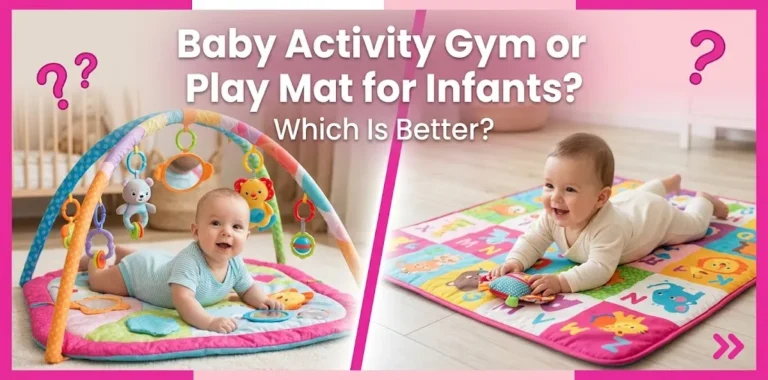
If your budget allows for both, they do not necessarily compete. A compact baby gym can sit on top of a foldable play mat, giving you a larger base with a focused activity area.
Safety Considerations for Apartment Play
A play mat or baby gym does not make the entire surrounding area safe.
Before putting your baby down, check the nearby space for hazards such as accessible cords, unstable furniture, small objects, stairs, heaters, and other items your baby could reach.
As babies become more mobile, the safe area needs to change with them.
Also inspect the product regularly. Stop using it if parts are damaged, loose, broken, or no longer function as intended. Follow the manufacturer’s instructions for assembly, cleaning, age range, and use.
A larger mat can give your baby more room, but it also means the baby can travel farther from where you originally placed them.
The Best Small-Apartment Choice Depends on Your Biggest Constraint
If floor space during play is the problem, a foldable play mat usually wins.
If storage space and overall footprint are the bigger problems, a baby gym may be easier to live with.
For a very young baby, the baby gym has a strong convenience advantage. For a baby who is beginning to roll, sit, and crawl, the foldable mat usually becomes more valuable.
The most practical approach is to measure both your available play area and your storage spot before buying. That simple step can prevent you from choosing something that looks compact online but becomes difficult to live with in a small apartment.
Frequently Asked Questions
Is a foldable play mat better than a baby gym for a small apartment?
A foldable play mat is generally better if you want a play surface that can remain useful as your baby becomes more mobile. A baby gym can be better when your baby is younger and you need a smaller, activity-focused setup.
Can you use a baby gym on a foldable play mat?
Yes, many families can use a baby gym on top of a suitable play mat, provided the products are compatible and the setup is stable. Follow the instructions for both products and keep the surrounding area clear of hazards.
What size play mat is best for a small apartment?
There is no single ideal size because apartment layouts vary. Measure the area where you plan to use the mat and, more importantly, measure where you will store it when folded so the product works for both playtime and everyday living.
Final Takeaway
For most small-apartment families, a foldable play mat is the better long-term choice, while a baby gym is the better compact option for focused play during the early months.
If you can only buy one, think beyond today’s floor space. Choose the product that fits your storage area, baby’s current stage, and expected movement over the next several months.