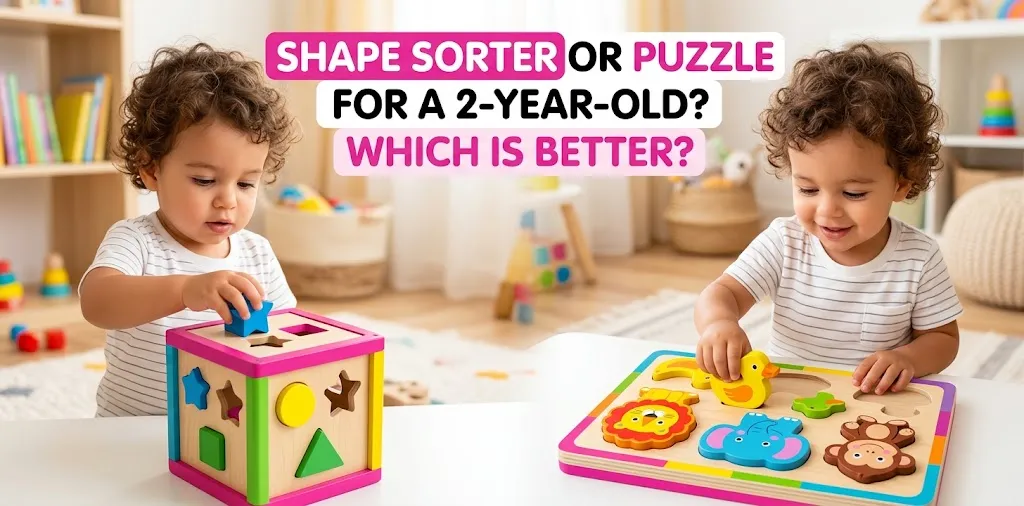
Shape Sorter or Puzzle for a 2-Year-Old? Which Is Better?

For most 2-year-olds, both can be useful, but the better choice depends on the child’s current skills. A shape sorter is often easier for a beginner who is still learning shapes and hand control. A simple puzzle may be better for a child who already enjoys matching objects and can stay focused on a task.
At age 2, children are beginning to understand relationships between objects and can learn through activities such as matching shapes and working with simple puzzles.
The Main Difference Between a Shape Sorter and a Puzzle
A shape sorter asks your child to recognize a shape, turn it, and fit it into the correct opening. The focus is mainly on shapes, spatial awareness, and hand-eye coordination.
A simple toddler puzzle usually asks your child to match a piece to one specific place. The child may use the picture, color, outline, and shape of the piece to figure out where it belongs.
| Feature | Shape Sorter | Simple Puzzle |
|---|---|---|
| Main challenge | Matching shapes to openings | Matching pieces to the correct place |
| Best for | Early shape recognition | Matching and problem-solving |
| Fine motor skills | Yes | Yes |
| Spatial thinking | Strong focus | Strong focus |
| Attention needed | Usually less | Often more |
| Beginner-friendly | Often easier | Depends on puzzle difficulty |
| Good for independent play | Yes | Yes, with simple designs |
Neither toy is automatically better. The best choice is the one that gives your child a manageable challenge without causing too much frustration.
Choose a Shape Sorter If Your Child Is Still Learning the Basics
A shape sorter is usually a good choice when a 2-year-old:
- Is still learning basic shapes such as circles, squares, and triangles
- Enjoys putting objects into containers or openings
- Gets frustrated with activities that require precise matching
- Has limited experience with puzzles
- Likes repeating the same activity many times
Shape sorters give children hands-on practice with how objects fit into spaces. They can turn, compare, test, and try again. This type of play supports early spatial thinking and gives parents natural opportunities to talk about shapes and positions.
For example, imagine a child holding a square block and trying to place it into several openings. They may discover that turning the block changes how it fits. That trial-and-error process is part of the learning.
What to Look for in a Shape Sorter
For many 2-year-olds, a good option has:
- Large, easy-to-hold pieces
- Clearly different shapes
- Smooth edges
- A simple design
- An appropriate age recommendation from the manufacturer
Avoid assuming that more shapes automatically make a toy better. A sorter that is too complicated may become frustrating, especially for a child who is just beginning.
Choose a Puzzle If Your Child Already Enjoys Matching
A simple puzzle may be the better choice if your child:
- Already understands basic matching
- Can sit with an activity for a few minutes
- Enjoys looking at pictures of animals, vehicles, or familiar objects
- Has used a shape sorter successfully
- Likes figuring out where things belong
Puzzles can ask for more precise matching because each piece usually has one correct location. A child may need to look closely at the picture and the outline before placing the piece.
For a newly turned 2-year-old, a very simple puzzle with large pieces or knobs may be easier than a traditional multi-piece jigsaw. As children gain confidence, they can gradually move to more complex puzzles. Current toddler toy guides commonly recommend starting with simple, age-appropriate designs rather than jumping immediately to difficult jigsaws.
For example, a child who can quickly complete a basic shape sorter may enjoy a puzzle featuring three familiar animals. The picture gives an extra clue, making the activity different from simply fitting geometric shapes into holes.
For Most 2-Year-Olds, Skill Level Matters More Than Age
“2 years old” covers a surprisingly wide range of development.
A child who turned 2 last week may have very different interests and abilities from a child who will turn 3 in a few months. That is why the number on the birthday cake should not be your only guide.
A useful way to decide is to watch what your child already does during play.
A younger or less experienced 2-year-old may prefer:
- Simple shape sorters
- Large pieces
- Basic shapes
- Easy matching activities
- Toys with quick, clear results
A more experienced 2-year-old may prefer:
- Simple knob puzzles
- Large-piece frame puzzles
- Familiar pictures
- Activities with several matching steps
- Slightly more challenging problem-solving
The goal is not to find the toy with the most educational claims on the package. The goal is to find one your child can enjoy while still having something new to learn.
Which Toy Builds More Skills?
Both toys support several similar skills, but they emphasize them differently.
Shape sorters are especially useful for:
- Shape recognition
- Spatial awareness
- Hand-eye coordination
- Object rotation
- Trial-and-error problem-solving
Puzzles are especially useful for:
- Visual matching
- Fine motor control
- Attention and concentration
- Problem-solving
- Recognizing pictures and patterns
The American Academy of Pediatrics’ HealthyChildren.org notes that around age 2, children can begin matching similar shapes with activities such as shape sorting toys and simple jigsaw puzzles.
So, instead of asking which toy develops more skills, it is often better to ask:
Which skills does my child need to practice next?
The Best Choice for Different Types of 2-Year-Olds
Here is a simple decision guide.
Choose a shape sorter first if: your child is new to matching toys, enjoys putting objects into containers, or is still learning basic shapes.
Choose a simple puzzle first if: your child already matches objects well, enjoys pictures, and can handle a slightly more precise challenge.
Consider having both if: your child enjoys hands-on activities and you want two different types of quiet, screen-free play.
You also do not need to buy expensive versions. A simple, sturdy, age-appropriate toy can provide plenty of opportunities for learning and repeated play.
How to Help Your Child Without Doing the Activity for Them
One common mistake is solving the toy for the child too quickly.
Instead of immediately saying, “Put it there,” try giving them time to experiment.
You can use simple language such as:
- “Let’s turn it.”
- “Does this one fit?”
- “You found the circle!”
- “Try another way.”
- “That piece goes with the dog.”
This keeps the activity playful while adding language and encouragement.
If your child becomes upset, simplify the challenge. You might remove some pieces, demonstrate one move, and then let your child try again.
A toy should offer some challenge, but constant frustration is usually a sign that it may be too difficult right now.
Safety Matters When Choosing Either Toy
Always check the manufacturer’s recommended age range and inspect the toy before giving it to a toddler.
Look for:
- Pieces large enough to be safe for the child’s age
- No loose or damaged parts
- Smooth surfaces without sharp edges
- Strong construction
- Non-toxic materials and finishes where applicable
Young children can be rough with toys, so inspect wooden pieces, plastic parts, and attachments regularly.
Frequently Asked Questions
Choosing the right learning toy for a 2-year-old can bring up a few questions. Here are answers to common questions parents have about shape sorters, simple puzzles, and which option may best match their child’s current skills.
Should a 2-year-old be able to complete a puzzle?
Some 2-year-olds can complete very simple puzzles, while others need more time and practice. Start with large, easy-to-handle pieces and increase the difficulty gradually based on your child’s interest and ability.
Is a shape sorter too easy for a 2-year-old?
Not necessarily. A shape sorter can still be useful if your child is learning shapes or enjoys the challenge. If your child completes it instantly every time, though, a simple puzzle may provide a better next step.
What type of puzzle is best for a 2-year-old?
Look for a simple, age-appropriate puzzle with large, sturdy pieces and familiar images. Knob puzzles and simple frame puzzles are often easier starting points than traditional jigsaw puzzles with many small pieces.
The Bottom Line
If you’re choosing between a shape sorter and a puzzle for a 2-year-old, start with your child’s current abilities rather than choosing based on age alone.
A shape sorter is often the better first step for a child still learning basic matching and shapes. A simple puzzle can be a great next challenge for a child who is ready for more precise problem-solving.
A practical tip: choose a toy that your child can mostly enjoy independently but cannot master instantly. That balance usually gives a toddler the best chance to stay interested, practice new skills, and enjoy learning through play.