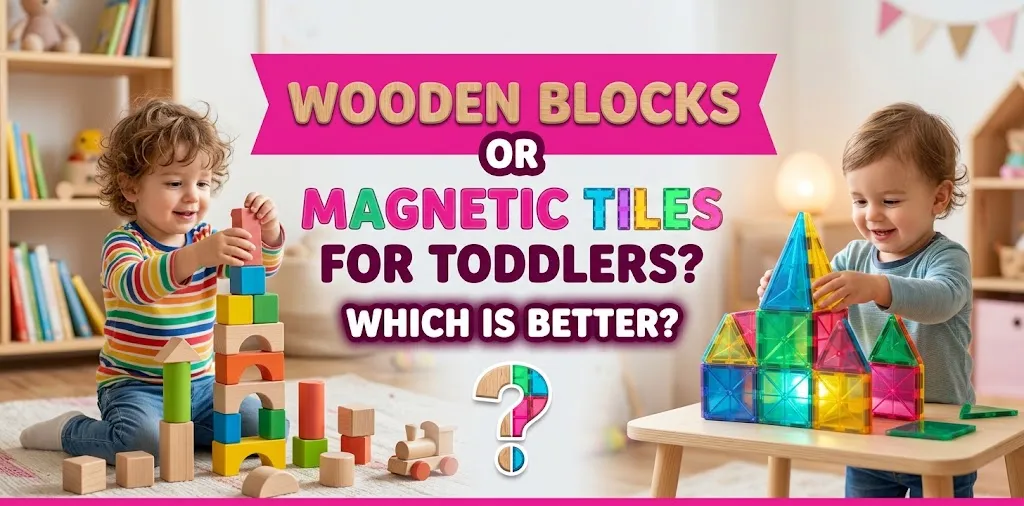
Wooden Blocks or Magnetic Tiles for Toddlers? Which Is Better?

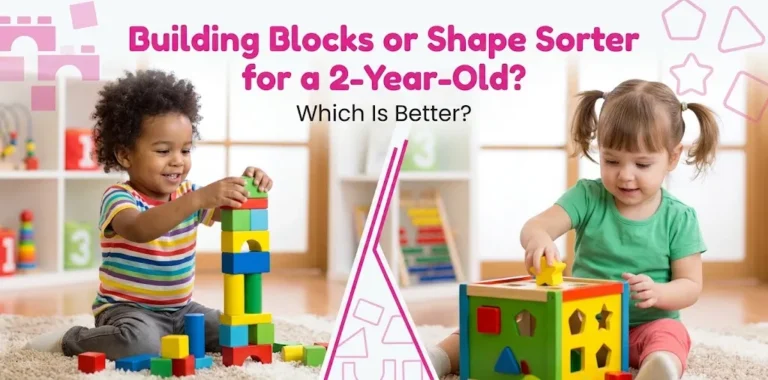
For most toddlers, large, age-appropriate wooden blocks are the better first choice, especially for younger children. Magnetic tiles often become more appealing around the preschool years because they make it easier to create taller and more complex structures. The best choice depends on your child’s age, play style, safety needs, and budget.
Both toys can provide hours of screen-free, open-ended play. But they encourage children to build in different ways.
Wooden blocks teach toddlers about stacking, balance, weight, and gravity. Magnetic tiles make it easier to connect shapes and create impressive structures without everything falling apart.
So, which one should you buy?
The Main Differences at a Glance
| Feature | Wooden Blocks | Magnetic Tiles |
|---|---|---|
| Best for younger toddlers | Excellent | Depends on manufacturer age guidance |
| Easy to build tall structures | More challenging | Very easy |
| Teaches balance and gravity | Excellent | Less directly |
| 3D shape building | Good | Excellent |
| Durability | Usually excellent | Good, but damaged tiles must be replaced |
| Storage | Can be bulky and heavy | Usually stacks flat |
| Budget | Often more affordable | Usually more expensive |
| Open-ended pretend play | Excellent | Excellent |
| Safety concerns | Mainly size, splinters, and finish quality | Damaged tiles can expose magnets |
| Long-term value | Often lasts for years | Can grow with preschool-age children |
Why Wooden Blocks Are Great for Toddlers
Wooden blocks have been popular for generations for a simple reason: children can do almost anything with them.
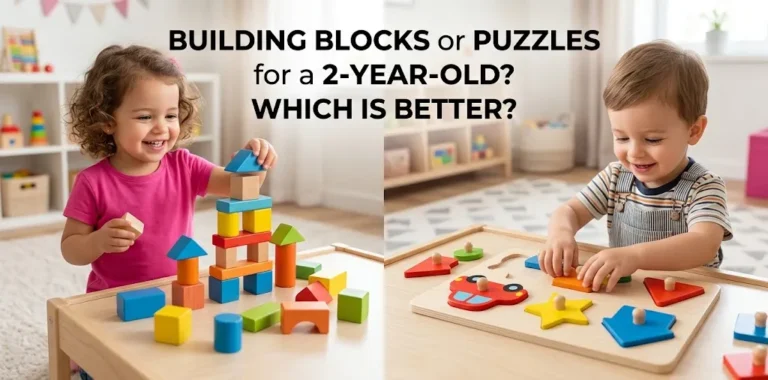
A toddler can stack two blocks, knock them down, line them up, carry them around, or pretend they are cars, houses, food, or anything else.
There are no instructions to follow.
They Teach Real-World Cause and Effect
When a toddler stacks blocks too high and the tower falls, they learn something important.
They begin to understand:
- Balance
- Weight
- Gravity
- Size differences
- Cause and effect
A magnetic tile can stay connected even when the structure would normally fall. That makes building easier, but wooden blocks give children more direct experience with balancing objects.
For example, a toddler may discover that a large block makes a better base than a small one. That lesson happens naturally through play.
Wooden Blocks Can Encourage More Imaginative Play
A simple wooden block does not tell a child what it is supposed to become.
Today, it might be part of a castle.
Tomorrow, the same block might become a road, a grocery store, or a garage for toy cars.
This makes wooden blocks especially useful for open-ended play.
They Can Last for Years
A good-quality wooden block set can often survive years of daily play.
They do not require batteries, apps, or replacement parts. Many families can pass a sturdy wooden block set from one child to another.
That can make blocks a strong value if you want one building toy that will stay useful for a long time.
Why Magnetic Tiles Are So Appealing
Magnetic tiles offer something wooden blocks cannot: quick success.
The pieces connect together, making it easier for children to build walls, towers, houses, and other 3D structures.
For some children, this can make building much less frustrating.
They Make Complex Building Easier
Imagine a child trying to build a tall house with wooden blocks.
The walls may fall repeatedly.
With magnetic tiles, the pieces connect together. A child can create a structure more quickly and keep adding to it.
This is especially helpful for children who enjoy construction but get upset when their creations collapse.
They Make Shapes and Geometry More Visible
Magnetic tiles often include squares and triangles that can be combined into different structures.
Children can experiment with:
- Flat and three-dimensional shapes
- Symmetry
- Patterns
- Towers
- Cubes
- Houses
- Bridges
A preschooler might start by connecting two squares and later learn how several shapes can form a cube.
That natural progression is one reason magnetic tiles often remain interesting as children get older.
They Are Usually Easier to Store
Wooden blocks can be heavy and bulky.
Magnetic tiles are usually flat, so they can often be stacked neatly inside a bin or storage container.
This can be helpful for families with limited playroom space.
Which Toy Is Better by Age?
Age matters more than many parents realize.
A toy that is perfect for a 4-year-old may not be the best choice for a child who has just turned 2.
Ages 1 to 2: Wooden Blocks Usually Make More Sense
For younger toddlers, large wooden blocks designed specifically for their age are usually the simpler choice.
At this stage, children are often interested in:
- Stacking
- Carrying
- Knocking things down
- Sorting
- Exploring different shapes
Choose blocks that are large enough for the child’s age and follow the manufacturer’s safety recommendations.
Ages 2 to 3: It Depends on the Child
Some children at this age may enjoy more advanced building toys, while others are still happiest stacking simple blocks.
Wooden blocks remain a strong choice.
Magnetic tiles should only be considered when the product is clearly designed and labeled for the child’s age. Many magnetic construction toys are intended for children ages 3 and older.
Ages 3 to 5: Magnetic Tiles Often Become More Interesting
This is often where magnetic tiles really shine.
Many preschoolers can create more intentional structures and enjoy experimenting with different shapes.
Wooden blocks are still useful, but magnetic tiles may provide more exciting building possibilities for children who enjoy making houses, towers, garages, and other recognizable creations.
Wooden Blocks vs. Magnetic Tiles for Learning
Both can support learning through play. The difference is in how children interact with the materials.
Wooden Blocks Are Better for Physical Building Challenges
Wooden blocks encourage children to figure out questions like:
- Why did my tower fall?
- Which block should go on the bottom?
- How wide should the base be?
- Can I balance this piece?
The child has to solve these problems physically.
Magnetic Tiles Are Better for Easy 3D Construction
Magnetic tiles make it easier to explore:
- Geometric shapes
- Three-dimensional structures
- Patterns
- Design ideas
- Creative construction
A child can focus more on what they want to create because the magnetic connections reduce some of the balancing challenges.
Neither approach is automatically better.
They simply offer different types of learning.
Safety Is an Important Part of the Decision
Parents should pay close attention to safety when choosing either toy.
Choosing Safe Wooden Blocks
Look for blocks that are:
- Appropriate for your child’s age
- Smooth and free from splinters
- Made with a durable, child-safe finish
- Large enough to avoid choking hazards
Very small blocks should not be used by children who are still likely to put toys in their mouths.
Choosing Safe Magnetic Tiles
Magnetic toys require extra attention.
The magnets should be securely enclosed inside the tiles. If a magnetic tile cracks, breaks, or opens, stop using it and keep it away from children.
Loose magnets can be extremely dangerous if swallowed.
Always follow the manufacturer’s age recommendations and inspect magnetic toys regularly for damage.
Which One Is Better for a Child Who Gets Frustrated Easily?
Magnetic tiles may be the better choice for a child who loves building but becomes upset when towers repeatedly fall.
The magnetic connections allow children to experience success quickly.
For example, a preschooler who struggles to balance a block tower may happily spend a long time creating a magnetic house or garage.
But frustration is not always bad.
A child who enjoys experimenting may actually love the challenge of making a wooden tower stand.
The best choice depends on your child’s personality.
Which One Gives You Better Value for the Money?
Wooden blocks often win on initial value.
A basic set can provide many years of play without needing additional pieces.
Magnetic tiles usually cost more, especially if you want enough pieces to build larger structures.
A small magnetic tile set can sometimes feel limiting because children quickly want more pieces for bigger creations.
Think about what you are really buying:
- Wooden blocks: simple, durable, long-lasting building play
- Magnetic tiles: easier construction and more advanced 3D possibilities
If your budget allows only one toy, the child’s age should play a major role in your decision.
For a younger toddler, a quality wooden block set may provide better long-term value.
For a preschooler who loves building structures, magnetic tiles may get more daily use.
Two Real-Life Situations That Make the Choice Easier
A 2-year-old who loves knocking down towers
Wooden blocks would likely be the better starting point.
The child can stack, knock down, carry, and experiment without needing complicated construction skills.
A 4-year-old who wants to build houses and castles
Magnetic tiles may be more exciting.
The child can create walls and larger structures without constantly dealing with collapsing towers.
This does not mean the 4-year-old has outgrown wooden blocks. Both toys can work together.
Do You Really Have to Choose Only One?
Not necessarily.
Wooden blocks and magnetic tiles can complement each other well.
Wooden blocks can provide hands-on experience with balance, weight, and open-ended pretend play.
Magnetic tiles can introduce easier 3D construction and geometric exploration.
If you start with wooden blocks when your child is younger, magnetic tiles can become a natural addition later.
For many families, that is a better approach than trying to find one toy that does everything.
What to Buy Based on Your Main Priority
Choose wooden blocks if you want:
- A great first building toy for a younger toddler
- Simple and open-ended play
- Strong durability
- A more budget-friendly option
- Activities involving stacking and balance
- A toy that can last for years
Choose magnetic tiles if you want:
- Easier 3D building
- Less frustration from collapsing structures
- More opportunities to build houses and geometric designs
- Compact storage
- A toy that may become especially engaging during the preschool years
Frequently Asked Questions
Are wooden blocks good for toddler development?
Yes. Age-appropriate wooden blocks can help toddlers practice hand-eye coordination, stacking, spatial awareness, and problem-solving through play. They also give children direct experience with balance and cause and effect.
What age should toddlers start using magnetic tiles?
It depends on the specific product and its manufacturer’s age recommendation. Many popular magnetic tile sets are designed for children ages 3 and older, so parents should always check the packaging and stop using damaged tiles.
Are magnetic tiles better than wooden blocks for preschoolers?
For many preschoolers, magnetic tiles can be more exciting because they make complex structures easier to build. However, wooden blocks still offer excellent open-ended play, so the better choice depends on the child’s interests and how they like to build.
The Bottom Line
If you’re buying a first building toy for a younger toddler, start with large, age-appropriate wooden blocks. They are simple, durable, and encourage hands-on learning about stacking and balance.
If your child is closer to the preschool years and loves creating houses, towers, and larger structures, magnetic tiles may be the better fit. A practical tip: choose based on how your child currently plays—not just which toy looks more impressive—and always check the manufacturer’s age and safety guidance before buying.