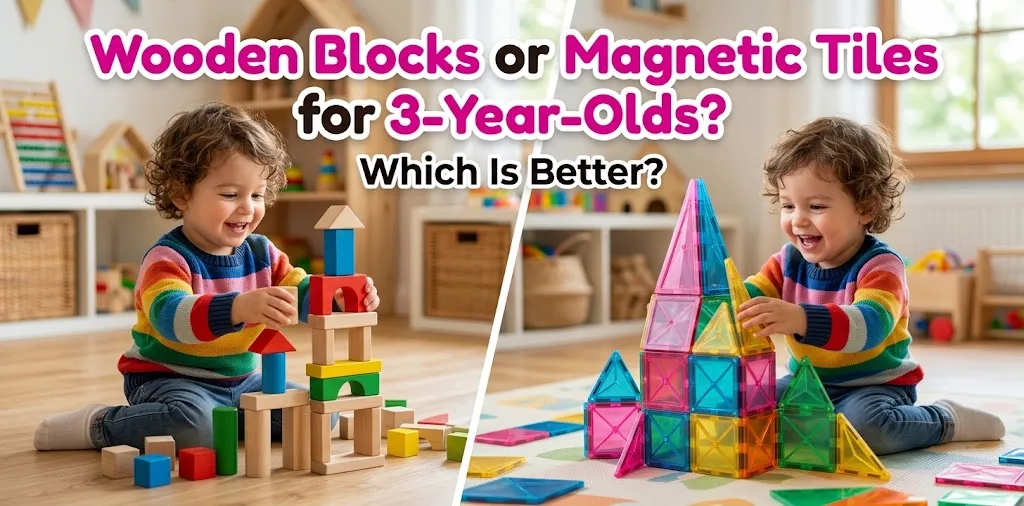
Wooden Blocks or Magnetic Tiles for 3-Year-Olds? Which Is Better?

For most 3-year-olds, magnetic tiles are usually the better choice for easy, exciting building, while wooden blocks are better for learning balance and simple open-ended play. If you can choose only one, magnetic tiles often keep preschoolers engaged longer—but a good wooden block set is still an excellent budget-friendly option.
Both toys encourage creative building, problem-solving, and hands-on play. The better choice depends on how your child likes to play.
The Main Difference Between Wooden Blocks and Magnetic Tiles
Wooden blocks rely on gravity and balance. A child stacks one block on another and learns what happens when a structure becomes too tall or unstable.
Magnetic tiles connect with enclosed magnets along their edges. This makes it easier for a 3-year-old to create towers, houses, cubes, and other structures without everything immediately falling apart.
That difference can have a big effect on the play experience.
| Feature | Wooden Blocks | Magnetic Tiles |
|---|---|---|
| Easy for a 3-year-old to use | Yes | Yes |
| Easy to build tall structures | No | Yes |
| Teaches balance | Excellent | Less directly |
| Encourages open-ended play | Excellent | Excellent |
| Early frustration level | Can be higher | Usually lower |
| Storage | Can be bulky | Usually easy to stack |
| Durability | Very high | Depends on quality |
| Typical cost | Usually lower | Usually higher |
| Visual geometry and 3D shapes | Basic | Excellent |
Why Magnetic Tiles Often Work So Well at Age 3
Three is a great age for many magnetic tile sets designed for children ages 3 and up.
At this stage, many children want their creations to look like something recognizable. They may try to build a house, garage, castle, rocket, or animal enclosure. Magnetic tiles make those projects easier because the pieces connect quickly.
A child does not need to carefully balance every piece.
That can lead to more successful builds and less frustration.
For example, imagine a 3-year-old trying to build a garage for toy cars. With wooden blocks, the walls may fall down several times while the child is still learning how to balance them. With magnetic tiles, the walls can connect and stay together more easily.
That quick success can encourage the child to keep experimenting.
Magnetic tiles are especially good for children who:
- Get frustrated when towers repeatedly fall
- Enjoy colorful and visual toys
- Like building houses, castles, and garages
- Want to create tall structures
- Enjoy experimenting with shapes
- Have older siblings who may also play with the same set
Another advantage is longevity. A child may start with simple towers at age 3 and later create more complicated structures as their skills improve.
Why Wooden Blocks Are Still an Excellent Choice
Wooden blocks may look simple compared with colorful magnetic tiles, but simplicity is one of their biggest strengths.
There are no magnets guiding the child. There are no special connections telling the pieces where to go.
The child has to figure things out.
Wooden blocks naturally introduce ideas such as:
- Balance
- Weight
- Stability
- Cause and effect
- Size and shape
- Stacking
- Imaginative play
When a tower falls, the child can try again and change the design.
For example, a child might discover that a wide base helps make a tower more stable. That lesson comes naturally through play rather than instruction.
Wooden blocks can also become almost anything. A block structure might be a house one day, a zoo the next day, and a pretend grocery store later.
Wooden blocks may be the better choice if your child:
- Already enjoys stacking things
- Likes simple, hands-on toys
- Has plenty of imagination during pretend play
- Does not get discouraged when structures fall
- Needs a budget-friendly building toy
- Will share the toy with younger children
A quality wooden block set can also last for years and may be passed down to younger siblings.
Which Toy Is Better for Learning?
There is no need to think of one toy as educational and the other as just fun.
Both can support valuable learning through play.
Wooden blocks teach physical building skills
Wooden blocks give children direct experience with gravity and balance.
A child quickly learns that:
- Tall structures need support
- Uneven surfaces can cause a tower to fall
- Larger pieces may work better at the bottom
- Careful placement matters
This makes wooden blocks especially useful for exploring basic physical concepts through trial and error.
Magnetic tiles make shapes and structures easier to explore
Magnetic tiles can help children experiment with two-dimensional and three-dimensional shapes.
A child can combine squares and triangles to create structures that are difficult for many preschoolers to build with ordinary blocks.
They can explore:
- Squares
- Triangles
- Rectangles
- Cubes
- Walls
- Roofs
- Three-dimensional structures
The magnetic connections allow children to focus more on designing than on constantly rebuilding collapsed structures.
The Biggest Factor: Your Child’s Personality
Age matters, but personality can matter just as much.
Two children can be the same age and prefer completely different building toys.
A child who loves experimenting and carefully stacking objects may spend a long time with wooden blocks.
Another child may quickly lose interest when a tower falls and become much more engaged with magnetic tiles.
Think about what happens when your child faces a challenge.
Do they enjoy trying again? Wooden blocks may be a great match.
Do they get upset when things do not work quickly? Magnetic tiles may create a more enjoyable experience.
Magnetic Tiles vs. Wooden Blocks for Creativity
Both toys encourage creativity, but in different ways.
Wooden blocks offer almost complete freedom. A child can place them in any direction and use them for building or pretend play.
Magnetic tiles also support open-ended play, but their shapes naturally encourage certain types of structures, such as:
- Houses
- Castles
- Towers
- Garages
- Geometric designs
Wooden blocks are often better for combining construction with other toys. A child might build roads, fences, bridges, or buildings around toy cars and figures.
Magnetic tiles are often better for creating impressive structures quickly.
Neither approach is automatically better. They simply create different types of play.
Cost: Which Gives Better Value?
Wooden blocks usually cost less than a quality magnetic tile set.
A basic wooden block set can provide years of play without needing expansion pieces.
Magnetic tiles often cost more, especially when you buy larger sets from established brands. A small set can also feel limiting once a child wants to build larger structures.
For that reason, think about how much building your child actually enjoys.
If your child only occasionally stacks blocks, an expensive magnetic tile collection may not be necessary.
If building is already one of their favorite activities, magnetic tiles may provide enough regular use to justify the higher cost.
Safety Matters More With Magnetic Tiles
Magnetic tiles should always be age-appropriate and well-made.
The magnets should be securely enclosed inside the tiles. If a magnetic toy becomes cracked, broken, or damaged, stop using that piece and inspect the rest of the set.
Loose magnets can be dangerous if swallowed.
When buying magnetic tiles for a 3-year-old, check:
- The manufacturer’s recommended age
- The condition of the tiles
- Whether the seams are securely sealed
- Whether pieces show cracks or damage
Avoid continuing to use damaged magnetic pieces.
Wooden blocks also need basic safety checks. Look for smooth surfaces, sturdy construction, and pieces appropriate for your child’s age.
Storage and Cleanup Can Make a Difference
This may seem like a small detail, but parents often notice it after several weeks of daily play.
Magnetic tiles usually stack flat and fit neatly into a storage bin.
Wooden blocks can take up more space because they are thicker and heavier.
Wooden blocks can also be louder. Dropping a heavy block on a hardwood or tile floor creates much more noise than dropping a lightweight magnetic tile.
For families living in apartments or homes with limited storage, magnetic tiles may be easier to manage.
So, Which Should You Buy for a 3-Year-Old?
Here is the simplest way to decide:
Choose magnetic tiles if your 3-year-old enjoys quick results, colorful designs, and building structures that stay together.
Choose wooden blocks if you want a simpler, lower-cost toy that encourages balance, imagination, and hands-on experimentation.
For many families, the strongest choice is not replacing one with the other.
They complement each other.
A child can use wooden blocks to learn stacking and balance while using magnetic tiles for larger and more complex structures.
Two Realistic Buying Scenarios
Scenario 1: A child who gets frustrated easily
Imagine your child becomes upset when a tower falls after several attempts.
Magnetic tiles may be the better first choice. The pieces connect easily, allowing the child to experience success and continue building.
Scenario 2: A child who loves stacking everything
Imagine your child regularly stacks cups, books, toys, and other safe household objects.
Wooden blocks may provide exactly the kind of challenge they already enjoy. The child can experiment with different shapes and learn through repeated attempts.
Frequently Asked Questions
Parents often have a few practical questions before choosing between these two popular building toys. Here are answers to the most common questions that can help you decide which option better fits your 3-year-old.
Are magnetic tiles safe for 3-year-olds?
Magnetic tiles can be appropriate for 3-year-olds when the set is specifically designed and labeled for that age group. Choose well-made tiles with securely enclosed magnets, and stop using any pieces that become cracked or damaged.
Do 3-year-olds get bored with wooden blocks?
Some children may move on quickly if they prefer fast, visually impressive builds, while others can use wooden blocks for years. Adding toy cars, figures, or pretend-play ideas can also give block play new life.
How many magnetic tiles does a 3-year-old need?
A small starter set can work for simple building, but larger sets give children more freedom to create houses, towers, and other structures. The right number depends on how much your child enjoys building and whether siblings will play too.
The Bottom Line
For most 3-year-olds, magnetic tiles are the easier choice for immediate fun and successful building, while wooden blocks offer a stronger challenge in balance and open-ended physical play.
If you are unsure, watch how your child currently plays. A child who loves building tall, recognizable structures may get more use from magnetic tiles. A child who enjoys stacking, experimenting, and rebuilding may love wooden blocks.
One practical tip: choose the toy your child is most likely to use repeatedly—not the one that simply looks more educational on the shelf.