Wooden Puzzle or Shape Sorter for Toddlers? Which Is Better?

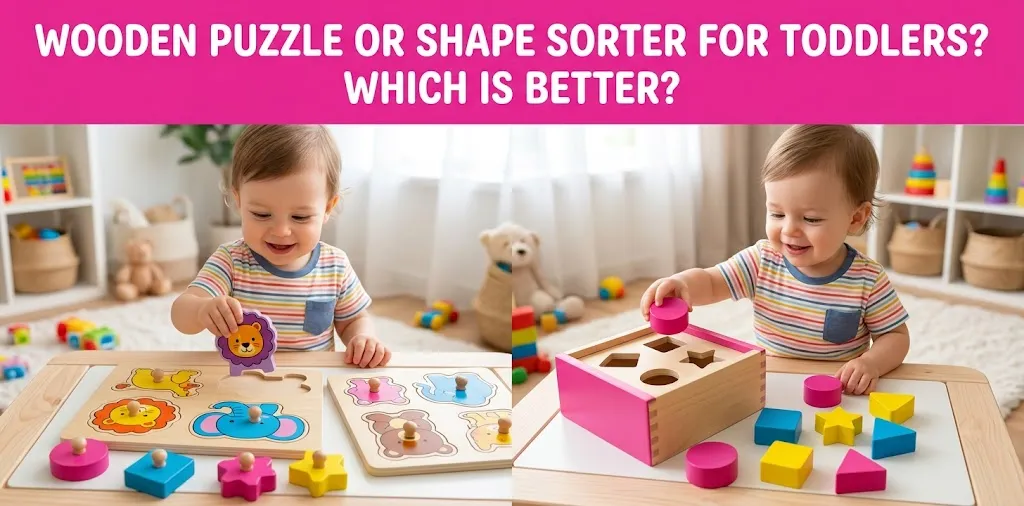
A wooden puzzle and a shape sorter both give toddlers hands-on practice with matching, problem-solving, and fine motor control, but they ask children to solve different kinds of problems. For younger toddlers or children new to matching toys, a simple shape sorter is often easier to start with. A wooden puzzle can be the better choice when a child is ready for more precise matching and longer periods of focused play.
The main difference between a wooden puzzle and a shape sorter
The biggest difference is how the child solves the problem.
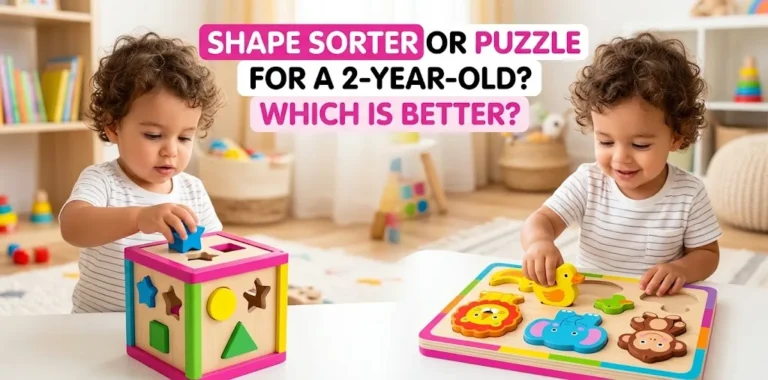
A shape sorter usually has several openings and separate blocks. The child picks up a shape, looks for the opening where it belongs, turns the piece, and tries to fit it through. The feedback is simple: it either fits or it does not.
A wooden toddler puzzle usually has pieces that belong in specific spaces on a board. The child must compare the piece with the matching outline, picture, or shape and place it in the correct location.
That makes the two toys similar in some ways, but different in the type of thinking they encourage.
| Feature | Wooden Puzzle | Shape Sorter |
|---|---|---|
| Main task | Match a piece to its exact place | Match a shape to the correct opening |
| Typical challenge | More precise matching | Shape recognition and orientation |
| Trial and error | Moderate | High |
| Fine motor practice | High | High |
| Spatial reasoning | High | High |
| Best for beginners | Depends on puzzle type | Often easier |
| Independent play | Can require more practice | Often easy to understand after demonstration |
| Good next step | Larger or more complex puzzles | More shapes or harder fitting tasks |
Neither toy is automatically better for every toddler. The better choice depends on the child’s current skills and what kind of challenge they enjoy.
Why a shape sorter may be better for a younger toddler
A shape sorter can be a good first matching toy because the child can experiment.
For example, a toddler might pick up a triangle and try several openings. If the first opening does not work, they can move to another one. They can also rotate the triangle and try again.
This creates a simple cycle:
look → try → adjust → try again → succeed
That kind of trial-and-error play is one reason shape sorters are commonly used for early hands-on learning.
A simple sorter with a small number of large pieces can also be easier for a child who is just beginning to understand matching.
What a shape sorter can help children practice
During normal play, a toddler may practice:
- Recognizing basic shapes
- Comparing objects
- Rotating and repositioning pieces
- Hand-eye coordination
- Grasping and releasing objects
- Early problem-solving
- Understanding spatial relationships
- Staying with a simple task after an unsuccessful attempt
These are not separate lessons that need to be taught formally. They happen naturally as the child handles the pieces and tries to make them fit.
When a wooden puzzle may be the better choice
A wooden puzzle can be a better option when a toddler is ready for a more exact matching task.
With a simple knob puzzle, for example, a child may need to recognize that a particular animal, vehicle, or shape belongs in one specific space. The piece has to be positioned correctly rather than simply finding an opening large enough for it.
This can make a puzzle feel more challenging than a basic shape sorter.
A toddler who already enjoys sorting objects, matching shapes, or completing simple fitting activities may be ready for this extra challenge.
The type of puzzle matters, though. A large wooden knob puzzle with only a few chunky pieces is very different from a traditional jigsaw puzzle with many small pieces.
Start with the simplest puzzle that matches the child’s ability
For a toddler who is new to puzzles, look for:
- Large, easy-to-grip pieces
- A small number of pieces
- Clear pictures or outlines
- Sturdy construction
- Knobs that are easy to hold, when appropriate
- Pieces that are not frustratingly tight
As the child becomes comfortable, you can move toward puzzles with more pieces or less obvious matching cues.
This gradual increase in difficulty is more useful than buying the most complicated puzzle simply because it looks more educational.
Wooden puzzle vs. shape sorter for different play goals
The better choice becomes clearer when you think about what you want the child to practice.
Choose a shape sorter if your toddler enjoys putting things in and taking them out
Some toddlers love dropping blocks into containers, putting objects through openings, or repeatedly taking pieces out and starting over.
A shape sorter fits naturally into this type of play.
It also gives the child a clear physical goal without requiring them to understand a picture.
Choose a wooden puzzle if your toddler enjoys matching pictures
If your child likes pointing to animals in books, matching objects, or putting specific pieces in specific places, a simple wooden puzzle may hold their attention better.
For example, a child who loves animals might be more interested in matching a wooden cow to a cow-shaped space than matching a geometric block to a hole.
The child’s interest matters. A toy that matches their interests may get much more use than a toy chosen only because it claims to teach a particular skill.
Which is easier for toddlers to solve?
In general, a simple shape sorter tends to be more forgiving, while a wooden puzzle often requires more precise matching.
A shape sorter may have several pieces that can be explored independently. A puzzle has a fixed board, and each piece has a particular destination.
But design makes a big difference.
A shape sorter with ten unusual shapes can be harder than a three-piece wooden puzzle. Likewise, a simple four-piece knob puzzle may be much easier than a complicated sorter with tightly fitting openings.
So instead of asking only, “Is a puzzle harder than a shape sorter?” ask:
How many decisions does this particular toy require my child to make?
That is a much better way to judge difficulty.
Which one helps with fine motor skills?
Both can provide fine motor practice, but the movements are slightly different.
With a shape sorter, the child picks up a block, moves it toward an opening, rotates it, and pushes it through. The repeated movement can encourage control of the hands and fingers.
With a wooden puzzle, the child usually grasps a piece, moves it over the board, rotates it if necessary, and places it into a specific space.
Both activities involve hand control and visual guidance. The difference is mainly in the type of task rather than one toy being capable of developing fine motor skills while the other is not.
Which one is better for problem-solving?
Both encourage problem-solving, but they present the problem differently.
A shape sorter asks:
“Which opening does this shape fit, and how should I turn it?”
A puzzle asks:
“Where does this particular piece belong?”
That distinction matters.
If your toddler enjoys experimenting and trying different possibilities, a shape sorter may be more satisfying.
If your toddler enjoys finding one exact answer, a wooden puzzle may be more rewarding.
There is no need to choose a toy based on which one sounds more educational. Both give children opportunities to observe, make a choice, test it, and adjust their approach.
What about a toddler who gets frustrated easily?
This is one area where a shape sorter can have an advantage, particularly when it has large pieces and simple shapes.
You can also make either toy easier by reducing the number of pieces available.
For example, instead of putting all six pieces of a sorter on the floor, start with two or three. Once the child understands the basic idea, add the others.
The same approach works with a puzzle. Give the child only a few pieces at first and let them complete part of the board.
The goal is not to see how quickly the toddler can finish. The goal is to give them a challenge they can reasonably explore.
What should you look for in a wooden toddler toy?
Material is only one part of the decision.
A wooden toy can be attractive and durable, but “wooden” does not automatically mean it is better designed or safer. Construction quality, smooth surfaces, appropriate piece size, stable construction, and the manufacturer’s age guidance all matter.
For either toy, check:
- The manufacturer’s recommended age range
- Piece size and whether the pieces are appropriate for the child
- Smooth, well-finished surfaces
- Securely attached knobs, joints, or other parts
- A shape sorter that stays reasonably stable during use
- Puzzle pieces that are easy enough to grasp
- Clear, simple matching cues
- Materials and finish information from the manufacturer
Avoid choosing a toy simply because it has the most pieces or the longest list of claimed learning benefits.
A simple toy that a toddler actually wants to use can be much more valuable than a complicated toy that stays on the shelf.
Two everyday examples
Imagine a 15-month-old who enjoys putting blocks into cups and dumping them back out. A basic shape sorter with a few large shapes may be a natural next step. The child can explore putting, removing, turning, and fitting pieces without needing to understand a picture.
Now consider a 2-year-old who already enjoys matching animal pictures and can complete simple fitting activities. A chunky wooden animal puzzle may provide a more interesting challenge because each piece has a specific location.
These are examples of how the child’s current interests and abilities can matter more than choosing one toy as universally better.
So, which should you buy first?
If you are choosing just one, use the child’s current play skills as the deciding factor.
| If your toddler… | Consider |
|---|---|
| Is new to matching toys | Shape sorter |
| Loves putting objects into containers | Shape sorter |
| Enjoys rotating and fitting objects | Shape sorter |
| Already matches simple shapes or pictures | Wooden puzzle |
| Enjoys animals, vehicles, or familiar pictures | Wooden puzzle |
| Likes finding one exact answer | Wooden puzzle |
| Gets frustrated by difficult matching | Start with the simpler option |
| Enjoys both types of activities | Either, or eventually both |
For many younger toddlers, a simple shape sorter is a sensible first choice. Once matching becomes familiar, a basic wooden puzzle can add a different type of challenge.
But there is no rule saying you must buy them in that order. If your child is already interested in puzzles and can handle the pieces, starting with a simple wooden puzzle can make perfect sense.
Are wooden puzzles and shape sorters worth having together?
They can be.
They do not completely replace each other because the play experience is different. A shape sorter focuses heavily on fitting and orientation, while a puzzle focuses more on precise matching and placement.
You also do not need to buy several versions of each.
One well-designed shape sorter and one appropriately simple puzzle can provide plenty of opportunities for hands-on matching play. Other everyday activities, such as stacking blocks, sorting household objects, and playing with containers, can offer related types of practice too.
The goal is not to build a shelf full of “educational” toys. It is to give your toddler interesting things to explore.
Frequently Asked Questions
Is a shape sorter better than a puzzle for a 1-year-old?
For many younger toddlers, a simple shape sorter can be an easier introduction to matching because it allows plenty of trial and error. However, readiness varies, so a simple chunky puzzle can also work if the child can comfortably handle its pieces.
What age is best for a wooden shape sorter?
Many children begin exploring shape sorters during the toddler years, with some products designed for children around 12–18 months and others intended for older toddlers. Always follow the specific manufacturer’s age guidance because piece size and difficulty vary between toys.
Should I buy a wooden puzzle or shape sorter first?
If your toddler is new to matching and enjoys putting objects into openings, start with a simple shape sorter. If your child already matches shapes or pictures and enjoys placing objects in specific locations, a basic wooden puzzle may be the better first purchase.
The Bottom Line
A wooden puzzle is not better than a shape sorter, and a shape sorter is not better than a puzzle. They simply give toddlers different problems to solve.
For a child who is just discovering matching, a simple shape sorter is often the easier starting point. For a toddler who is ready for more precise matching, a chunky wooden puzzle may offer the better challenge.
The best practical tip is to choose based on what your child can do and what they want to do. If the toy is too difficult, simplify it; if your toddler solves it easily and stays interested, move to the next level.