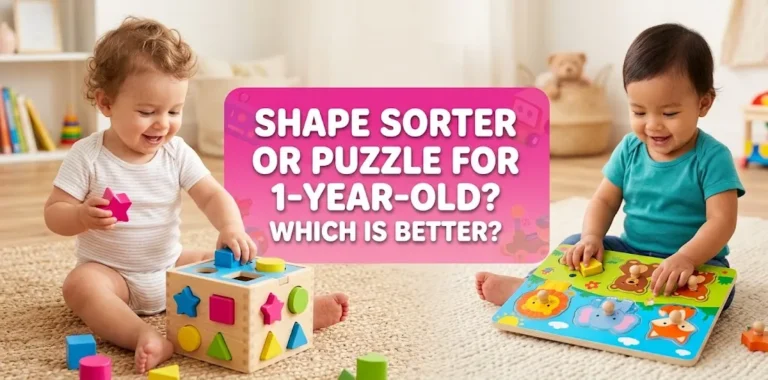
Knob Puzzle or Shape Sorter for a 2-Year-Old? Which Is Better?

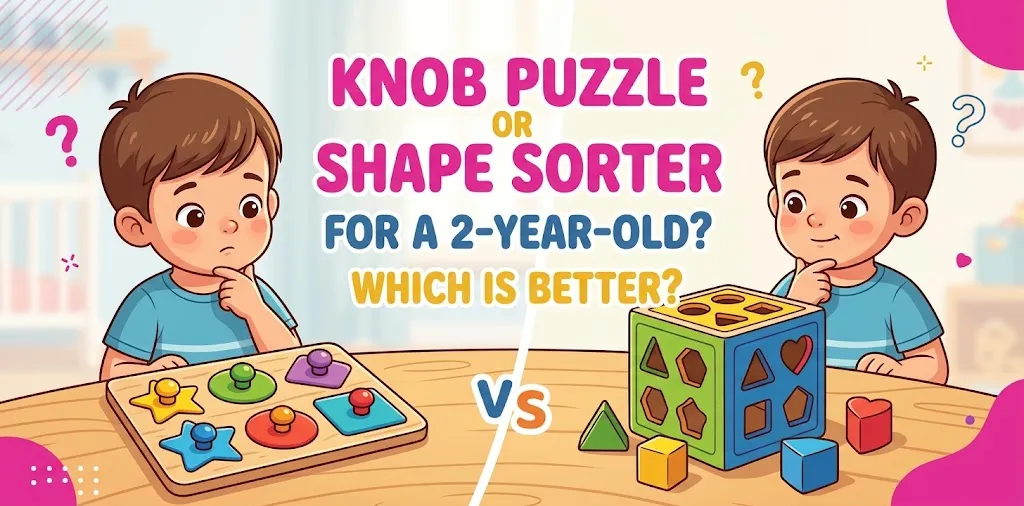
For most 2-year-olds, a simple knob puzzle is the better choice if they already understand basic matching, while a shape sorter is often better for toddlers who still enjoy trial-and-error play and need more practice rotating and matching shapes. Both build useful skills, so your child’s current ability matters more than age alone.
At age 2, children are learning to match objects, recognize familiar pictures, sort basic shapes, and solve simple problems. The American Academy of Pediatrics notes that traditional toys such as shapes and puzzles can support problem-solving and fine-motor development. The CDC also recommends simple puzzles and shape-sorting activities for toddlers.
The main difference is the type of challenge each toy provides. A knob puzzle usually asks a toddler to match one piece with one visible space on a flat board. A shape sorter asks the child to find the correct opening and then turn a three-dimensional piece until it fits.
For a 2-year-old, neither choice is automatically better. The right one should provide a little challenge without making play frustrating.
Knob Puzzle vs. Shape Sorter at a Glance
| Feature | Knob Puzzle | Shape Sorter |
|---|---|---|
| Main activity | Place pieces into matching spaces | Put shapes through matching openings |
| Fine-motor challenge | Grasping, lifting, turning, and placing | Grasping, rotating, aligning, and pushing |
| Matching style | Mostly visual matching on a flat surface | Shape-to-opening matching in 3D |
| Difficulty for beginners | Usually easier with large knobs and few pieces | Can require more trial and error |
| Good for independent play | Yes, when the puzzle is simple | Yes, after the child understands the toy |
| Shape learning | Good with a shape-based puzzle | Usually a major part of play |
| Picture vocabulary | Strong with animal, vehicle, or object puzzles | Usually more limited |
| Best fit | Toddler ready for simple matching tasks | Toddler who enjoys sorting and experimenting |
A toddler does not need to master one before using the other. Many 2-year-olds can enjoy both at different times.
Why a Knob Puzzle May Be Better for a 2-Year-Old
A knob puzzle has individual pieces with raised handles or knobs. Each piece usually belongs in one specific opening on the board.
That simple design can work especially well around age 2 because the child receives clear visual information about where each piece belongs.
The CDC specifically suggests helping young children complete simple puzzles involving shapes, colors, or animals and naming the pieces while they play.
It gives toddlers an easier matching challenge
Imagine a puzzle containing a cow, horse, pig, and sheep.
Your child can look at the cow-shaped piece, scan the board, and search for an opening with the same outline or picture. There is usually only one correct location.
That can make the connection between the object and its matching space easier to understand.
A shape sorter adds another step. Your toddler may recognize the circle correctly but still need to rotate the piece or approach the opening from a different angle before it goes through.
For a child who becomes frustrated quickly, a simple knob puzzle may therefore be easier to introduce.
The knob makes pieces easier to control
Large knobs give little hands something obvious to hold.
While playing, toddlers practice movements such as:
- grasping a knob
- lifting a piece
- turning it
- moving it toward a target
- lowering it into the correct space
These movements require hand-eye coordination and increasingly accurate hand control.
At age 2, children are developing more control over objects and learning how objects relate to one another. The American Academy of Pediatrics notes that 2-year-olds begin matching similar shapes with toys such as shape sorters and simple puzzles.
Picture puzzles can support vocabulary
Knob puzzles are not limited to circles, squares, and triangles.
You can find simple boards featuring:
- farm animals
- pets
- vehicles
- fruits
- household objects
- basic shapes
That gives parents an easy way to add conversation to play.
If your toddler picks up a dog piece, for example, you might say, “That’s the dog. Where does the dog go?” After they place it, you could ask, “What sound does a dog make?”
At this age, play becomes even more useful when an adult talks with the child rather than treating the puzzle as a silent test. The CDC recommends naming puzzle pieces as toddlers place them.
When a Shape Sorter May Be the Better Choice
A shape sorter can be more challenging because toddlers must solve several small problems in one activity.
They need to:
- Pick a shape.
- Compare it with the available openings.
- Choose an opening.
- Turn the piece into the right position.
- Push or drop it through.
That makes shape sorters particularly useful for toddlers who already handle basic matching activities easily.
It provides more practice with shape and spatial relationships
A flat puzzle piece generally approaches its matching space from one main direction.
With a shape sorter, the child may need to turn a square block several ways before its sides line up with the square opening.
That trial-and-error process helps the child learn that the same object can look different when it is turned.
The ability to sort and match shapes is developmentally appropriate around this age. HealthyChildren.org lists beginning to sort by shapes and colors among cognitive milestones associated with 2-year-olds.
It encourages experimentation
A toddler may first try putting a triangle through the circle hole.
It does not work.
They try another opening.
Still no.
Then they find the triangle opening and turn the piece until it drops inside.
That process is valuable because the child is discovering the answer through physical experimentation rather than simply being shown what to do.
Toddlers at this age are becoming increasingly thoughtful problem-solvers and are starting to understand relationships between objects.
It may keep an experienced toddler challenged longer
Suppose your 2-year-old can already complete a four-piece animal knob puzzle quickly without help.
Buying another puzzle at the same difficulty level may not add much challenge.
A shape sorter with a manageable number of clearly different shapes may encourage more rotation, testing, and problem-solving.
In that situation, the shape sorter can be the more useful next step.
Which One Is Easier for a 2-Year-Old?
A simple knob puzzle is usually easier, especially when it has large knobs, clear pictures, and only a few pieces.
The toddler can see the possible destinations at once and compare the piece directly with the board.
A shape sorter may be slightly harder because recognizing the correct opening is not always enough. The child also has to orient the piece correctly.
However, individual experience makes a big difference.
A toddler who has used sorting toys since infancy may find a shape sorter easy but struggle with a picture puzzle they have never seen before.
Instead of choosing based only on the age printed on the package, watch how your child currently plays.
If they are still learning the idea of matching one object with one location, start simple.
If matching is already easy, give them a toy that adds a little more problem-solving.
Which Toy Builds Better Fine-Motor Skills?
Both toys develop fine-motor control, but they emphasize slightly different movements.
A knob puzzle encourages controlled grasping and precise placement. The child must pick up a piece, guide it toward a relatively exact location, and lower it into place.
A shape sorter adds more rotation. The child may need to turn a block with the fingers or wrist several times before the orientation is correct.
The AAP describes traditional manipulative toys, including shapes and puzzles, as useful for developing problem-solving and fine-motor skills.
So there is little reason to choose one solely because you want your toddler to work on hand skills.
A better question is: Which movement is challenging for your child right now?
If grasping and accurate placement are still difficult, a large-knob puzzle can be a comfortable starting point.
If your toddler already places pieces accurately but needs a harder spatial challenge, a shape sorter can add that extra step.
Which Is Better for Learning Shapes?
A shape sorter generally has the advantage for focused shape practice.
Many sorters repeatedly expose toddlers to recognizable geometric forms such as circles, squares, triangles, and rectangles. The child must compare each physical piece with its corresponding opening.
However, a shape-based knob puzzle can teach many of the same concepts.
What parents say during play matters too.
Instead of simply telling your child, “Put it there,” try using the shape name:
“Here’s the triangle. Can you find another triangle?”
Or:
“You found the circle. The circle goes in the round space.”
This connects the physical object with the word used to describe it.
How to Know Which Toy Your Child Is Ready For
Chronological age is useful, but readiness gives you a better answer.
Choose a knob puzzle first when your toddler:
- has little experience with puzzles
- is still learning basic matching
- needs easy-to-grasp pieces
- gets frustrated by complicated toys
- enjoys familiar pictures such as animals or vehicles
- benefits from seeing exactly where a piece belongs
Choose a shape sorter first when your toddler:
- already matches basic shapes or pictures
- enjoys putting objects into containers
- likes trial-and-error activities
- can rotate objects deliberately
- completes basic puzzles easily
- needs a slightly more challenging spatial task
For example, suppose your 24-month-old recognizes a circle and square but has never completed a puzzle. A basic knob puzzle with three or four large pieces may provide an easier introduction.
Now imagine a 2-year-old who already completes simple inset puzzles without help and spends time turning blocks to see how they fit together. That child may get more value from a shape sorter.
Both are normal situations.
What to Look for in a Knob Puzzle
For a beginner around age 2, complexity matters more than having lots of pieces.
Look for a puzzle with sturdy pieces, clear matching spaces, and knobs your child can grasp comfortably.
A board with a small number of clearly different pieces is often easier to understand than one crowded with similar images.
Themes involving familiar objects can also make play more meaningful. Animals, foods, vehicles, and household items give you opportunities to name objects and talk about what they do.
Avoid assuming that more pieces automatically means more educational value. If the puzzle is too difficult, your toddler may simply stop playing.
The useful challenge is one that makes the child think and try again without requiring constant adult correction.
What to Look for in a Shape Sorter
A good shape sorter for this age should make the relationship between each piece and opening reasonably clear.
For a beginner, several highly distinct shapes are usually more manageable than many shapes that look almost identical.
Also consider how the toy opens after the shapes go inside.
Toddlers often enjoy repeating the activity:
shape goes in, container opens, shapes come out, and play starts again.
That repetition is not wasted play. Young children often learn through doing the same physical task many times.
Choose a design appropriate for your child’s age, and follow the manufacturer’s age recommendation and safety instructions.
Safety Matters More Than the Type of Toy
Whether you choose a puzzle or sorter, check the toy itself carefully.
For a 2-year-old, pieces should not present an obvious choking hazard, and the toy should be sturdy enough for normal toddler handling.
Inspect wooden toys for damaged edges or loose components. If the toy has attached knobs or other small parts, make sure they remain secure.
Age labels also matter because toys that look similar can contain very different-sized pieces.
The AAP recommends choosing toys that fit a child’s developmental stage rather than assuming a more complicated or electronic toy is more beneficial. Traditional hands-on toys can provide valuable opportunities for children and caregivers to play together.
You Do Not Have to Choose Only One
If your budget and storage space allow it, knob puzzles and shape sorters actually work well together.
They overlap in several skills but do not create exactly the same challenge.
A toddler might use a shape sorter in the morning and an animal knob puzzle later in the day without experiencing them as duplicate toys.
You can also alternate toys instead of leaving everything available at once.
For example, keep a simple knob puzzle available for several days. Once your toddler knows it well, put it away temporarily and bring out the shape sorter.
Rotating toys can make familiar activities feel interesting again without constantly buying something new.
How Parents Can Make Either Toy More Useful
You do not need to turn playtime into a lesson.
A few simple comments and questions are enough.
When your toddler picks up a piece, name it. When they struggle, give them time to experiment before correcting them.
You might say:
“Where could the triangle go?”
“Try turning it.”
“You found the horse.”
“Does that piece match this space?”
If the child becomes frustrated, reduce the challenge instead of repeatedly giving instructions. With a puzzle, you could offer only two or three pieces at first. With a sorter, you could give the child a couple of very different shapes rather than the entire set.
The goal is not for a 2-year-old to finish as fast as possible.
The thinking, turning, testing, matching, and trying again are part of the activity.
FAQ
Are knob puzzles too easy for a 2-year-old?
Not necessarily. A simple knob puzzle can be a good match for a 2-year-old who is new to puzzles, while a child who already completes basic puzzles easily may need a more challenging version. Watch your child’s ability rather than judging the toy only by age.
How many puzzle pieces should a 2-year-old start with?
There is no single piece count that fits every 2-year-old. Beginners generally benefit from a small number of large, clearly different pieces, and you can increase the challenge once your child completes the puzzle with little help.
Should a 2-year-old be able to use a shape sorter?
Many 2-year-olds can begin matching and sorting shapes, but children develop at different rates. The CDC and AAP describe shape matching, sorting, and simple puzzle play as appropriate activities around this stage, so offer help when needed without expecting instant mastery.
Conclusion
For most 2-year-olds, a knob puzzle is a great starting point, while a shape sorter can offer a bigger challenge once basic matching becomes easier. Both toys support important early skills, including hand-eye coordination, problem-solving, and shape recognition.
The best choice is to match the toy to your child’s current abilities. Start with a simple option that feels achievable, then gradually introduce more challenging activities as your toddler gains confidence.