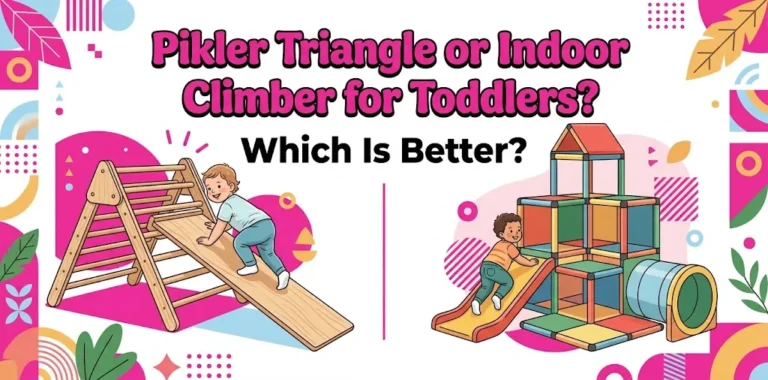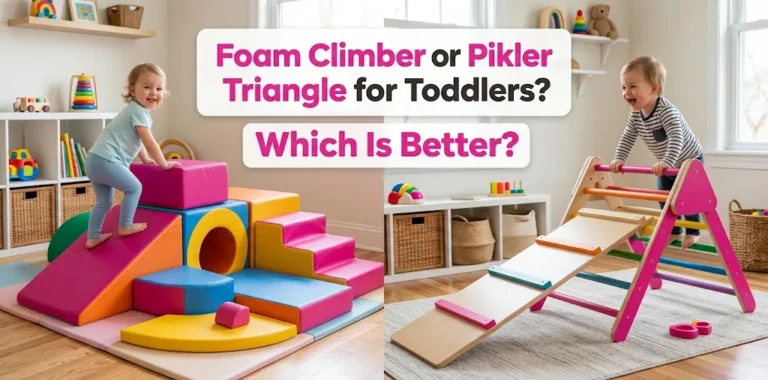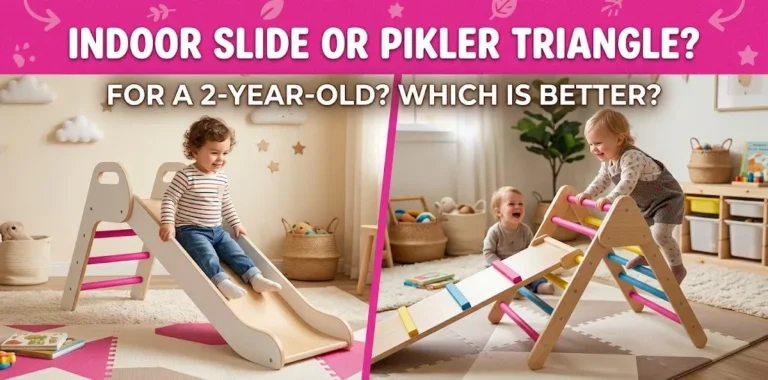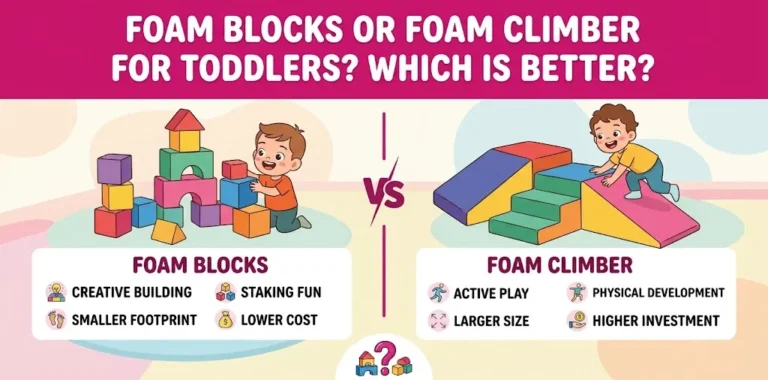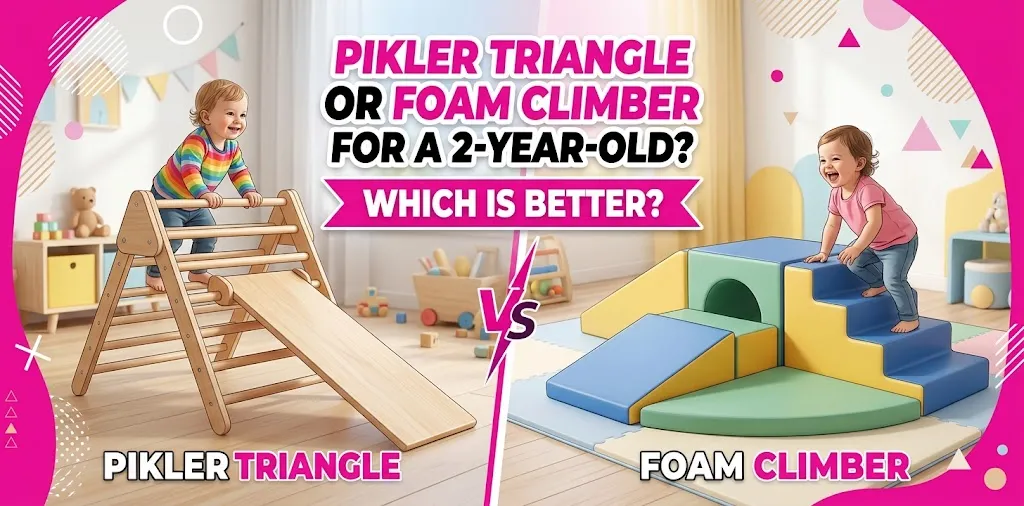
Pikler Triangle or Foam Climber for a 2-Year-Old? Which Is Better?

For most 2-year-olds, a foam climber is the better choice for safe, low-level indoor play, especially for beginners. A Pikler triangle is usually better for a confident climber who needs more challenge and can use a sturdy climbing structure with close adult supervision. The best choice depends on your child’s climbing ability, your space, and how you plan to use it.
Both can encourage active play, but they create very different experiences. A 2-year-old who is just beginning to climb may enjoy the soft, forgiving design of a foam climber. A child who already climbs confidently on furniture, playground equipment, and other structures may get more long-term use from a Pikler triangle.
Pikler Triangle vs. Foam Climber at a Glance
| Feature | Pikler Triangle | Foam Climber |
|---|---|---|
| Best for | Confident climbers | Beginners and younger toddlers |
| Main material | Usually wood | Soft foam with a wipeable cover |
| Climbing challenge | Higher | Lower to moderate |
| Fall surface | Requires extra attention | Softer structure, but falls are still possible |
| Indoor use | Yes, with enough space | Especially well suited to indoor play |
| Long-term challenge | Often lasts longer as skills grow | May become less challenging sooner |
| Configuration | Usually fixed or partly adjustable | Often rearrangeable |
| Weight and portability | Usually heavier | Often lighter and easier to move |
| Best for small children learning to climb | Depends on the child’s ability | Usually the easier starting point |
Choose a Foam Climber if Your 2-Year-Old Is Still Learning to Climb
A foam climber is often the simpler choice for a newly active toddler.
These sets commonly include pieces such as ramps, steps, wedges, blocks, and tunnels. Your child can crawl over them, climb short surfaces, slide down gentle slopes, and experiment with different arrangements.
The biggest advantage is that the play experience can feel less intimidating.
Why foam climbers work well for beginners
A 2-year-old may not yet have the balance, coordination, or confidence for a taller wooden climbing frame. Low foam pieces allow the child to practice movement closer to the floor.
For example, imagine a toddler who has recently started climbing onto the couch. A low foam set can give that child a more appropriate place to practice climbing, crawling, and stepping up and down.
Foam climbers can also be useful when parents want an indoor active-play option for:
- Rainy days
- Apartment living
- Playrooms
- Smaller children who are still gaining confidence
- Toddlers who enjoy rearranging their play space
That said, soft equipment does not eliminate the need for supervision. Toddlers can still fall, and climbing equipment should not be placed on hard surfaces where a fall could cause more serious injury. The U.S. Consumer Product Safety Commission specifically warns against placing children’s climbing gyms on hard surfaces such as wood floors, concrete, or asphalt.
Choose a Pikler Triangle if Your Child Already Loves a Climbing Challenge
A Pikler triangle is generally a more structured climbing frame. Most versions use wooden rungs that children climb up and over.
For a physically confident 2-year-old, this can provide a greater challenge than a basic foam climbing set.
Some Pikler setups also include accessories such as ramps, climbing boards, or slides, depending on the specific product.
Why a Pikler triangle can offer longer-lasting play
A confident toddler may quickly learn how to use a simple foam climber. Once that happens, the set may no longer feel very challenging.
A Pikler triangle can continue to offer new climbing challenges as coordination improves.
For example, imagine two different 2-year-olds:
- Child A is cautious and prefers crawling over low objects.
- Child B already climbs confidently at the playground and constantly tries to climb furniture at home.
Child A may be happier starting with a foam climber. Child B may get more value from a properly sized Pikler triangle.
The goal is not to buy the most challenging equipment. It is to choose something that matches your child’s current abilities.
Young children at this age are rapidly developing their ability to walk, run, climb, and explore, but they also do not fully understand danger. Close supervision remains important during climbing play.
The Biggest Difference: Soft Exploration vs. Structured Climbing
This is the main decision factor many parents miss.
A foam climber is usually designed around open-ended movement. Your child might turn the pieces into steps one day and a small obstacle course the next.
A Pikler triangle is more focused on learning to climb a specific structure.
Neither approach is automatically better. They simply suit different types of play.
A foam climber may be better when your child likes variety
Rearrangeable foam pieces can create different activities without buying another large toy.
A toddler might:
- Crawl through a tunnel
- Climb a wedge
- Walk across low blocks
- Slide down a ramp
- Help rearrange the pieces
This flexibility can make foam sets especially useful for indoor gross-motor play.
A Pikler triangle may be better when your child seeks physical challenges
Some toddlers naturally want to climb everything around them.
For those children, a sturdy climbing structure may provide a more focused activity than a collection of low foam blocks.
However, parents should avoid assuming that a child who climbs constantly is automatically ready for any climbing structure. Product age recommendations, size, height, weight limits, setup instructions, and the child’s individual ability all matter.
Which One Is Safer for a 2-Year-Old?
Neither a Pikler triangle nor a foam climber should be called completely safe without considering the specific product and setup.
A foam climber may reduce the impact of contact with the equipment itself, but a child can still fall onto the surrounding floor or collide with nearby furniture.
A Pikler triangle is usually firmer and may involve greater climbing height, so placement and supervision become especially important.
The CPSC recommends paying close attention to hazards associated with children’s climbing and playground equipment, including falls, sharp edges, pinch points, structural problems, and protective surfacing.
Before buying either option, check these points
- Follow the manufacturer’s age and weight recommendations.
- Make sure the product is stable and assembled correctly.
- Check regularly for loose parts, tears, damage, or exposed hardware.
- Keep the climbing area away from sharp furniture and windows.
- Avoid placing climbing equipment directly on a hard floor without appropriate protective consideration.
- Supervise your 2-year-old during active climbing.
- Consider how the equipment will be used if siblings play together.
For children’s products, quality and construction matter. CPSC guidance also highlights concerns such as sharp points, small parts, pinch hazards, and other risks when choosing products for young children.
Think About Your Home Before Choosing
The better option is also the one that fits realistically into your home.
A Pikler triangle can take up significant floor space, especially if you add a ramp or slide. Even a foldable model needs a clear area while your child is using it.
Foam climbers can also become surprisingly large, but many sets can be separated and rearranged.
For apartments or multipurpose rooms
A foam climber may be easier if you need to change the room throughout the day.
You may be able to move the pieces aside after playtime or use different arrangements based on the available space.
A foldable Pikler triangle can also work well, but check how easy it actually is to fold, move, and store before buying.
For a dedicated playroom
Either option can work.
In a larger playroom, the decision should focus more on your child’s play style than storage. A confident climber may enjoy the challenge of a Pikler triangle, while a child who enjoys crawling, building, and changing activities may get more use from a foam set.
Which Option Gives You Better Long-Term Value?
A Pikler triangle may offer better long-term value for the right child because climbing ability can grow over time.
A foam climber may provide excellent value if your child enjoys imaginative movement and you can rearrange the pieces into new setups.
The better value is not always the product that lasts the longest. It is the one your child will actually use.
Before spending more money, ask yourself:
Will my child outgrow the challenge, or will the equipment be too difficult right now?
That question often matters more than choosing the most expensive option.
A Good Decision Based on Your Child’s Climbing Style
Pick a foam climber if your 2-year-old:
- Is new to climbing
- Seems cautious on taller structures
- Enjoys crawling and low-level movement
- Needs a flexible indoor play option
- Likes changing how toys are arranged
- Has a play space where portability matters
Pick a Pikler triangle if your 2-year-old:
- Already climbs confidently
- Actively seeks more challenging physical play
- Has enough dedicated space
- Can use the structure with close supervision
- Would benefit from a climbing activity that can remain challenging as skills improve
What if You Are Still Not Sure?
If your child is right in the middle—not a complete beginner but not yet a confident climber—consider the product’s actual dimensions rather than relying only on its name.
Not all Pikler triangles are the same height, and not all foam climbers are equally low or soft.
Look closely at:
- Overall height
- Base width and stability
- Climbing angles
- Age recommendation
- Weight limit
- Material quality
- Available floor space
- Whether the product can be stored
- Whether your child will have close supervision
A smaller, lower climbing structure may be a better first step than buying the largest setup available.
FAQ
Is a Pikler triangle good for a 2-year-old?
A Pikler triangle can be a good choice for a 2-year-old who is physically ready for its climbing challenge and uses it with appropriate adult supervision. Check the manufacturer’s recommended age, size, and weight guidelines because different models are designed differently.
Are foam climbers worth it for a 2-year-old?
Foam climbers can be worth it for a 2-year-old, especially for indoor gross-motor play and beginner climbing. Rearrangeable pieces can also provide different activities, which may help keep play interesting.
Can a foam climber replace a Pikler triangle?
It can, depending on what your child needs. A foam climber is often better for low-level, flexible movement play, while a Pikler triangle is usually better for children who want a more structured and challenging climbing experience.
The Bottom Line
For most beginners, a foam climber is the easier choice for a 2-year-old. For a confident toddler who already loves climbing and needs more challenge, a Pikler triangle may be the better long-term option.
Before buying, focus less on which type is more popular and more on your child’s current ability. The best next step is to measure your play space, compare the actual dimensions and safety guidance for the products you are considering, and choose a level of challenge your child can enjoy without being pushed too far.