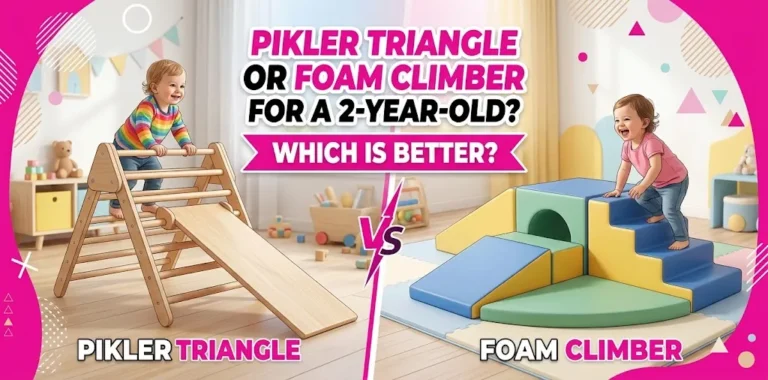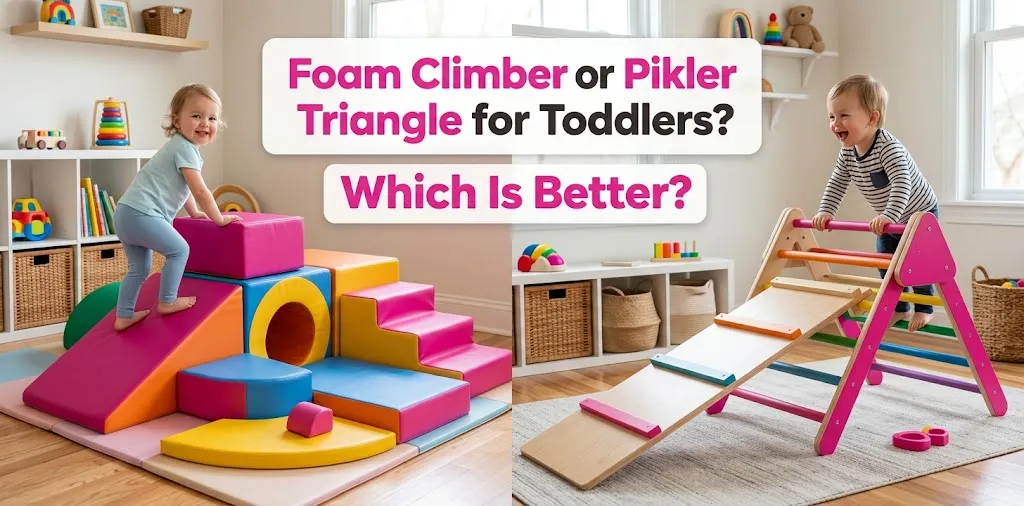
Foam Climber or Pikler Triangle for Toddlers? Which Is Better?

A foam climber is usually the better choice for younger or less-steady toddlers because its soft surface makes climbing and tumbling more forgiving. A Pikler triangle is often the better long-term choice for toddlers who are already confident on their feet and ready for more structured climbing, balance, and motor-planning challenges. The right choice depends on your child’s current skills, your space, and how you want the toy to be used.
For many parents, the decision is less about which toy is “better” and more about which type of climbing experience fits their toddler right now. Foam climbers offer soft, flexible play, while Pikler triangles provide a more defined climbing challenge. Current parenting and toy guides also tend to frame the choice around age, climbing ability, versatility, and available space.
Foam Climber vs. Pikler Triangle at a Glance
| Feature | Foam Climber | Pikler Triangle |
|---|---|---|
| Best fit | Younger or less-steady toddlers | Confident climbers and older toddlers |
| Main activity | Climbing, crawling, rolling, building | Climbing, balancing, pulling, descending |
| Surface | Soft foam | Usually solid wood |
| Fall impact | More forgiving | Requires more careful setup |
| Play style | Open-ended and flexible | More focused on climbing |
| Configuration | Pieces can often be rearranged | Usually one main climbing frame |
| Storage | Pieces may take up more floor space | Many models fold for storage |
| Motor challenge | Gentle to moderate | Moderate to challenging |
| Imaginative play | Strong, especially with multiple pieces | Strong with ramps, blankets, and accessories |
| Long-term use | Depends heavily on the design | Often useful as climbing ability develops |
| Best for small apartments | Depends on the set | Folding models can be convenient |
What Is a Foam Climber?
A foam climber is a set of soft, lightweight pieces that toddlers can climb over, crawl across, sit on, or arrange into different configurations. Common sets include wedges, steps, arches, tunnels, and ramps.
The biggest advantage is that the child does not have to climb a tall or rigid structure. A toddler can crawl up a low wedge, slide down a slope, move through a tunnel, or rearrange pieces for a new game.
That makes foam climbers particularly appealing for children who are still developing confidence with climbing.
Some parents also like them because the same pieces can be used for activities that do not involve climbing at all. A wedge can become a ramp for toy cars, while an arch can become a tunnel or part of a pretend-play setup.
What Is a Pikler Triangle?
A Pikler triangle is a freestanding wooden climbing frame shaped roughly like an upside-down V, with rungs that children can grip and step on. It is associated with the child-led movement philosophy of Hungarian pediatrician Dr. Emmi Pikler.
Instead of giving a toddler a soft pile of pieces to climb over, it creates a defined physical challenge.
A child may:
- Pull up on the rungs
- Climb from one rung to another
- Practice shifting weight
- Reach for the next handhold
- Climb up and back down
- Use a ramp or slide attachment on compatible models
- Turn the structure into part of pretend play
The main attraction is not simply reaching the top. The child has to figure out how to move their hands, feet, and body through the structure.
Which Is Better for a Younger Toddler?
For a toddler who is still unsteady, a foam climber often makes more sense.
If your child is crawling, pulling up, taking early steps, or frequently losing balance, a low foam setup provides an easier introduction to climbing. The soft material can also make accidental bumps less intimidating.
That does not mean a Pikler triangle is automatically inappropriate for every young toddler. Some children become interested in climbing early, and individual development varies. The important point is to follow the specific product’s age, size, weight, and use instructions rather than choosing solely by a child’s birthday.
Why foam can be a good first step
A foam climber lets a child experiment with movement without requiring them to immediately negotiate wooden rungs.
For example, a 14-month-old who is beginning to walk might crawl over a foam wedge, climb onto a low platform, and come back down. The activity can gradually become more challenging as the child becomes more confident.
Which Is Better for an Active Toddler?
For a toddler who already loves climbing furniture, stairs, cushions, or playground equipment, a Pikler triangle may offer a more interesting challenge.
The rungs give the child something specific to grip and step across. Climbing also requires coordination between the hands and feet, along with balance and body awareness. Pediatric physical-therapy sources commonly describe these types of movement as useful for gross-motor development.
There is another practical advantage: a Pikler triangle gives a climbing-focused toddler an activity designed specifically for climbing instead of encouraging them to climb a bookshelf, dresser, or other household furniture.
That distinction matters because the American Academy of Pediatrics recommends securing furniture that children might climb and warns about serious injuries from furniture tip-overs.
Foam Climber vs. Pikler Triangle for Gross Motor Play
Both can support active movement, but they do it differently.
A foam climber encourages a toddler to:
- Crawl
- Climb over low surfaces
- Push and pull pieces
- Step onto different heights
- Move through tunnels
- Rearrange the play area
- Combine several movements into one play sequence
A Pikler triangle focuses more strongly on:
- Climbing
- Pulling
- Gripping
- Balance
- Weight shifting
- Coordinating hands and feet
- Planning how to get up and down
Neither toy needs to be marketed as a tool that “teaches” a child to walk or climb. Instead, both provide opportunities for children to practice movement through play.
Which One Offers More Versatility?
Foam climbers usually win for physical flexibility.
The individual pieces can often be moved into different arrangements. A toddler might use them as a small climbing course one day and as tunnels, ramps, or pretend furniture the next.
Pikler triangles can be versatile in a different way.
A basic triangle can become more varied when paired with a compatible ramp, slide, arch, or other accessory. Some models are designed to fold for storage, while others are part of larger modular climbing systems.
So if by “versatile” you mean lots of different configurations, foam usually has the advantage.
If you mean a climbing structure that can provide progressively harder movement challenges, a Pikler triangle may have the edge.
Which Is Better for Small Spaces?
This depends on the particular product.
A compact Pikler triangle can be easier to keep in one location, and folding models can be stored when they are not being used. But the triangle still needs enough open space around it for safe climbing.
Foam climbers can be deceptively space-hungry because several individual pieces may spread across the floor.
Before buying either one, measure the actual play area rather than relying only on the product’s folded or packaged dimensions.
Leave enough room for the child to move around the equipment and for you to supervise comfortably.
Which One Is Safer?
Neither option should be considered completely risk-free.
A foam climber has one obvious advantage: the material is soft. That can make low falls and bumps less severe than contact with a hard wooden surface.
But foam does not eliminate risks. Pieces can slide, separate, or create gaps depending on their design and how they are positioned.
A Pikler triangle has a rigid structure and can involve greater climbing height. That makes setup, stability, surface selection, and supervision especially important.
The CPSC specifically warns that children can be injured when climbing equipment is placed on hard surfaces and advises against using climbing gyms on surfaces such as wood flooring, concrete, or asphalt.
The American Academy of Pediatrics also recommends soft surfaces under play equipment because falls are a major source of playground injuries.
Safe setup matters more than the material alone
For either toy:
- Follow the manufacturer’s age and weight recommendations.
- Inspect the equipment regularly for damage.
- Place climbing equipment on an appropriate impact-absorbing surface.
- Keep the surrounding area free of sharp furniture and other hazards.
- Supervise young children during climbing play.
- Do not encourage a child to climb higher than they can manage.
- Keep the climber away from windows, stairs, and unstable furniture.
The CPSC also emphasizes checking equipment condition and using age-appropriate equipment.
Foam Climber or Pikler Triangle for Different Toddler Ages?
Age can help narrow the choice, but developmental ability is more useful than age alone.
| Toddler stage | Often the better fit |
|---|---|
| Crawling or newly pulling up | Low foam climber |
| Early walking and still unsteady | Foam climber |
| Confident walking and climbing | Either, depending on setup |
| Regularly climbs furniture | Pikler triangle can provide a dedicated challenge |
| Strong climber who wants harder challenges | Pikler triangle |
| Child who loves building and rearranging | Foam climber |
| Child who loves climbing the same structure repeatedly | Pikler triangle |
These are general buying guidelines, not developmental rules. Toddlers develop movement skills at different rates, so the child’s actual abilities and the manufacturer’s instructions should guide the decision.
Two Real-World Examples
Imagine a 15-month-old who has recently started walking. The child enjoys crawling over couch cushions but still falls often when trying to climb. A low foam climber would likely be the easier starting point because it provides climbing opportunities without immediately introducing a rigid climbing frame.
Now consider a 2½-year-old who confidently climbs stairs, playground structures, and the couch. A Pikler triangle could offer a more focused challenge, especially if the child enjoys figuring out how to climb up and back down independently.
In both situations, the goal is not to make the child perform a specific exercise. The equipment simply gives them an appropriate place to explore movement.
What About Longevity?
A Pikler triangle may have an advantage if you are specifically looking for a climbing structure that can remain interesting as your toddler becomes more capable.
As climbing skills improve, the child can attempt different parts of the structure and experiment with new ways of moving.
Foam climbers can also last for years, but longevity depends heavily on the design. A simple low wedge may become less challenging as a strong climber grows, while a larger modular foam set can continue to offer new configurations.
If longevity is your priority, look at how many ways the specific product can be used, not just whether it is called a foam climber or Pikler triangle.
What Should You Choose?
Choose a foam climber if:
- Your toddler is young or still developing balance.
- You want a soft, forgiving climbing surface.
- Your child enjoys crawling, rolling, and climbing over objects.
- You want pieces that can be rearranged.
- You want climbing equipment that can also support open-ended play.
Choose a Pikler triangle if:
- Your toddler is already a confident mover.
- Climbing is one of their favorite activities.
- You want a dedicated climbing challenge.
- You value balance, gripping, and climbing practice.
- You want a structure that may remain challenging as climbing skills develop.
If you’re still unsure, watch how your child naturally plays. A toddler who spends the day crawling over pillows and building little obstacle courses may get more from foam pieces. A toddler who repeatedly tries to climb the couch, stairs, or playground ladder may be more interested in a Pikler-style climbing frame.
How Much Should You Spend?
There is no single price point that guarantees a better climbing toy.
Instead of choosing based only on price, compare:
- Materials
- Stability
- Construction quality
- Maximum weight
- Recommended age range
- Available play configurations
- Storage requirements
- Included accessories
- Ease of cleaning
- Warranty or manufacturer support
A cheaper product can make sense if it fits your child’s needs and has appropriate construction. A more expensive set may be worthwhile if its modular design gives your family substantially more ways to use it.
For an affiliate buyer, this is also an important distinction: a higher-priced climbing toy is not automatically a better choice for every toddler.
Which Is Better: Foam Climber or Pikler Triangle?
For younger toddlers and children who are still developing climbing confidence, I would lean toward a foam climber. It offers a softer, more flexible introduction to active play.
For confident toddlers who specifically enjoy climbing, a Pikler triangle is usually the more compelling choice. It provides a defined climbing challenge and can continue to offer new movement problems as the child becomes more capable.
If your budget and space allow it, having both can also make sense because they offer different types of play rather than simply duplicating each other.
The most important point is to choose equipment that matches your child’s current ability, follow the manufacturer’s instructions, and create a safe play area around it.
Frequently Asked Questions
Is a foam climber safer than a Pikler triangle?
A foam climber generally has a softer surface, which can make minor falls and bumps more forgiving. However, neither type is risk-free, and safe placement, equipment stability, appropriate use, and supervision still matter.
What age is best for a Pikler triangle?
There is no single “right” age for every child. Pikler triangles are used by babies and toddlers at different stages, but parents should follow the specific product’s age and weight limits and consider whether their child has the motor skills to use it safely.
Can a foam climber replace a Pikler triangle?
Yes, if your main goal is giving your toddler a place to climb, crawl, and explore movement. However, the two provide different experiences: foam climbers offer softer, more flexible configurations, while Pikler triangles provide a more defined climbing and balance challenge.
The Bottom Line
There is no universal winner between a foam climber and a Pikler triangle.
Foam is the better starting point for many younger or less-steady toddlers, while a Pikler triangle can be the better fit for confident climbers who are ready for a greater physical challenge.
Before buying, focus less on what is popular and more on what your toddler already tries to do. If they are constantly climbing cushions and building little obstacle courses, foam may be the better match. If they are determined to climb every ladder and piece of furniture they can find, a well-chosen Pikler triangle may give that energy a more appropriate place to go.