Foam Blocks or Foam Climber for Toddlers? Which Is Better?

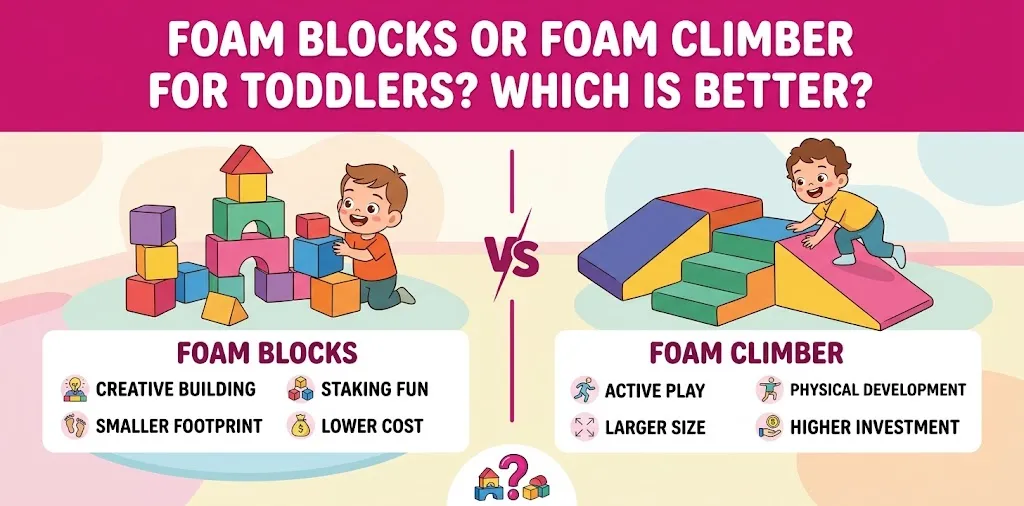
If your toddler mainly enjoys building, stacking, knocking things down, and imaginative play, foam blocks are usually the better choice. If your child is constantly climbing, crawling, stepping, and looking for physical challenges, a foam climber is usually a better fit. The right choice depends on how your toddler plays, your available space, and how much active supervision you can provide.
Foam Blocks vs. Foam Climber: What Is the Difference?
Foam blocks and foam climbers can look similar, but they are designed for different types of play.
Foam blocks are usually loose, soft pieces that toddlers can stack, carry, arrange, knock over, or use in pretend games. Some larger sets can also support simple climbing or crawling, depending on the manufacturer’s instructions.
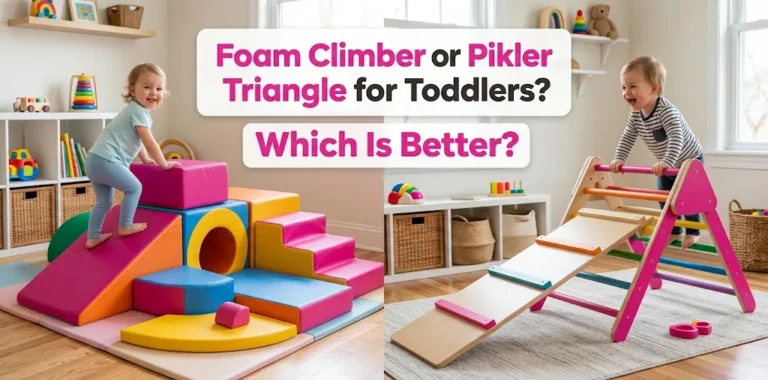
Foam climbers are designed more specifically for movement. They may include pieces such as ramps, steps, wedges, arches, or platforms that encourage toddlers to climb over, crawl through, step up, and move around.
The main difference is simple: foam blocks are more open-ended, while foam climbers are more movement-focused.
| Feature | Foam Blocks | Foam Climber |
|---|---|---|
| Main purpose | Building and imaginative play | Climbing and active movement |
| Best for | Toddlers who like stacking and creating | Toddlers who love climbing and exploring |
| Gross motor play | Moderate | Strong |
| Open-ended play | Excellent | Good |
| Building | Excellent | Limited to the set’s shapes |
| Space needed | Usually moderate | Often more floor space |
| Storage | Easier for smaller sets | Can take more room |
| Parent involvement | Often lower | Usually higher during climbing |
| Best choice for | Creative, construction-focused play | Active, movement-focused play |
When Foam Blocks Are the Better Choice
Foam blocks make more sense when you want one toy that can support several types of play without being built around climbing.
A toddler can stack two or three blocks, knock them down, make a pretend house, create a simple obstacle course, or use the pieces as part of another game. The play can change as the child gets older and develops new ideas.
Choose foam blocks if your toddler likes building
If your child spends a lot of time stacking cups, making towers, arranging toys, or putting objects together, large foam blocks can be a natural next step.
They also tend to be less structured. There is no single “correct” way to use them, which gives toddlers room to experiment.
For example, a 2-year-old might stack blocks into a tower in the morning and turn them into pretend furniture later. That flexibility can make a basic set useful beyond one type of activity.
Foam blocks can work well in smaller spaces
If you live in an apartment or have a small play area, a modest foam block set may be easier to manage than a full climbing setup.
The important thing is to consider the size of the individual pieces, not just the number of pieces. A six-piece set of large blocks can take more storage space than a larger set of small blocks.
Foam blocks are better for open-ended play
Foam blocks can support building, pretend play, sorting, stacking, carrying, and simple obstacle courses.
That makes them a good option if you don’t want your toddler’s play to revolve around climbing.
When a Foam Climber Is the Better Choice
A foam climber is a stronger choice when your toddler wants to move constantly.
Some children would rather climb over a cushion than sit and build a tower. For those toddlers, a climbing set can give their active play a more appropriate place to happen.
Choose a foam climber for active toddlers
If your toddler regularly tries to climb onto the couch, chairs, or other household furniture, a purpose-designed soft play setup may provide a more suitable activity.
Foam climbers commonly combine shapes such as ramps, wedges, steps, and other soft-play pieces. They can create simple routes where a child climbs up, moves across, and comes back down.
However, a foam climber does not make climbing risk-free. The CPSC has emphasized that climbing equipment needs appropriate surfaces and supervision because falls can cause serious injuries.
Foam climbers offer more gross motor play
Climbing, crawling, stepping, balancing, and moving around obstacles all require body movement and coordination.
That makes a foam climber especially appealing for toddlers who seem to have more energy than a traditional floor toy can handle.
The goal isn’t simply to “tire out” your child. A good setup gives them a place to practice movement while still allowing play to remain fun and flexible.
A climber can become an indoor movement zone
A foam climber can be useful when outdoor play isn’t always practical.
For example, a toddler who wants to climb after coming inside from daycare might use a small foam ramp and step configuration for supervised indoor play instead of trying to climb furniture.
The setup should always follow the product’s age, weight, configuration, and use instructions.
Which One Is Safer for Toddlers?
Neither option is automatically safe just because it is made from foam.
Foam can reduce the impact of bumps compared with harder materials, but the way the product is designed and used still matters. A foam structure can tip, move, create gaps, or be used in a way the manufacturer did not intend.
The CPSC distinguishes different types of children’s climbing and play equipment and notes that applicable safety requirements depend on how a product is designed and marketed.
When shopping, look for:
- A clearly stated age range
- Manufacturer instructions
- Appropriate weight limits, if provided
- Stable construction
- Durable, securely attached covers
- No accessible damaged foam
- No unexpected openings or gaps created during normal assembly
- A play area that gives your toddler enough room to move safely
- A manufacturer that provides clear product and safety information
Supervision is particularly important when a toddler is climbing. CPSC safety materials also emphasize the importance of keeping children in age-appropriate play areas and supervising active play.
Which Is Better for a 1-Year-Old?
For a 1-year-old, foam blocks may be the more flexible starting point, but the specific product and the child’s developmental abilities matter more than the label “toddler.”
A newly walking toddler may enjoy pushing, carrying, stacking, and crawling around large soft pieces. A more mobile child may also enjoy a low, appropriately designed foam climbing setup.
Don’t choose a climber simply because the packaging says it is for toddlers. Check the manufacturer’s recommended age and intended use, and avoid configurations that create unnecessary fall risks.
Which Is Better for a 2-Year-Old?
For many 2-year-olds, the choice becomes more dependent on personality.
An active 2-year-old who loves climbing may get more value from a foam climber. A child who prefers construction and pretend play may use foam blocks more often.
If you’re unsure, watch what your child already does.
If they climb furniture: lean toward a foam climber.
If they build and stack: lean toward foam blocks.
If they do both: a modular foam set that supports both building and movement may be worth considering.
Which Is Better for a 3-Year-Old?
At age 3, a foam climber can still be useful, especially for a child who enjoys physical play. But the set needs to remain appropriate for the child’s size and ability.
Foam blocks can also become more interesting at this age because children can use them for more elaborate pretend structures and simple obstacle courses.
For a 3-year-old, consider how long the toy is likely to remain interesting, rather than choosing based only on today’s favorite activity.
What About Space and Storage?
Space can make the decision much easier.
A foam climber usually needs a clear floor area during use because the pieces need to be arranged with enough room around them. A larger modular set can also become difficult to store.
Foam blocks may be easier to put into a toy corner or storage area, particularly when the pieces are smaller.
Before buying, measure the area where your toddler will actually play. Then consider the space required when the pieces are spread out, not just when they are stacked together.
Foam Blocks or Foam Climber: Which Gives Better Value?
Value depends on how often your toddler will actually use the toy.
A cheaper set that sits untouched in a corner isn’t necessarily a better purchase than a more expensive set that your child uses every day.
| If your priority is… | Better choice |
|---|---|
| Building towers | Foam blocks |
| Pretend play | Foam blocks |
| Stacking and knocking down | Foam blocks |
| Climbing | Foam climber |
| Crawling and stepping | Foam climber |
| Balance practice | Foam climber |
| Indoor active play | Foam climber |
| Flexible play ideas | Foam blocks |
| Smaller play area | Usually foam blocks |
| A dedicated movement activity | Foam climber |
Two Real-World Buying Scenarios
Scenario 1: The furniture climber
Imagine your 2-year-old spends most of the afternoon trying to climb onto the couch.
In this situation, foam blocks may still be useful, but a properly designed foam climber is more closely matched to the child’s interest. A low ramp, step, or climbing shape can provide a more intentional movement activity while an adult supervises.
The key is not to assume that the foam climber eliminates the risk of falling. It simply gives the child an age-appropriate play option designed around movement.
Scenario 2: The little builder
Now imagine your 2-year-old spends most of the day stacking blocks, making towers, pretending to build houses, and carrying pieces around the room.
A foam block set is probably the better purchase. The child can use the same pieces in many different ways instead of being limited to a climbing route.
This type of play may also remain useful as the child’s imagination develops.
What Should Parents Check Before Buying?
Don’t choose based only on bright colors or the number of pieces.
Check the product information carefully and ask:
- Is the age range appropriate for my child?
- What does the manufacturer actually say the pieces are designed for?
- How large is the setup when fully assembled?
- Will I have enough clear floor space?
- Can the covers be cleaned easily?
- Are the seams and covers well constructed?
- Does the manufacturer provide clear safety and use instructions?
- Will my toddler still be interested in it several months from now?
Be cautious about relying on vague claims such as “100% safe” or “injury-proof.” No soft toy can remove every risk associated with active toddler play.
Which Should You Buy?
Choose foam blocks if your main goal is flexible, open-ended play. They are particularly useful for toddlers who enjoy stacking, building, carrying, and pretend play.
Choose a foam climber if your toddler’s main interest is physical movement. It is a better match for children who want to climb, crawl, step, balance, and create simple indoor movement routes.
If your toddler enjoys both, look for a modular set that combines large soft pieces with climbing-friendly shapes. Just make sure the product is intended for your child’s age and use it according to the manufacturer’s instructions.
FAQs
Are foam blocks good for toddlers?
Yes, appropriately designed foam blocks can be useful for toddler building, stacking, pretend play, and supervised movement. Choose pieces that match the manufacturer’s recommended age and intended use.
Is a foam climber worth it for a 2-year-old?
A foam climber can be a worthwhile choice for a 2-year-old who enjoys climbing and active indoor play. The value depends on how often the child uses it, the available space, and whether the setup is appropriate for the child’s age and abilities.
Can toddlers climb on foam blocks?
Some large foam blocks are specifically designed to support climbing or active play, while others are intended only for building. Always follow the manufacturer’s instructions rather than assuming that every foam block can safely support a child’s weight.
The Bottom Line
For most families, the decision comes down to what your toddler naturally wants to do. Foam blocks are the better all-around choice for building and imaginative play, while a foam climber makes more sense for toddlers who are constantly moving and climbing.
Before buying, watch your child’s current play habits, measure your available floor space, and check the product’s age and safety instructions. Choose the toy that matches how your toddler actually plays—not simply the one with the most pieces.