Activity Table or Busy Board for a 2-Year-Old? Which Is Better?

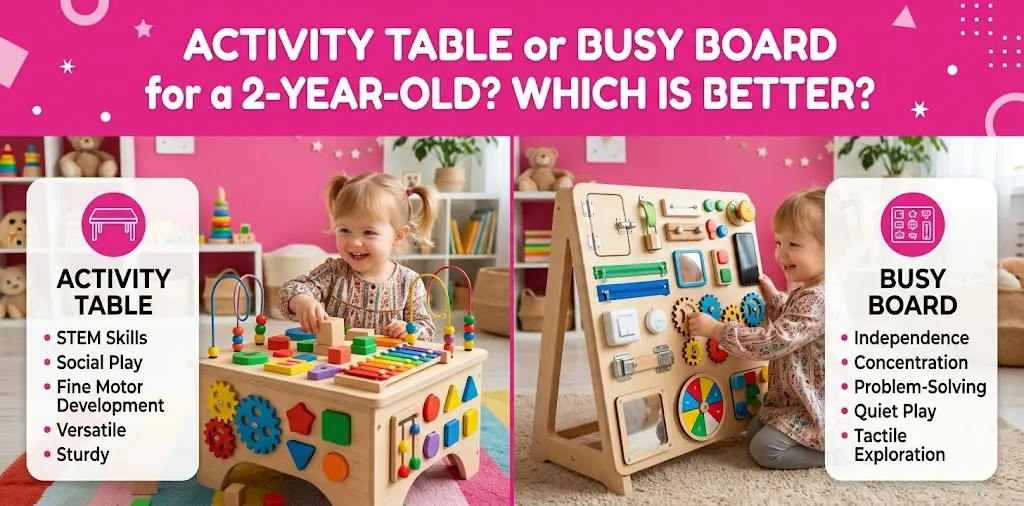
For most 2-year-olds, an activity table is the better choice for active, varied play at home, while a busy board is better for focused fine-motor practice, practical-life activities, and smaller spaces. If your toddler enjoys buttons, gears, zippers, locks, and figuring out how things work, a busy board may hold their attention longer. If they enjoy standing, moving around, music, pretend play, and multiple activities in one place, an activity table is usually the more versatile pick.
The right choice depends less on the label and more on how your 2-year-old likes to play. At this age, toddlers are becoming better at manipulating objects, turning handles, using zippers, building, drawing, and working with their hands.
Activity table vs. busy board at a glance
| Feature | Activity Table | Busy Board |
|---|---|---|
| Best for | Active, varied play | Focused hands-on play |
| Typical position | Standing or sitting | Sitting, standing, or wall-mounted |
| Play style | Buttons, music, gears, pretend activities | Zippers, latches, switches, locks, wheels |
| Fine-motor practice | Good | Excellent |
| Movement | More | Less |
| Portability | Usually low | Often better |
| Space needed | More | Less |
| Independent exploration | Good | Very good |
| Best for small homes | Sometimes difficult | Usually easier |
| Good for travel | Usually not | Some compact boards are |
| Ideal child | Likes variety and movement | Likes figuring out mechanisms |
What is an activity table for a 2-year-old?
An activity table is a toddler-sized play station with several activities built into the tabletop or sides. Depending on the design, it may include gears, buttons, tracks, shape activities, musical elements, spinning pieces, pretend-play features, or other hands-on activities.
The main advantage is variety. Instead of asking a toddler to master one type of movement, an activity table can let them switch between several activities during the same play session.
For a 2-year-old who gets bored quickly, that variety can be useful.
Some activity tables are also designed for children to stand and move around them, while others can be used while sitting. That makes them a better fit for toddlers who do not want to stay in one position for long.
What an activity table does well
An activity table can be a strong choice if your child:
- Likes pressing buttons and turning knobs
- Enjoys music or sound-producing activities
- Moves frequently while playing
- Likes switching between different activities
- Enjoys cause-and-effect toys
- Plays with a toy for a few minutes before moving to something else
- Has enough floor space for a larger toy
The American Academy of Pediatrics notes that hands-on toys such as blocks, shapes, and puzzles can encourage problem-solving and fine-motor skills, while imaginative play also supports children’s development.
What is a busy board for a 2-year-old?
A busy board, sometimes called an activity board or sensory board, is a board with hands-on mechanisms that children can manipulate.
Common features include:
- Zippers
- Buckles
- Latches
- Large switches
- Wheels
- Knobs
- Gears
- Doors
- Simple locks
- Velcro
- Sliding pieces
- Matching activities
For a 2-year-old, the appeal is often the process of figuring out how something works.
A child may open a latch, close it, try again, move a slider, or work out how a zipper operates. That type of repeated manipulation fits well with the hand and finger skills many children are developing around age two.
What a busy board does well
A busy board may be the better option if your child:
- Loves zippers and buckles
- Is fascinated by doors, switches, and locks
- Likes taking things apart or figuring out how they work
- Enjoys repeating the same action
- Prefers quieter play
- Has limited space at home
- Needs a compact activity for travel
- Enjoys practical-life activities
A busy board can also change as a child becomes more capable. A simple activity that was frustrating at 18 months may become easy and enjoyable at age two, while more challenging mechanisms can provide something new to figure out.
Which is better for fine-motor skills?
A busy board usually has the edge for focused fine-motor practice.
Its activities require children to use their fingers and hands for specific movements. Zipping, fastening, turning, sliding, pressing, and opening all require controlled hand movements.
That makes a busy board particularly appealing for a 2-year-old who already enjoys manipulating small objects.
An activity table can also provide fine-motor practice, especially when it has gears, sliders, buttons, and other manipulatives. The difference is that the table usually combines those skills with more variety and movement.
At age two, children are typically becoming more capable with tasks such as turning doorknobs, unzipping larger zippers, manipulating objects, and using their hands with greater coordination.
Which is better for independent play?
A busy board often works better for focused independent exploration, but neither toy guarantees independent play.
A toddler may spend several minutes repeatedly opening a latch or moving a gear without needing much help. Another child may lose interest quickly.
Activity tables can encourage independent exploration too, especially when they offer several simple activities that do not require adult instruction.
The important factor is whether the activities are challenging without being frustrating.
If a 2-year-old cannot operate most of the features, the toy may become something they ask an adult to solve rather than something they explore independently.
Which is better for an active 2-year-old?
Choose an activity table.
If your toddler is constantly moving, standing, walking around toys, and changing activities, an activity table generally offers a better match.
A busy board is more focused. Even if it can be mounted at standing height, much of the play involves staying in one place and manipulating individual components.
An activity table gives an active toddler more opportunities to move around the toy while changing from one activity to another.
Which is better for a toddler who loves locks, zippers, and switches?
Choose a busy board.
This is probably the clearest situation where a busy board makes more sense.
If your 2-year-old already tries to open cabinets, pull zippers, press switches, turn knobs, or fasten buckles, a well-designed busy board can give them a safer toy-based way to practice similar movements.
The key is to choose activities that match the child’s current ability. A board that is packed with difficult locks may be more frustrating than useful.
Which is better for small spaces?
A busy board is usually the easier choice.
An activity table needs floor space and a place where the child can comfortably stand or sit around it.
A busy board can be much more compact. Some can sit on a lap, rest on a table, or be mounted securely to a suitable surface.
For an apartment, small playroom, or home where floor space is limited, the difference can matter more than the number of activities included.
Which is better for travel?
A compact busy board is usually the better travel option.
An activity table is generally too large to make sense for most car trips, flights, restaurants, or waiting rooms.
A lightweight busy board can be easier to pack and bring out when a toddler needs a quiet hands-on activity.
However, not every busy board is travel-friendly. A large wooden board with heavy components may be just as inconvenient as other bulky toys.
For travel, look for:
- Compact dimensions
- Securely attached parts
- No loose pieces
- A manageable weight
- Activities that do not make excessive noise
Which one offers more variety?
Usually the activity table.
Activity tables are often designed around several different types of play. One side may have a gear activity, another may have buttons, and the top may include a separate play surface.
Busy boards can also contain many activities, but their overall play style is usually more focused on manipulating mechanisms.
If your child likes switching from one activity to another, the activity table may stay interesting longer.
If your child enjoys mastering one mechanism and then moving to the next, a busy board may be just as engaging.
Which one is better for a 2-year-old who gets frustrated easily?
This depends on why the child becomes frustrated.
If your toddler becomes frustrated because a toy is too difficult, choose a simpler design. A busy board with complicated locks and tiny mechanisms may not be the best choice.
If your toddler becomes frustrated because they get bored quickly, an activity table with several easy-to-understand activities may work better.
A good rule is to look for a toy that offers a small amount of challenge without requiring constant adult help.
What should you look for when buying either toy?
Age labeling should be the first filter, not the last. The CPSC recommends choosing toys based on a child’s age, skills, abilities, and interests and following the safety information on the packaging.
For an activity table
Look for:
- A stable base
- Sturdy construction
- Activities that are easy for a 2-year-old to reach
- Large, easy-to-manipulate pieces
- Smooth edges
- Securely attached components
- A design that matches your child’s interests
- Reasonable sound levels if the table is electronic
A table with dozens of flashing buttons is not automatically better than a simpler one. The quality and usefulness of the activities matter more than the number of features.
For a busy board
Look for:
- Age-appropriate mechanisms
- Large, securely attached components
- Easy-to-grip pieces
- Zippers, sliders, switches, or latches that provide an achievable challenge
- Smooth edges and surfaces
- Strong attachment points
- A stable design
- No loose pieces that could become hazardous
Avoid choosing a board simply because it has the most locks, buckles, or gadgets.
Safety matters more than the number of activities
A 2-year-old is still within the age range where choking hazards require particular attention. The CPSC says toys intended for children under 3 must not contain small parts that present a choking hazard, and parents should follow age guidance and safety information.
Before giving a busy board or activity table to a toddler, check it carefully.
Look for:
- Loose screws
- Parts that can detach
- Cracked plastic
- Sharp or rough edges
- Broken components
- Loose magnets
- Small pieces that have come away from the toy
Also check the toy periodically. A component that was securely attached when new can become loose after repeated pulling and twisting.
If the manufacturer specifies adult supervision, follow that guidance.
Activity table or busy board: which one should you buy?
The decision becomes easier when you focus on your child’s actual play style.
| If your 2-year-old… | Better choice |
|---|---|
| Loves buttons, sounds, and music | Activity table |
| Loves zippers and buckles | Busy board |
| Moves around constantly | Activity table |
| Likes figuring out how things work | Busy board |
| Gets bored with one activity quickly | Activity table |
| Prefers quiet, focused play | Busy board |
| Has limited floor space | Busy board |
| Needs a toy mainly for home play | Activity table |
| Needs something easier to take on trips | Busy board |
| Enjoys several types of play | Activity table |
| Likes repeating the same action | Busy board |
Scenario 1: The active explorer
Imagine a 2-year-old who walks around the room, presses every button they see, enjoys music, and rarely stays with one activity for long.
For this child, an activity table is likely the better fit because it offers multiple activities and supports a more active style of play.
Scenario 2: The little problem-solver
Now imagine a toddler who spends several minutes trying to open a zipper, close a buckle, turn a knob, or figure out a latch.
A busy board is probably the stronger choice. It gives the child more opportunities to practice exactly the type of hands-on manipulation they already enjoy.
Can a 2-year-old have both?
Yes. They serve different purposes, so owning both can make sense if you have the space and budget.
An activity table can provide variety and more active play, while a busy board can be brought out for quieter, focused activities.
You also do not need to buy both at the same time. If your child already has several active toys, a busy board may add something different. If they already have puzzles, books, and hands-on boards, an activity table may provide more variety.
Is a busy board too simple for a 2-year-old?
No. A busy board is not automatically too simple at age two.
In fact, many 2-year-olds are developing the hand control needed for activities such as zippers, turning mechanisms, and other manipulatives.
The important question is whether the specific board is appropriate for your child.
A board designed for a younger toddler may become boring once the child has mastered every activity. A board intended for older children may be unnecessarily difficult.
Look for something that gives your child a few easy wins and a few activities that require practice.
Is an activity table better than a busy board for learning?
Not necessarily.
Both can provide hands-on learning, but they encourage different types of play.
A busy board is particularly useful for manipulation and practical-life-style activities, while an activity table may provide a broader mixture of sensory, cause-and-effect, musical, and problem-solving activities.
Neither toy replaces books, conversation, creative play, outdoor play, or play with caregivers. The American Academy of Pediatrics emphasizes that human interaction remains important to children’s development, even as toys provide opportunities for exploration and skill-building.
Frequently Asked Questions
Is an activity table or busy board better for a 2-year-old?
For most families, an activity table is better for a toddler who enjoys variety, movement, and multiple types of play. A busy board is the better choice when the child prefers zippers, locks, switches, and focused hands-on activities.
What should a 2-year-old have on a busy board?
A good busy board can include age-appropriate zippers, large buckles, sliders, knobs, switches, wheels, and simple latches. Choose features that the child can operate with some effort, while avoiding small detachable parts and activities that are clearly intended for older children.
Are busy boards safe for 2-year-olds?
They can be appropriate when the specific product is designed and labeled for the child’s age and is made with securely attached components. Check the toy regularly for loose or broken parts, follow the manufacturer’s safety instructions, and avoid small parts that can create choking hazards for children under 3.
The bottom line
For a 2-year-old who loves movement, music, buttons, and variety, choose an activity table. For a toddler who enjoys zippers, buckles, locks, switches, and figuring out how things work, a busy board is usually the better match.
If you are unsure, pay attention to what your child already reaches for around the house. Their natural interests are often a better buying guide than choosing a toy simply because it has more features. And whichever option you choose, prioritize age-appropriate design, sturdy construction, and safe, securely attached parts.