Push Toy or Ride-On Toy for a 2-Year-Old? Which Is Better?

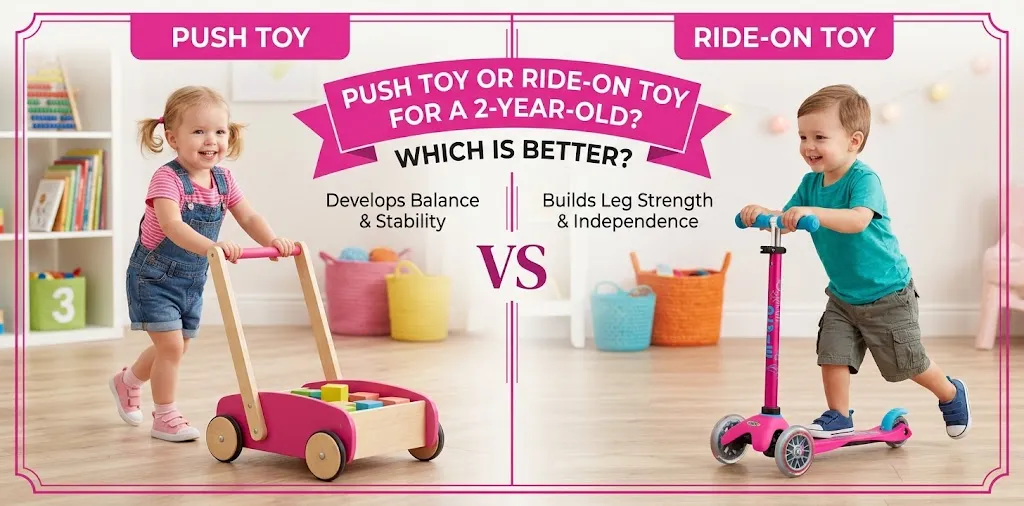
For most 2-year-olds, a ride-on toy is the better choice if the child already walks and runs confidently, while a push toy can be better for a toddler who is still working on balance, steering, or controlled movement. The right choice also depends on where the toy will be used, how much space you have, and whether your child prefers active riding or pushing and pretend play.
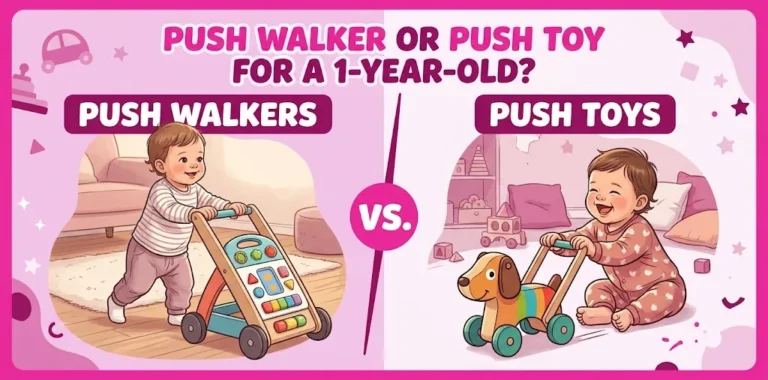
The Main Difference Between Push Toys and Ride-On Toys
At age 2, children are becoming more confident movers. Many can walk independently, begin running, kick a ball, climb onto furniture, and carry toys while walking.
That makes both push toys and ride-on toys useful, but they encourage slightly different types of play.
| Feature | Push Toy | Ride-On Toy |
|---|---|---|
| Main movement | Child pushes the toy | Child sits and moves the toy |
| Best for | Walking, pushing, pretend play | Riding, steering, balance, movement |
| Physical challenge | Standing and walking while pushing | Leg movement, balance and coordination |
| Parent involvement | Usually low | Usually low, unless it has a push handle |
| Indoor use | Often easier | Needs more open floor space |
| Best fit for a 2-year-old | Children who enjoy pushing or are still developing confidence | Confident walkers who enjoy moving around independently |
The terms can also overlap. Some toddler vehicles are designed to work as both a push toy and a ride-on, giving parents more flexibility as the child develops.
Which Is Better for a 2-Year-Old?
If your 2-year-old is already a confident walker and enjoys moving around, I would generally choose a simple foot-to-floor ride-on toy over a basic push toy.
A foot-to-floor ride-on lets the child sit securely while using their feet to move forward, backward, and around obstacles. It also gives them opportunities to practice steering and controlling their own movement.
The American Academy of Pediatrics includes push and ride-on toys among physical-activity toys that can support children’s physical development.
However, that does not mean every 2-year-old needs a ride-on. A push toy may be the better fit when the child enjoys walking behind a toy, pushing objects around the house, or using toys for pretend play.
Choose a push toy if your child…
- Enjoys pushing shopping carts, strollers, or similar objects.
- Is still developing confidence with balance and walking.
- Likes pretend play more than sitting and riding.
- Has limited indoor space.
- Frequently plays indoors on surfaces where a ride-on is difficult to maneuver.
For a 2-year-old, CPSC guidance describes suitable push-and-pull toys as sturdy, rounded, and stable, with broad bases and low centers of gravity being useful characteristics.
Choose a ride-on toy if your child…
- Walks and runs confidently.
- Enjoys cars, trucks, tractors, or other vehicle-style toys.
- Likes moving quickly from one area to another.
- Can sit down and get off the toy without much help.
- Has enough safe floor or outdoor space to ride.
CPSC guidance specifically notes that 2-year-olds show interest in realistic ride-on vehicles and ride-ons with storage areas, while small tricycles become more appropriate as children begin pedaling around 2½ to 3 years.
Why a Ride-On Toy Can Be a Good Choice at Age 2
A ride-on is more than a toy car. A well-designed foot-to-floor model gives a toddler a chance to control their own movement.
The child has to coordinate several actions at once: sit securely, place their feet on the floor, push, slow down, turn the steering wheel, and avoid objects.
That makes a ride-on especially appealing to a 2-year-old who has already developed basic walking skills.
It can also encourage pretend play. A toddler may pretend to drive to the store, carry stuffed animals in a storage compartment, or imitate the way adults drive a car.
At this age, pretend play becomes increasingly important, and toddlers often imitate the actions they see adults perform.
Why a Push Toy Can Still Be the Better Choice
A push toy should not be viewed as a “younger” or less useful option.
Some 2-year-olds simply get more meaningful play from pushing than riding. A pretend lawn mower, shopping cart, wagon, or similar toy can encourage walking, carrying, pushing, and imaginative play.
CPSC guidance for 2-year-olds specifically includes push toys that resemble familiar adult equipment, such as lawnmowers, vacuum cleaners, and shopping carts.
Push toys can also make more sense in a smaller home. A toddler can push one around a hallway or open room without needing the same turning space required by a larger ride-on vehicle.
The Best Middle Ground: A Convertible Toy
If you are unsure which type to buy, a 2-in-1 push-and-ride toy can solve the problem.
These toys typically allow a parent or child to push the vehicle when the child wants to sit, while a removable floorboard or similar design allows the toddler to use their feet to propel it independently.
This type of design can be useful because a 2-year-old’s abilities can change quickly. A child who needs help today may be confidently steering the same toy a few months later.
A real-world example would be a newly confident 2-year-old who still has trouble steering around furniture. A parent could use the push function in a controlled area and later allow the child to use the foot-to-floor mode independently.
Another example is a confident 2-year-old who already loves riding. A convertible model can provide independent riding while still giving parents a way to move the child when they are tired.
What Matters More Than Push vs. Ride-On
The type of toy matters, but fit and safety matter more.
Before buying, look at these factors:
Stability
Choose a toy with a wide, stable base that does not easily tip when the child turns or leans.
For ride-on toys, stability is especially important because the child’s weight shifts while steering and pushing with their feet. CPSC toy safety requirements include stability standards for ride-on toys.
Size and fit
Your child’s feet should be able to reach the floor comfortably on a foot-to-floor ride-on.
A toy that is too large can make it difficult for a toddler to control their movement. A toy that is too small may become uncomfortable quickly.
Do not rely only on the age printed on the package. Check the manufacturer’s height, weight, and other fit recommendations when available.
Steering
Simple steering is usually better for a 2-year-old than a complicated control system.
The child should be able to understand how turning the wheel changes direction without needing advanced coordination.
Speed
For a 2-year-old, there is little reason to choose a fast motorized vehicle simply because it looks exciting.
CPSC guidance notes that children at this age may not yet have the steering skills needed to avoid obstacles and hazards with motorized vehicles.
A simple foot-powered ride-on gives the child much more direct control over their speed.
Where the toy will be used
Think about your actual home before buying.
If you live in a smaller apartment, a large ride-on may become frustrating because the child has nowhere to turn. If you have a flat, enclosed yard or large play area, a ride-on may provide much more enjoyable play.
Never allow a toddler to use a riding toy in the street or driveway. The American Academy of Pediatrics warns that driveways and streets can be dangerous places for young children.
Age and safety labeling
Always follow the manufacturer’s age guidance and safety instructions.
The CPSC recommends choosing toys that match a child’s age, interests, and abilities. It also recommends paying attention to safety information and using appropriate safety gear for riding toys when applicable.
What About Battery-Powered Ride-On Cars?
For a 2-year-old, a battery-powered ride-on car is usually not the first type I would choose.
The attraction is obvious: the child can sit in a realistic-looking vehicle and use controls to move around. But powered movement introduces another layer of control that a young toddler may not be ready to manage safely.
A simple foot-to-floor ride-on is generally easier for a 2-year-old to control because the child creates the movement directly with their feet.
If you are considering a powered vehicle, follow the exact manufacturer’s age and safety requirements rather than assuming that every 2-year-old can use one.
Push Toy vs. Ride-On Toy: Which One Should You Buy?
The simplest way to decide is to start with your child’s current behavior rather than the toy’s appearance.
| If your child… | Better choice |
|---|---|
| Loves pushing objects around | Push toy |
| Is still gaining confidence with balance | Push toy |
| Loves pretend household activities | Push toy |
| Walks and runs confidently | Ride-on |
| Loves cars and vehicles | Ride-on |
| Enjoys steering and exploring | Ride-on |
| Has limited indoor space | Smaller push toy |
| You want one toy that can adapt | Convertible push-and-ride toy |
If your child fits both sides, a convertible model may offer the most flexibility.
Common Mistakes Parents Make
One mistake is buying based only on appearance. A large, realistic vehicle may look exciting, but that does not mean it will be easy for a 2-year-old to control.
Another mistake is buying a toy that is too advanced. More buttons, faster movement, and extra electronic features do not automatically make a toy better.
It is also easy to overlook the play environment. A ride-on that works beautifully in a large playroom may be frustrating in a small living room.
Finally, remember that supervision still matters. Toddlers are curious and can move into unsafe areas quickly. Riding toys should be used in a controlled space away from stairs, traffic, pools, and other hazards.
Frequently Asked Questions
Is a push toy or ride-on toy better for a 2-year-old?
For a confident 2-year-old walker, a simple foot-to-floor ride-on is often the more engaging choice because it combines movement with steering and independent play. A push toy can be better for a child who prefers walking while pushing or is still developing confidence with balance.
Can a 2-year-old use a ride-on toy?
Yes, many ride-on toys are designed for toddlers, but the correct age range depends on the specific toy. Choose a stable model that fits the child’s size and abilities, and follow the manufacturer’s age and safety instructions.
Should I buy a battery-powered ride-on car for a 2-year-old?
A simple foot-powered ride-on is usually a better starting point for a 2-year-old than a powered vehicle. Young toddlers may not yet have the steering and hazard-avoidance skills needed for motorized ride-on toys, so the manufacturer’s age guidance and close supervision are especially important.
The Bottom Line
For most confident 2-year-old walkers, a stable foot-to-floor ride-on toy is the better choice if you have enough safe space for riding. It gives the child more control and combines movement, steering, balance, and pretend play.
Choose a push toy instead if your child enjoys walking and pushing, has limited space, or is still building confidence with movement. If you want flexibility, a well-designed push-and-ride toy can give you the advantages of both without buying two separate toys.
The best practical tip is to match the toy to what your child can comfortably control today, not simply what looks most exciting on the shelf.