Balance Bike or Scooter for a 2-Year-Old? Which Is Better?

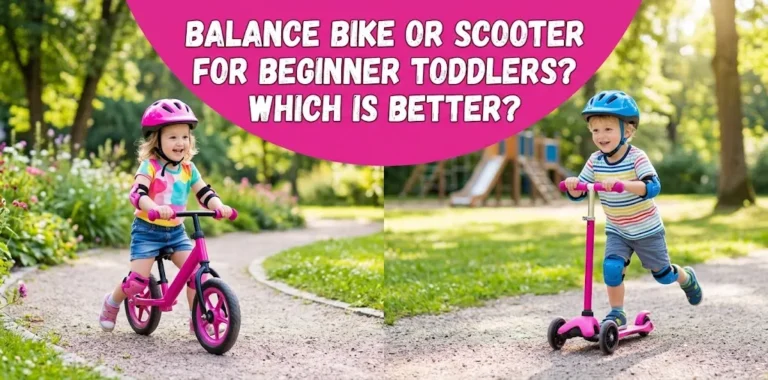
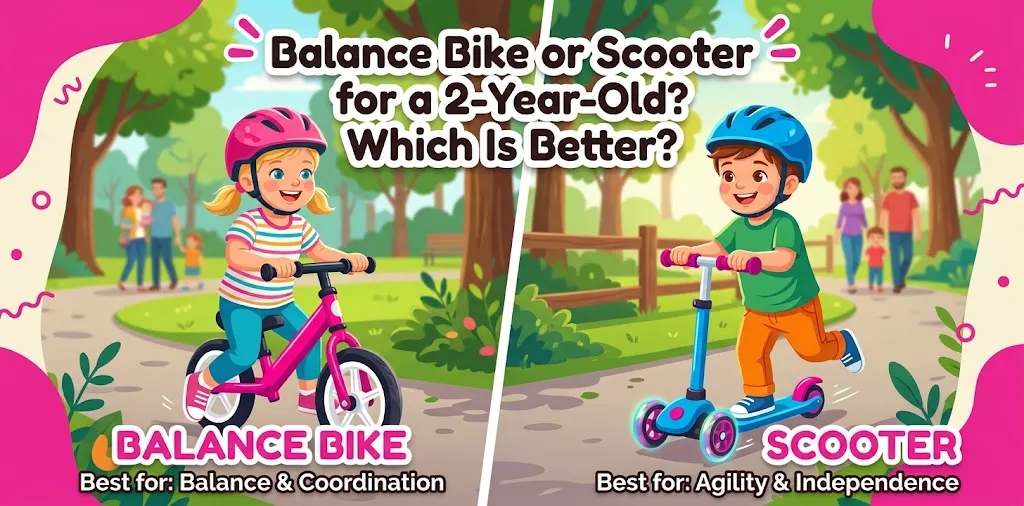
For most 2-year-olds, a balance bike is the better choice if your goal is to build skills for future bicycle riding. A stable three-wheel scooter can be easier for some toddlers to enjoy right away. The best choice depends on your child’s coordination, confidence, size, and interest—not age alone.
Both can be good outdoor toys, but they teach movement in different ways. A balance bike asks a toddler to sit, steer, push with both feet, and eventually glide on two wheels. A toddler scooter usually lets the child stand on a deck, hold the handlebars, and push with one foot.
For a 2-year-old, the comparison should also be between a balance bike and a non-motorized three-wheel toddler scooter. An electric scooter is not an appropriate alternative. The American Academy of Pediatrics recommends that children under 16 should not operate or ride motorized or e-scooters.
| Factor | Balance Bike | Three-Wheel Scooter |
|---|---|---|
| Best for | Learning early bike skills | Simple riding and outdoor play |
| Riding position | Seated | Standing |
| How the child moves | Pushes with both feet | Pushes mainly with one foot |
| Balance required | More two-wheel balance | Usually more stable at low speeds |
| Bike-skill transfer | Strong | Less direct |
| Learning curve | May take more patience | Some toddlers understand it quickly |
| Fit for a cautious toddler | Depends on seat height and confidence | Stable models may feel less intimidating |
| Portability | Usually larger | Often compact and lightweight |
| Best long-term goal | Moving toward a pedal bike | Recreational scooting |
Why a Balance Bike Often Makes More Sense at Age 2
A balance bike looks like a small bicycle without pedals. Instead of pedaling, your child sits on the seat and walks or pushes the bike along with their feet.
At first, a 2-year-old may simply walk while sitting on it. That is normal. As confidence grows, they may take longer steps, coast for a moment, and eventually lift both feet while gliding.
The big advantage is that your child practices several skills that also matter when riding a bicycle:
- balancing on two wheels
- steering while moving
- controlling speed
- coordinating both sides of the body
- putting a foot down when balance is lost
The American Academy of Pediatrics specifically suggests considering a pedal-free balance bike for young children who are learning riding skills.
A balance bike is therefore especially useful if you are thinking beyond today’s playtime and want to prepare your child for a pedal bike later.
It does not mean your 2-year-old needs to glide immediately. Walking the bike around is part of learning.
Proper fit matters more than the age printed on the box
One common mistake is buying a balance bike that a child can “grow into.”
A bike that is too tall can make a toddler feel insecure because they cannot easily support themselves with their feet. The American Academy of Pediatrics advises parents to buy a bike that fits the child now rather than an oversized model intended for future growth.
For a young balance-bike rider, check the manufacturer’s fit instructions and make sure your child can comfortably reach the ground while seated. They should also be able to reach and control the handlebars without stretching.
This can matter more than choosing a product simply because the package says “ages 2+.”
When a Scooter May Be Better for a 2-Year-Old
A scooter should not automatically be ruled out just because your child is two.
Some toddlers are much more interested in standing and pushing than sitting on a bike. A three-wheel toddler scooter, particularly one designed for your child’s age and size, may provide the stability they need while learning.
Three-wheel scooters commonly have two wheels at the front and one at the rear. Because they do not need to balance on two wheels in the same way as a bicycle, some toddlers find them easier to approach.
That can make a scooter worth considering when your child:
- refuses to sit on a balance bike
- already has strong walking and running skills
- enjoys standing ride-on toys
- wants something for short periods of sidewalk or driveway play
- has tried both options and clearly prefers the scooter
Interest matters. A theoretically useful balance bike does not offer much value if it stays untouched in the garage.
A scooter also tends to be convenient for families who need something relatively compact to take to a park or store in a small space.
The trade-off is that scooter riding is not the same as balancing a bicycle. Your child usually keeps one foot on the deck and uses the other to push, so the movement pattern is different from sitting and balancing on two wheels.
Which One Is Easier for a 2-Year-Old to Learn?
There is no universal winner.
A stable three-wheel scooter may initially feel easier because the scooter supports itself when moving slowly. Your child can hold the handlebars, place one foot on the deck, and experiment with pushing.
A balance bike can require more patience. Your toddler has to get comfortable sitting on the seat, moving the bike with their feet, steering, and eventually balancing while gliding.
But children develop differently.
Consider two hypothetical toddlers.
Toddler A loves climbing, running, and sitting on ride-on toys. When given a properly fitted balance bike, they immediately walk it around the driveway. After several practice sessions, they begin taking longer steps and briefly lifting their feet. A balance bike fits this child’s interests well.
Toddler B refuses to sit on a bike but constantly tries to stand on an older sibling’s scooter. A correctly sized three-wheel toddler scooter may be the more practical choice. It gets the child outside and moving instead of forcing a toy they do not enjoy.
Neither toddler is learning incorrectly. They are simply starting from different places.
Balance Bike vs. Scooter for Learning to Ride a Pedal Bike
If your main goal is eventually teaching your child to ride a pedal bike, the balance bike has the clearer advantage.
Pedaling is only one part of bicycle riding. A child also has to balance, steer, look ahead, and control the bike while it moves. A balance bike lets toddlers work on balance and steering without simultaneously worrying about pedals.
That does not mean every balance-bike rider will move directly to a pedal bike at a particular age. Children develop at different rates, and there is no need to rush the transition.
A scooter still develops useful movement and coordination skills, but scooter riding does not reproduce the seated two-wheel balancing position of a bicycle.
So if you are buying only one ride-on toy and future cycling is a priority, a properly fitted balance bike is usually the more logical investment.
Safety Matters With Either Choice
Toddlers can fall from either a balance bike or scooter. Do not assume a low seat or an extra wheel makes protective equipment unnecessary.
The American Academy of Pediatrics recommends establishing the helmet habit as soon as children begin riding scooters, tricycles, or bicycles.
For a balance bike, look for a helmet that meets the U.S. Consumer Product Safety Commission bicycle helmet standard. A properly fitted helmet should sit level on the head, cover the upper forehead, and remain secure instead of sliding around.
Also keep early practice simple:
- Choose a flat, open area away from vehicles.
- Keep your toddler under close adult supervision.
- Avoid steep hills and long slopes.
- Stay away from stairs, pools, driveways with moving cars, and crowded paths.
- Use closed-toe shoes that stay securely on the feet.
- Check the wheels, frame, handlebars, seat, and other parts before riding.
- Follow the manufacturer’s age, weight, and assembly instructions.
Small wheels can react poorly to cracks, stones, bumps, and other obstacles, so smooth riding surfaces are especially helpful while a child is learning. CPSC safety guidance also warns that small scooter wheels can be affected by uneven surfaces and obstacles.
Knee and elbow pads can add protection, particularly for a child who is learning, falling often, or riding on harder surfaces.
How to Choose a Balance Bike for a 2-Year-Old
Do not choose based on appearance alone. At this age, fit and manageability are more important than extra features.
Start with seat height. Your toddler should be able to support themselves comfortably rather than balancing on the tips of their toes.
Next, consider weight. A smaller child may struggle to steer, pick up, or reposition a very heavy bike. You also need to think about carrying it yourself because 2-year-olds have a habit of deciding they are finished riding halfway through a walk.
Check the handlebars as well. Your child should be able to grip and turn them comfortably without leaning too far forward.
Finally, consider the tires and the surfaces where the bike will normally be used. The goal is not to find the most advanced balance bike. It is to find one your toddler can comfortably control.
Whenever possible, letting your child try the bike before purchase can reveal fit problems that an age recommendation cannot.
How to Choose a Scooter for a 2-Year-Old
For this age, focus on a toddler-specific three-wheel scooter rather than a standard two-wheel scooter.
Check the manufacturer’s minimum age, height, and weight requirements. “Kids scooter” is a broad product category, and not every children’s scooter is intended for a 2-year-old.
The handlebars should be within comfortable reach. The deck should give your child’s foot enough room without being unnecessarily large or high off the ground.
Also understand how the scooter steers. Some three-wheel toddler scooters use a lean-to-steer design rather than handlebars that turn like a bicycle. One system is not automatically better for every toddler, but your child needs to understand how the particular scooter responds.
Check the brake design as well. If the scooter has a rear foot brake, a young rider may need time and practice before using it reliably. Until then, keep speeds low and provide close supervision.
What If Your Child Is Not Ready for Either?
There is no reason a child has to ride a balance bike or scooter simply because they have turned two.
Development at this age varies widely.
A toddler may be interested immediately, while another child may spend weeks simply touching the handlebars, walking beside the bike, or standing on the scooter deck.
Avoid turning riding practice into a test.
If your child cannot comfortably control the toy, repeatedly becomes frightened, or is physically too small for the available models, put it aside and try again later.
You can also start with very short sessions on a flat surface. Five enjoyable minutes can be more useful than a long practice session that leaves your toddler frustrated.
So, Should You Buy the Balance Bike or Scooter?
If you can buy only one, start by asking what you want the toy to accomplish.
Choose a balance bike if:
- learning bicycle balance is a priority
- your toddler enjoys sitting on ride-on toys
- they can comfortably fit an appropriately sized bike
- you want a direct stepping stone toward future pedal-bike skills
Choose a three-wheel scooter if:
- your toddler strongly prefers standing and pushing
- a stable toddler scooter feels more natural to them
- compact storage or portability matters
- your main goal is active outdoor play rather than preparing for a bicycle
For many 2-year-olds, the balance bike offers more useful long-term skill transfer. But the better toy is ultimately the one that fits correctly, matches your child’s current abilities, and actually gets ridden.
Frequently Asked Questions
Parents often have a few extra questions when deciding between a balance bike and a scooter for a 2-year-old. Here are clear answers to some of the most common concerns.
Is a 2-year-old too young for a balance bike?
Not necessarily. Many balance bikes are designed for toddlers, but the specific bike must fit your child’s size and abilities. Your child does not need to glide right away; walking the bike with both feet on the ground is a normal starting point.
Can a 2-year-old ride a three-wheel scooter?
Some 2-year-olds can use a non-motorized three-wheel scooter designed for their age and size, while others may not yet have the coordination or interest. Follow the manufacturer’s requirements, supervise closely, and use a properly fitted helmet.
Does a 2-year-old need a helmet on a balance bike or scooter?
Yes. The American Academy of Pediatrics recommends getting children into the helmet habit when they begin riding scooters and other wheeled toys, and bicycle riders should wear a properly fitted helmet on every ride.
Conclusion
For most families, a balance bike is the better choice for a 2-year-old if the goal is to build skills for riding a pedal bike later. A three-wheel scooter can still be a great option for toddlers who prefer standing and want a simple way to enjoy active outdoor play.
The most important step is to choose a ride that fits your child properly and matches their confidence level. Whichever option you choose, start slowly on a smooth, safe surface and make wearing a properly fitted helmet part of every ride.