Push Walker or Push Toy for a 1-Year-Old? Which Is Better?

If by “push walker” you mean a standing toy that a child holds and pushes from behind, it is essentially a type of push toy. For a 1-year-old who is already pulling to stand, cruising, or taking supported steps, a stable push toy can be a useful way to encourage active movement. The key is choosing one that moves slowly and steadily rather than rolling away too easily.
The confusing part is that “walker” can also mean a sit-in baby walker with wheels and a seat. That is a very different product. The American Academy of Pediatrics (AAP) advises parents not to use traditional baby walkers because they can cause serious injuries and do not help children learn to walk.
So, if you’re shopping for a 1-year-old, the real comparison is usually a standing push walker/push toy versus other ways of supporting early walking—not a sit-in baby walker.
Push Walker vs. Push Toy: What’s the Difference?
The terms overlap, and retailers do not always use them consistently.
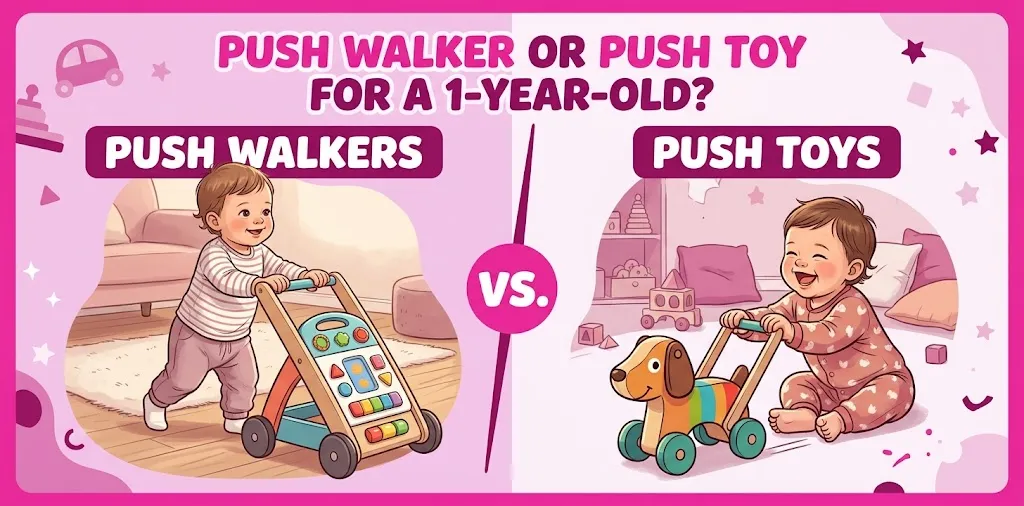
A push walker usually has a handle that a child holds while standing behind it. It may also include an activity panel with gears, beads, buttons, or other play features.
A push toy is a broader category. It can be a simple cart, wagon, animal, vehicle, or activity toy that a toddler pushes while walking.
In other words, most standing push walkers can be considered push toys, but not every push toy is designed specifically as a walking aid.
| Feature | Push Walker | Simple Push Toy |
|---|---|---|
| Main purpose | Walking and standing practice plus play | Pushing, movement, and play |
| Typical design | Handle + wheels + activity features | Cart, wagon, vehicle, or other rolling toy |
| Best for | Children beginning to stand and move | Children who enjoy pushing while crawling, cruising, or walking |
| Activity features | Often included | Varies |
| Long-term play | Depends on design | Often useful for pretend play and carrying toys |
| What matters most | Stability and controlled rolling | Stability, weight, and wheel control |
For a 1-year-old, the label matters less than the actual design. A sturdy push toy with a well-designed handle may be a better choice than a flashy “walker” that is too light or rolls too quickly.
Which Is Better for a 1-Year-Old?
For most 1-year-olds who are ready for a walking toy, a stable standing push toy is the better choice.
The reason is simple: the child has to stand, hold the handle, shift weight, and move their legs to make the toy travel. That makes the child an active participant rather than sitting inside a device that moves for them.
The AAP specifically recommends alternatives such as sturdy wagons or push cars for babies learning to walk, provided they are weighted so they do not tip when a child pulls up on them.
A push toy also does not need to make a child walk sooner. Walking develops on its own schedule, and a toy should be treated as a fun way to practice movement—not as a device that guarantees earlier walking.
When a push walker makes more sense
A push walker with an activity panel can be a good fit when your 1-year-old:
- Pulls up to stand
- Cruises along furniture
- Can stand while holding support
- Shows interest in moving forward
- Enjoys interactive toy features
- Is beginning to take supported steps
The activity features can give the child a reason to stand and interact with the toy even when they are not actively walking.
When a simple push toy may be better
A simple cart or wagon can be a better choice when your child already has plenty of toys and you mainly want something stable to push.
Simple designs can also remain useful after the child becomes a confident walker. A toddler might later use the same cart to carry stuffed animals, blocks, or other toys around the room.
The U.S. Consumer Product Safety Commission (CPSC) notes that push-and-pull toys are commonly used by children who are crawling or beginning to walk, and its toy guidance emphasizes factors such as motor skills, stability, and age appropriateness.
The Most Important Factor: How Fast It Rolls
This is one of the easiest details to overlook when buying a walking toy.
A push toy can look sturdy in a product photo but still move too quickly on a smooth floor. If the toy shoots forward when a child puts weight on the handle, the child may be pulled off balance.
For a new walker, look for:
- A broad, stable base
- Enough weight to resist sudden movement
- Wheels with good traction
- Controlled rolling rather than free, fast movement
- A handle that allows a comfortable upright position
- Strong construction with no loose wheels or parts
The CPSC’s toy guidance specifically points to broad bases and low centers of gravity as features that can improve stability in appropriate push-and-pull toys.
Flooring matters, too. A toy that feels controlled on carpet may roll much faster on smooth hardwood, laminate, or tile.
What If Your 1-Year-Old Isn’t Walking Yet?
You do not need to buy a push toy simply because your child has turned 1.
There is a wide range of normal timing for first steps. The AAP notes that many babies take first steps around their first birthday, but some start earlier and some later.
If your child is pulling up and cruising but has not started walking independently, a push toy may be interesting and useful for supported movement. But it should not become a test of whether your child is “ready” to walk.
Floor play, crawling, pulling to stand, cruising along furniture, and reaching for toys while standing all give children opportunities to develop movement skills.
For example, imagine a 12-month-old who can pull up on the couch but is nervous about letting go. A very stable push cart can give that child something to hold while experimenting with moving forward.
On the other hand, if a child cannot yet stand with support, a rolling toy may simply move away when they try to grab it. In that situation, ordinary floor play and supported standing may be more appropriate for the moment.
What to Look for When Buying One
The best push walker or push toy is not necessarily the one with the most buttons, lights, or sounds.
1. Stability
This should be your first priority.
Try to choose a design with a wide base and a low center of gravity. The toy should not easily tip when a child pulls up or leans on the handle.
2. Controlled wheels
Look for wheels that do not spin freely at excessive speed.
Some toys work better on carpet than hard floors, so consider where your child will actually use the toy.
3. Comfortable handle height
The handle should allow your child to hold it without having to bend far forward.
A poor handle position can make an otherwise good toy difficult for a new walker to control.
4. Strong construction
Check the wheels, axles, handle, and activity components before giving the toy to your child.
The CPSC has issued recalls involving push toys and activity walkers because components such as wheels or other parts could detach and create hazards.
5. Age-appropriate parts
Follow the manufacturer’s age recommendation and inspect the toy regularly.
The CPSC advises parents to follow age guidance and safety information on toy packaging. Toys for young children should also be checked for small parts and other hazards.
6. A useful design beyond the first steps
If you’re spending money on a push toy, think about what happens after your child learns to walk.
A simple wagon or cart may continue as a pretend-play or toy-carrying item. An activity walker may continue to work as a stationary activity toy but may become less interesting once your child becomes a confident walker.
Push Walker vs. Sit-In Baby Walker
This distinction is extremely important when shopping online.
A standing push walker is a toy that the child stands behind and pushes.
A sit-in baby walker has a seat inside a wheeled frame, allowing the child to move around while seated.
These should not be treated as two versions of the same product.
The AAP says traditional baby walkers with wheels are not safe and recommends that parents avoid them. Children can move quickly in these walkers, reach hazards they normally could not reach, and fall down stairs or suffer other serious injuries.
So if a product search shows both types, do not assume that “walker” automatically means a safe walking-practice toy.
For a 1-year-old, a standing push toy is the more appropriate category to consider if the child is developmentally ready and the toy is used safely.
How to Use a Push Toy Safely
Even a standing push toy can cause a fall if it rolls unexpectedly.
Use it on a clear, level surface and stay close enough to intervene. Keep it away from stairs, fireplaces, hot surfaces, pools, and other hazards.
Before each use, check that:
- Wheels are securely attached
- The handle is firmly connected
- No small component has become loose
- The toy is not damaged
- The floor is clear of objects that could stop the wheels suddenly
- Your child is using the toy according to its age and ability
CPSC guidance emphasizes following age recommendations and checking toys for hazards, while the AAP recommends sturdy push toys as alternatives to traditional baby walkers.
One especially important point: do not use a push toy as a substitute for supervision. A child who is learning to walk can move unpredictably, even with a stable toy.
Is a Push Toy Necessary for Learning to Walk?
No.
A child does not need a push walker or push toy to learn to walk. Children can develop walking skills through ordinary movement such as crawling, pulling up, cruising, standing, and taking supported or independent steps.
A push toy is better viewed as an optional play tool.
It can make movement more interesting and give a child another way to practice shifting weight and moving forward. The AAP also recognizes push-and-pull toys as toys that encourage physical activity.
That means you should not worry if your child ignores the push toy and prefers furniture, your hands, or simply crawling around the room.
The Better Choice Depends on Your Child
Consider these two common situations.
Your child is pulling up and cruising but is hesitant to take steps:
A heavy, stable push cart may give them something interesting to hold while they practice moving forward. Keep the toy on a surface where it does not roll too quickly.
Your child is already walking confidently:
A basic push wagon, cart, or pretend-play vehicle may offer more long-term value than a dedicated activity walker. At this stage, the toy can become part of active and imaginative play rather than being used mainly for walking practice.
In both cases, stability matters more than having the newest design or the largest activity panel.
Frequently Asked Questions
Is a push walker better than a push toy for a 1-year-old?
A push walker is usually a type of push toy, so the names can overlap. For a 1-year-old who is ready for supported walking, choose the design that is most stable, rolls at a controlled speed, and matches the child’s current abilities.
Can a 1-year-old use a push toy if they are not walking yet?
Yes, if the child can already stand or move with support and the toy is designed for their age and abilities. A push toy should not be used to force walking, and children develop these skills at different times.
Are push walkers safer than traditional baby walkers?
A standing push walker is different from a traditional sit-in baby walker. The AAP recommends avoiding traditional wheeled baby walkers because they can allow children to move quickly into dangerous areas and can cause serious injuries.
The best practical tip is to test stability and wheel control before choosing a push toy. For a new walker, a sturdy toy that moves slowly is generally more useful than a lightweight toy that races across the floor.
Final Choice
For a 1-year-old who is beginning to stand, cruise, or take supported steps, a stable standing push toy is usually the better choice. A push walker with an activity panel can be useful if your child enjoys interactive features, while a simple push cart or wagon may offer better long-term play value.
The most important features are controlled movement, a stable base, appropriate handle height, sturdy construction, and close supervision.
And if by “walker” you mean the traditional sit-in walker with wheels, choose neither for walking practice. The AAP recommends avoiding those devices because of their injury risks.
When shopping, focus less on the word “walker” on the package and more on how the toy supports your child’s actual movement and how safely it behaves on your home’s floors.