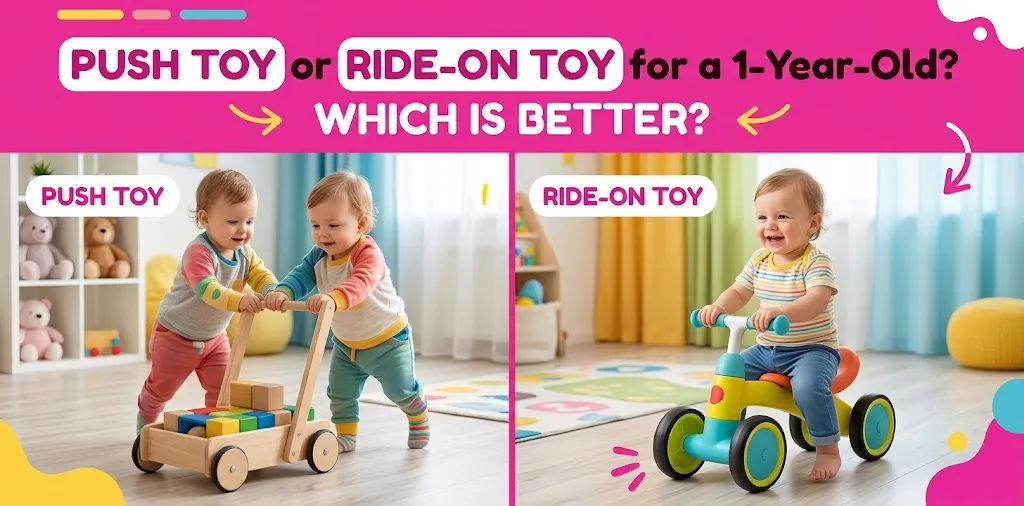
Push Toy or Ride-On Toy for a 1-Year-Old? Which Is Better?

For most 1-year-olds, a push toy is the better first choice, especially if the child is still developing steady walking skills. Push toys encourage movement while letting the child stay on their feet. A ride-on can also work for a confident walker, but it should be low, stable, easy to mount, and appropriate for the child’s size and ability.
The right choice depends less on which toy looks more exciting and more on how confidently your child walks, how stable the toy is, and where you plan to use it.
Push Toy vs. Ride-On Toy for a 1-Year-Old
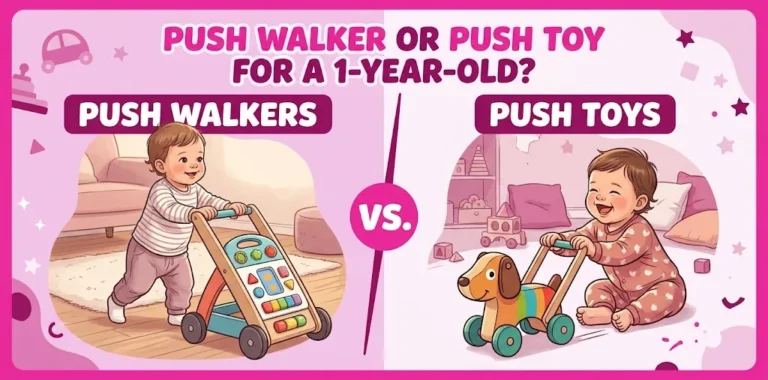
A push toy is designed for a child to walk behind or alongside the toy while holding a handle or bar. A ride-on toy allows the child to sit on or in the toy and move it by pushing against the floor with their feet.
| Feature | Push Toy | Ride-On Toy |
|---|---|---|
| Main position | Standing and walking | Sitting |
| Best for | Developing walkers and active floor play | Steady walkers ready to sit and propel |
| Main movement | Child pushes the toy | Child pushes with their feet |
| Balance demand | Higher while standing | Lower while seated, but steering can be harder |
| Space needed | Usually easy to use indoors | Needs more open floor space |
| Best starting point for many 1-year-olds | Yes | Depends on the child |
| Adult supervision | Needed | Needed |
The CPSC‘s age guidance for 1-year-olds specifically includes sturdy push toys with large wheels. Its guidance for children 12–18 months also describes suitable ride-on toys as low, stable, wide-based, and easy to mount, with the child’s feet able to reach the floor.
Why a Push Toy May Be Better at Age 1
A 1-year-old may be at a very different stage from another child of the same age. Some are walking confidently, while others are taking their first steps.
A push toy makes sense when your child enjoys standing, cruising around furniture, or walking while holding onto something. The child controls the movement instead of sitting inside a moving toy.
The CPSC recommends push toys for young toddlers and describes simple, sturdy designs with large wheels as suitable for this age group. The American Academy of Pediatrics also lists push and pull toys among toys that encourage physical activity.
A good push toy should be:
- Stable enough that it does not easily tip when your child leans on it
- Easy to grip
- Simple enough for the child to control
- Sturdy rather than lightweight or flimsy
- Appropriate for the child’s age and ability
- Free from small detachable parts that could become choking hazards
One important distinction: a push toy is not the same thing as a traditional seated baby walker. The AAP advises against infant walkers because they can increase the risk of falls and allow babies to reach dangerous areas.
When a Ride-On Toy Makes More Sense
A ride-on toy can be a good option when a 1-year-old already walks with reasonable steadiness and can sit on the toy with both feet comfortably touching the floor.
For children ages 12–18 months, CPSC guidance recommends ride-ons that are low and stable, with a wide wheelbase and easy mounting and dismounting. Four or more wheels generally provide more stability than two- or three-wheel designs for this age group.
Look for a ride-on that:
- Lets your child’s feet sit flat on the floor
- Has a low seat
- Has a wide, stable base
- Does not move too quickly
- Is easy to get on and off
- Does not require advanced steering skills
- Matches your child’s size and ability
At this age, a simple foot-to-floor ride-on is generally more appropriate than a pedal-powered vehicle. Children in the 12–18-month range typically propel these toys with both feet rather than pedaling.
Which Toy Is Better for a Child Who Is Just Learning to Walk?
A push toy is usually the more sensible choice.
If your child is taking only a few steps and still relies heavily on furniture for balance, a ride-on may be frustrating because it requires getting onto the toy, staying balanced while seated, and controlling movement.
A sturdy push toy gives the child an opportunity to move around while standing and walking. However, it should not be treated as a device that a parent uses to “teach” a child to walk. Children develop walking skills at different rates, and the toy should follow the child’s abilities rather than push them into a skill they are not ready for.
For example, if a 12-month-old is cruising along the sofa but falls frequently when walking independently, a stable push toy may be a better fit than a ride-on.
Which Toy Is Better for a Confident 1-Year-Old Walker?
A stable foot-to-floor ride-on can be a good choice if the child already walks steadily and can use the toy safely.
For example, imagine a 15-month-old who walks across a room without regularly falling and can easily sit down and stand up. A low, four-wheel ride-on with a wide base may provide enjoyable active play.
That does not mean every ride-on is suitable. The child should still be able to reach the floor with their feet and control the toy without struggling to steer or climb on and off.
Push Toy or Ride-On Toy for Indoor Play?
For many homes, a push toy is easier to use indoors.
Push toys generally need less open space because the child can walk behind them and change direction naturally. A ride-on needs enough room for the child to sit, push, turn, and stop without hitting furniture.
Think about your home’s layout before buying. A large ride-on may sound fun but become difficult to use if the main play area is crowded with tables, chairs, couches, or other toys.
A push toy can also be useful for short periods of active play throughout the day because the child can walk with it around an open room.
Safety Matters More Than the Toy Type
The safest choice is not automatically the toy labeled for the youngest age. Parents should check the manufacturer’s age guidance and make sure the toy matches the child’s actual abilities. The AAP recommends paying attention to age labels, checking that toys are sturdy, and keeping small parts away from young children.
For either type of toy:
- Supervise your child during play.
- Keep riding toys away from stairs, pools, traffic, and other hazards.
- Use the toy on an appropriate, stable surface.
- Check regularly for loose screws, broken wheels, sharp edges, or damaged parts.
- Avoid toys with accessible small parts that could become choking hazards.
- Follow the manufacturer’s age, size, and weight recommendations.
- Check the CPSC recall database before buying a used toy.
CPSC also requires ride-on toys to meet stability requirements, but parents should still inspect a particular toy and use it according to its instructions.
A recent recall history also shows why stability should not be overlooked. For example, CPSC recalled a children’s foot-to-floor ride-on in 2022 because it could tip forward and cause children to fall.
What About Push Toys With Seats?
Some products combine a push toy and a ride-on by offering a handle at the back and a seat for riding.
These can be convenient, but the combination does not automatically make the product better. Check whether the toy is stable in both modes.
If your child uses the push function, make sure the toy does not roll too easily when they pull themselves up. If they ride it, make sure their feet can reach the floor and the base is stable.
Also make sure the product is actually a toy designed for pushing and riding, rather than a traditional infant walker with a seat and wheels. Traditional infant walkers are a separate product category, and the AAP recommends avoiding them.
What Should You Choose?
For most 1-year-olds, I would choose based on the child’s walking ability rather than age alone.
Choose a push toy if:
- Your child is learning to walk.
- They still cruise along furniture.
- They enjoy standing and moving around.
- You want a simple option for indoor play.
- They are not yet confident getting on and off a ride-on.
Choose a ride-on if:
- Your child already walks fairly steadily.
- They can sit securely on the toy.
- Their feet reach the floor comfortably.
- The ride-on has a stable, wide base.
- You have enough open space for safe riding.
If you are unsure, a stable push toy is generally the safer starting point for a young 1-year-old, while a suitable foot-to-floor ride-on can be added once the child has the balance and coordination to use it comfortably.
Frequently Asked Questions
Can a 1-year-old use a ride-on toy?
Yes, some 1-year-olds can use an appropriate ride-on toy, especially after they have learned to walk with reasonable steadiness. CPSC guidance recommends a low, stable design where the child’s feet can reach the floor and the toy is easy to mount and dismount.
Is a push toy good for a baby learning to walk?
A sturdy push toy can be an appropriate active-play toy for a young toddler, but it should not be viewed as a required tool for learning to walk. Choose one that is stable and matches the child’s abilities, and remember that traditional seated infant walkers are a different product and are not recommended by the AAP.
Should a 1-year-old use a push toy or ride-on toy outside?
Either can work when the product is designed for the child’s age and used in a safe area, but the surface matters. For a young child, choose a flat, controlled area away from traffic, stairs, pools, and other hazards, and supervise the child closely during use.
The Bottom Line
For a typical 1-year-old, a stable push toy is the better starting choice, particularly if the child is still developing steady walking skills. A foot-to-floor ride-on can become a great option once the child walks confidently and can sit, mount, and propel the toy safely.
The best buying tip is simple: choose based on your child’s current abilities, not just the age printed on the box. A well-sized, stable toy that your child can control is more useful than a more advanced toy they are not ready to handle.