Busy Board or Activity Cube for Toddler Travel? Which Is Better?

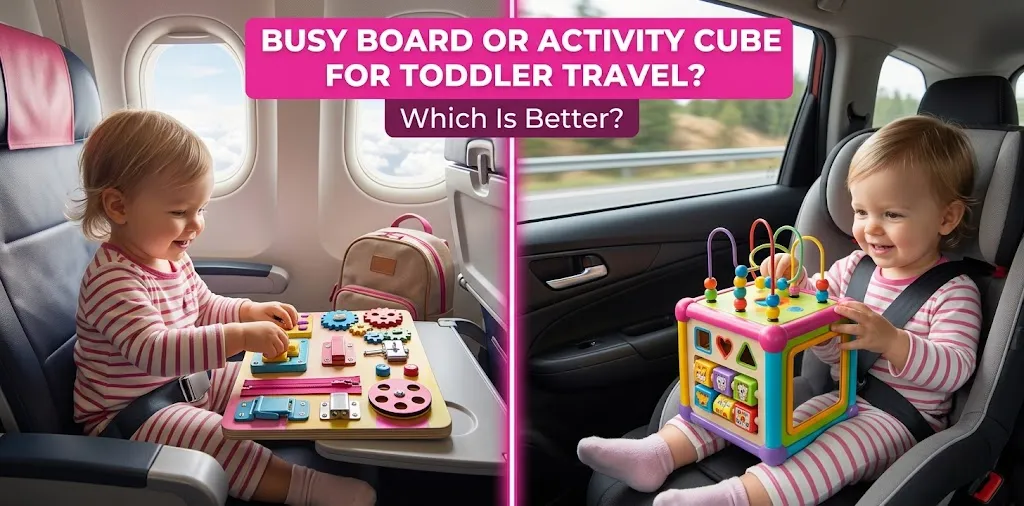
For most toddler travel, a busy board is better than an activity cube because it is flatter, lighter, quieter, and easier to use on a child’s lap. An activity cube offers more play surfaces and movement, but its bulk makes it better for hotel rooms, vacation rentals, and other places where you have more space.
Both toys can keep little hands busy without relying on a screen. The better choice depends on how you travel, your toddler’s age, and where the toy will actually be used.
| Travel factor | Busy board | Activity cube |
|---|---|---|
| Airplane use | Excellent | Fair |
| Road trips | Excellent | Good |
| Fits in carry-on | Usually easy | Often harder |
| Lap-friendly | Yes | Depends on size |
| Quiet play | Usually | Usually |
| Number of activities | Moderate to high | Often high |
| Hotel-room play | Good | Excellent |
| Easy to store | Excellent | Fair |
| Moving parts staying contained | Often good | Varies |
| Best overall for travel | Yes | Better for destination play |
If you want one toy mainly for flights, car rides, restaurants, and waiting areas, the busy board is usually the more practical buy. If you want a toy your toddler can explore after arriving at your destination, a compact activity cube can make more sense.
Why a Busy Board Usually Works Better for Travel
Travel changes what makes a toddler toy useful.
At home, a large toy with several sides may be a great choice. On a plane or in the back seat of a car, size suddenly matters much more. You want something that can come out of a bag quickly, stay within your toddler’s reach, and not create a collection of pieces under the seat.
Busy boards are designed around a mostly flat play surface. Depending on the model, a toddler may find zippers, buckles, switches, latches, snaps, gears, shoelaces, buttons, or textured materials.
That flat design gives busy boards several travel advantages.
They can often:
- Fit inside a backpack, diaper bag, or carry-on.
- Rest on a toddler’s lap.
- Work on an airplane tray table.
- Be used in a stroller or restaurant.
- Provide several activities without requiring much floor space.
- Offer quiet entertainment when electronic toys would be distracting.
A soft felt busy board can be especially convenient when luggage space matters because many versions fold like a book.
Wooden busy boards can still work for travel, but check the dimensions and weight before buying. A board that looks compact in a product photo may feel surprisingly large once you try fitting it into a packed carry-on.
When an Activity Cube Is the Better Choice
An activity cube should not automatically be ruled out just because you are traveling.
Its biggest strength is play variety in one toy.
A cube may have gears on one side, a maze on another, doors or switches on another, and beads or another activity on top. Instead of looking at one flat surface, your toddler can turn the cube or move around it to find something different.
That can be useful when you reach your destination.
For example, imagine a family taking a weeklong road trip. Most of the driving may be easier with a compact busy board, but once everyone reaches a vacation rental, a sturdy activity cube could provide more substantial floor play.
An activity cube may be the better choice when:
- You are traveling mainly by car and have plenty of cargo space.
- The toy will mostly stay at your hotel or vacation rental.
- Your toddler gets bored quickly with one play surface.
- Your child enjoys rotating, reaching, standing, or moving around a toy.
- Portability matters less than the amount of play packed into one item.
The problem comes when parents choose a normal home-sized cube and expect it to behave like a travel toy. A large wooden cube can take up valuable luggage space and may be awkward to balance on a plane seat, tray table, or toddler’s lap.
Busy Board vs. Activity Cube on an Airplane
For air travel, the busy board has the clearer advantage.
Airplane space is limited. Your toddler may be sitting in one position for long periods, and you cannot count on having floor space for a toy. A busy board allows the child to manipulate activities directly in front of them without turning a bulky object around.
Soft models have another practical advantage: they are less likely to feel cumbersome when you are already managing snacks, wipes, drinks, jackets, and other travel items.
Activity cubes are more difficult on planes because several of their advantages disappear. Your child may not be able to move around the cube, and accessing different sides can mean repeatedly turning it in a tight space.
A very small travel activity cube can still work. But once the cube becomes large enough that it needs its own significant section of your carry-on, you are sacrificing one of the most important qualities of a toddler travel toy: portability.
Which Is Better for a Road Trip?
The choice is closer for road trips.
You usually have more storage space in a car than on an airplane, so bringing a cube is more realistic. Even so, a busy board remains easier for actual use while the toddler is seated.
A hypothetical two-year-old on a four-hour drive might use a soft busy board with buckles and zippers during part of the trip. The board can stay on the child’s lap and then go back into a seat pocket or travel bag when attention moves to another activity.
A larger cube may be more useful during a rest stop or after arriving at the hotel.
There is also an important safety point: the driver should not be reaching back to retrieve dropped toys or help with complicated activities while the vehicle is moving. Choose activities your child can use safely with minimal help, and keep travel play from interfering with proper use of the child restraint.
Which One Keeps Toddlers Interested Longer?
There is no reliable winner here because toddler interests vary.
An activity cube may appear to have an advantage because it can provide several distinct play surfaces. A child can turn it and encounter something new.
But more activities do not automatically mean more engagement.
A toddler who loves opening buckles may spend much longer repeating one buckle on a busy board than exploring ten different features on a cube. Another toddler may lose interest in a flat board quickly and prefer moving from one side of a cube to another.
Look at what your child already does during everyday play.
Does your toddler repeatedly:
- Open and close things?
- Pull zippers?
- Press switches?
- Turn knobs?
- Fasten or unfasten buckles?
A busy board closely matches those interests.
Does your toddler prefer:
- Shape sorting?
- Bead mazes?
- Spinning gears?
- Exploring different sides of a toy?
- Standing and moving while playing?
An activity cube may have more staying power.
Choosing based on your child’s behavior is more useful than simply comparing the number of activities printed on the package.
What Age Is Best for a Travel Busy Board or Activity Cube?
Do not rely on the word “toddler” alone when choosing either toy. Check the manufacturer’s specific age recommendation and safety information.
The U.S. Consumer Product Safety Commission advises parents to follow age guidance on toy packaging and choose toys suited to a child’s abilities. It also warns that toys with small parts should be kept away from children younger than 3 because they can present a choking hazard.
That matters with both busy boards and activity cubes.
Some activities that look simple may include detachable shapes, beads, magnets, fasteners, or other components. For a younger toddler who still puts objects in their mouth, secure construction matters far more than how educational or attractive a toy appears.
The CPSC also notes that products intended for children under 3 must meet requirements concerning small parts and that certain choking hazards require labeling.
Age recommendations should therefore be treated as a starting requirement, not a marketing detail.
What to Look for in a Busy Board for Toddler Travel
The best travel busy board is not necessarily the one with the most switches, buckles, or pictures.
Start with portability.
A useful travel board should be small enough that you will actually bring it. If packing it means removing other essentials from your carry-on, it may not be practical.
Then look at how the activities are attached. Travel can put toys through rough handling. They get squeezed into bags, dropped, pulled, and used repeatedly.
Before buying or packing one, check for:
- Securely attached components.
- No easily detached small pieces for children under 3.
- Age-appropriate activities.
- Strong stitching on fabric models.
- Smooth edges on rigid boards.
- Secure hardware on wooden models.
- Manageable cords or laces.
- Easy-to-clean surfaces.
- A size your child can comfortably use while seated.
- Activities that do not require constant adult setup.
The CPSC recommends choosing toys that suit the child’s age, interests, and abilities and keeping toys with small parts away from children younger than 3.
For travel specifically, also think about noise. A toy that seems entertaining in your living room may become much less appealing to everyone around you if it plays the same song every time a button is pressed.
What to Look for in a Travel Activity Cube
If you prefer a cube, focus on compactness and stability rather than buying the largest version you can find.
Check the actual measurements before ordering. Product photos can make it difficult to judge scale.
Think about weight as well. A sturdy wooden cube may be easy for an adult to move around the house but inconvenient when carried through an airport along with everything else your family needs.
A travel-friendly cube should also have activities that remain attached. Shape sorters with several loose blocks can be enjoyable at home but become frustrating when pieces fall underneath airplane seats or disappear inside a car.
For destination use, loose pieces may matter less because you can set everything up on the floor of your hotel room or rental.
This is why the same cube can be a poor in-transit toy and an excellent vacation toy.
Soft Busy Board vs. Wooden Busy Board for Travel
Once you decide on a busy board, you still have another choice.
Soft felt or fabric busy boards are usually the most travel-friendly option. They can often fold, weigh relatively little, and fit into smaller bags. Many resemble a book or zippered folder.
Their weak point can be durability. Examine stitching, attachments, hook-and-loop fasteners, and any removable pieces.
Wooden busy boards provide a firmer surface. Switches, latches, gears, and other mechanisms may feel more substantial when attached to wood.
The trade-off is weight and rigidity.
If you travel frequently by air, a compact fabric model will usually be easier to live with. If most of your trips are by car and your child strongly prefers mechanical activities, a small wooden busy board may be worth the extra weight.
Does “Montessori” Make One Choice Better?
You will see both busy boards and activity cubes described as Montessori toys, but the label alone should not decide your purchase.
Look at what the child actually does with the toy.
A simple board that allows a toddler to practice opening a buckle, pulling a zipper, or turning a latch may provide meaningful hands-on play. A cube that encourages matching, turning, sliding, and problem-solving can do the same in different ways.
What matters for travel is whether those activities match your child’s ability and can be used comfortably in the places you are going.
Do not pay extra just because “Montessori” appears in a product title. Construction, age suitability, portability, and your toddler’s interests are more useful buying criteria.
How Many Travel Toys Should You Pack?
Neither a busy board nor an activity cube should be expected to entertain a toddler for an entire travel day.
Young children often move between activities quickly, especially when they are tired, hungry, overstimulated, or sitting somewhere unfamiliar.
Instead of expecting one large toy to solve everything, consider a small rotation.
For example, a parent flying with a two-year-old might pack:
- One compact busy board.
- A favorite small book.
- A mess-free drawing activity.
- One familiar comfort item.
- A separate small toy introduced later in the trip.
The goal is not to reveal everything at once. Keeping one or two activities out of sight gives you something different to offer later.
This approach also makes the portability advantage of a busy board more valuable. One flat toy can provide several activities while leaving room for other entertainment.
Common Mistakes When Choosing Between Them
The biggest mistake is buying according to the number of features instead of the travel situation.
A 25-activity toy is not automatically more useful than a 10-activity toy if half the activities are too difficult for your toddler.
Another mistake is overlooking dimensions. Always check measurements rather than judging size from photos.
Parents should also avoid assuming that every attached component will remain secure forever. Toys can wear with use, so inspect them periodically for loose parts, damaged fasteners, broken pieces, or other changes.
And be careful with toys marketed broadly for ages such as “1–4 years.” Development changes quickly during those years. The individual manufacturer’s age guidance and the specific components of the toy still need to be checked.
So, Which Should You Pack?
Choose a busy board if the toy needs to work during the journey itself.
It is usually the stronger option for:
- Airplanes.
- Car seats.
- Restaurants.
- Airport waiting areas.
- Strollers.
- Small carry-on bags.
- Quiet lap play.
Choose an activity cube if you have room to transport it and expect most of the play to happen after arrival.
It is often better for:
- Hotel-room floor play.
- Vacation rentals.
- Trips where you are driving.
- Toddlers who like several distinct play surfaces.
- Families who value play variety more than minimum packing size.
There is also nothing wrong with using both in different roles. A small busy board can be the travel-day toy while an activity cube stays at a grandparent’s home or goes in the trunk for destination play.
If you are buying only one specifically for toddler travel, though, the busy board is the more versatile choice for most families.
Frequently Asked Questions
Here are answers to some common questions parents ask when choosing between a busy board and an activity cube for toddler travel.
Are busy boards good for long flights with toddlers?
Yes, a compact busy board can work well because it provides several hands-on activities without taking up much tray-table or lap space. It works best as one part of a rotation rather than the only entertainment you bring for a long flight.
Is an activity cube too bulky for toddler travel?
A standard activity cube often is too bulky for convenient airplane travel, but small travel-sized cubes can still work. Compare the actual dimensions with your carry-on space and think about where your toddler will use it before buying.
Are busy boards safe for a 1-year-old?
Some are designed for that age, but you should follow the specific manufacturer’s age recommendation and inspect the components carefully. The CPSC advises keeping toys with small parts away from children younger than 3, so avoid boards with detachable or potentially loose small pieces.
Final Verdict
For most families deciding between a busy board or activity cube for toddler travel, choose the busy board. Its flatter shape, lighter design, lap-friendly play, and easier packing make it better suited to flights, road trips, restaurants, and other situations where space is limited.
An activity cube becomes more appealing when you have plenty of luggage room and want a richer play station at your destination.
One practical tip before buying: measure the toy against the bag you plan to travel with. A travel toy only earns its place in your luggage if it is easy enough to pack that you will actually bring it.