Activity Cube or Busy Board for Quiet Play? Which Is Better?

Choosing a toy for quiet play can be harder than it sounds. You may want something that keeps your child busy without screens, loud noises, or a room full of scattered toys. Two popular options are the activity cube and the busy board.
Both can give toddlers hands-on activities and encourage independent play. But they are not exactly the same. One may work better for travel and quiet sitting, while the other may be a better fit for longer play sessions at home.
So, Activity Cube or Busy Board for Quiet Play: Which Is Better?
For most situations where you need a child to play quietly while sitting in one place, a busy board is usually the better choice. An activity cube, however, can be better for longer independent play at home because it offers activities on multiple sides and gives children more variety.
The right choice depends on your child’s age, personality, play style, available space, and where you plan to use the toy.
Activity Cube vs. Busy Board: The Quick Answer
A busy board is usually better for quiet, focused play because it is often compact, portable, and easy for a child to use while sitting down. An activity cube is often better for longer play sessions at home because it provides several activities in one larger toy and encourages children to explore different sides.
If you want something for restaurants, travel, appointments, or quiet time, choose a busy board. If you want a larger activity toy for a playroom or living room, an activity cube may be the better option.
What Is an Activity Cube?
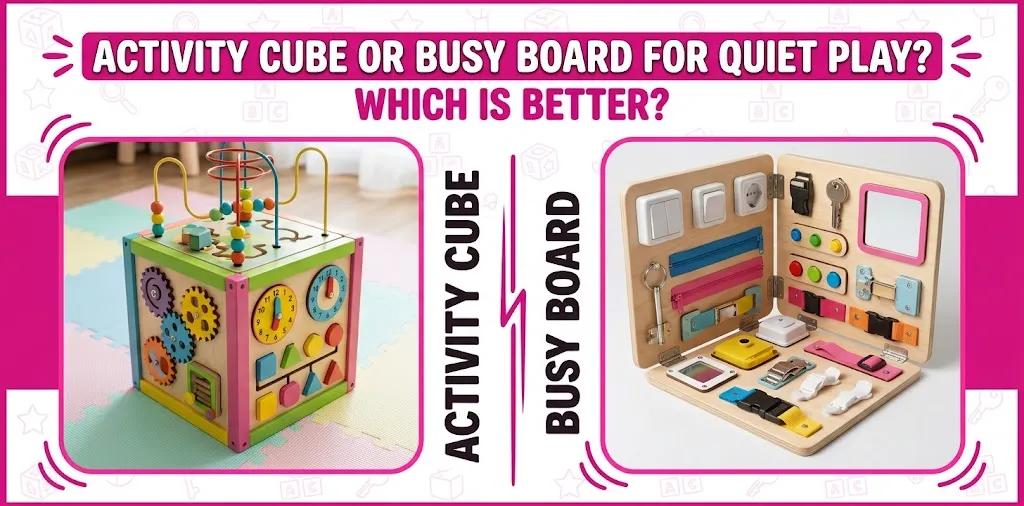
An activity cube is a three-dimensional educational toy with different activities on several sides. Depending on the design, it may include:
- Shape sorters
- Bead mazes
- Spinning gears
- Sliding pieces
- Small doors
- Picture blocks
- Number or letter activities
- Animal-themed features
- Moving parts
The main advantage of an activity cube is variety.
Instead of giving a child several different small toys, an activity cube can offer multiple activities in one place. A child can move around the cube and explore a different activity when they lose interest in the previous one.
This makes activity cubes especially useful for children who enjoy exploring and switching between activities.
However, their larger size can make them less convenient when you need portable quiet play.
What Is a Busy Board?
A busy board is usually a flat board filled with hands-on activities designed to keep young children engaged.
Common features include:
- Zippers
- Buckles
- Buttons
- Latches
- Locks
- Doors
- Shoelaces
- Velcro
- Sliders
- Switches
- Spinning wheels
Some busy boards are made from wood, while others are made from soft fabric. Fabric versions are often especially useful for travel because they are lightweight and easy to carry.
Busy boards encourage children to use their hands and fingers while figuring out how different objects work.
For example, a toddler might spend several minutes learning how to open a buckle, pull a zipper, or unlock a simple latch.
This type of focused activity can make a busy board a strong option for calm and quiet play.
The Biggest Differences Between an Activity Cube and a Busy Board
Although both toys are designed for hands-on learning and entertainment, they work differently in everyday situations.
| Feature | Busy Board | Activity Cube |
|---|---|---|
| Quiet sitting play | Excellent | Good |
| Variety of activities | Moderate to high | Usually high |
| Portability | Excellent | Usually limited |
| Travel-friendly | Usually yes | Usually no |
| Small-space friendly | Excellent | Depends on size |
| Independent home play | Very good | Excellent |
| Easy to store | Usually easier | Can require more space |
| Multiple play sides | Usually one main surface | Yes |
| Fine-motor activities | Often a major focus | Usually included |
| Restaurant or waiting-room use | Better choice | Less practical |
The table gives a general comparison, but the actual design of each toy matters.
A large wooden busy board may not be easy to travel with, while a small activity cube might work well in a compact play area.
That is why it helps to think about your family’s daily routine before making a decision.
Why a Busy Board Is Often Better for Quiet Play
If your main goal is to keep your child occupied quietly, a busy board often has several advantages.
It Encourages Focused Play
Busy boards are designed around small hands-on tasks.
A child might:
- Open and close a latch
- Pull a zipper
- Connect a buckle
- Turn a knob
- Move a slider
These activities can encourage a child to focus on one task at a time.
For quiet play, this can be useful because the child does not need to run around or move between several toys.
It Is Easier to Use While Sitting
Many busy boards can be placed:
- On a child’s lap
- On a table
- On the floor
- In front of a car seat during appropriate use
- In a travel bag
A child can often stay in one position while playing.
That makes busy boards particularly useful during situations where children need to remain relatively calm.
It Can Be More Portable
Portability is one of the biggest advantages of many busy boards.
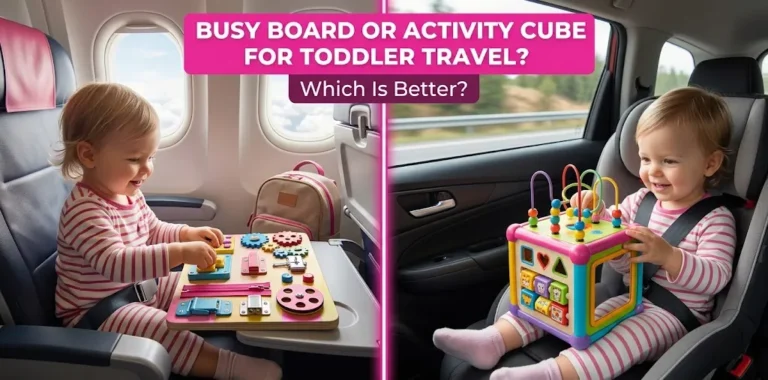
A compact fabric busy board can be useful when visiting:
- Restaurants
- Family members
- Doctors’ offices
- Airports
- Hotels
- Other places where children may need something to do
An activity cube is usually better left at home because of its size.
Why an Activity Cube Can Be Better for Home Play
An activity cube has advantages that a busy board may not offer.
More Activities in One Toy
A child can explore several sides of the cube.
For example, one side may have gears while another has a shape sorter. A different side might include doors or sliding pieces.
This variety can be useful for children who get bored quickly.
Instead of putting away one toy and finding another, the child can simply move to a different side of the cube.
It Can Support Longer Independent Play
Some toddlers enjoy moving around an activity cube and discovering different features.
For example, a child might:
- Play with the bead maze.
- Move to the gears.
- Try the shape sorter.
- Open and close small doors.
- Return to a favorite activity.
This can make an activity cube useful during independent playtime at home.
It Creates a Dedicated Play Station
An activity cube can work almost like a small activity center.
If you have space in a living room, bedroom, or playroom, the cube can stay in one location where your child can return to it throughout the day.
That may be more convenient than constantly bringing toys out and putting them away.
Which One Is Better for Travel?
For travel, the busy board is usually the clear winner.
A small or fabric busy board can often fit inside a diaper bag or backpack.
An activity cube can be difficult to carry because it is usually:
- Larger
- Heavier
- More awkward to pack
- Less convenient in public places
Imagine taking a toddler to a restaurant.
A compact busy board can sit on the table or the child’s lap. A large activity cube would take up too much space and could become inconvenient.
The same is true for airports, waiting rooms, and long car trips.
If portability is important, a busy board is usually the more practical investment.
Which One Is Better for a Child Who Gets Bored Easily?
This depends on why the child gets bored.
If your child gets bored because they want to constantly explore new activities, an activity cube may be better.
The multiple sides can provide a sense of variety.
However, if your child enjoys figuring out how things work, a busy board may hold their attention surprisingly well.
A child may spend a long time trying to master:
- A difficult buckle
- A zipper
- A latch
- A lock
- A set of buttons
The key is choosing activities that are challenging enough to be interesting but not so difficult that they cause frustration.
Your Child’s Play Style Matters More Than You Think
Two children of the same age may react very differently to the same toy.
Consider a child who constantly opens kitchen cabinets and drawers. That child may love a busy board with doors, locks, and latches.
Another child may enjoy walking around, touching different objects, and quickly moving from one activity to another. That child may prefer an activity cube.
Before buying, think about what your child already enjoys doing.
Ask yourself:
- Does my child like opening and closing things?
- Do they enjoy zippers and buckles?
- Do they prefer sitting with one activity?
- Do they like moving around while playing?
- Do they get bored with repetitive tasks?
- Do they enjoy discovering new objects?
The answers can help you choose better than simply buying the toy with the most features.
Quiet Play Does Not Always Mean a Completely Silent Toy
When parents search for quiet toys, they may mean different things.
For some families, quiet play means no electronic music or loud sounds.
For others, it means a child can stay entertained without running around the house.
Before buying either toy, check whether it includes:
- Electronic sounds
- Music
- Lights
- Bells
- Hard pieces that make noise
- Loose objects that can fall
A soft fabric busy board is usually quieter than a toy with lots of hard wooden or plastic pieces.
If you plan to use the toy in public places, a quiet non-electronic design may be the better choice.
Which Toy Is Better for Small Spaces?
For apartments, smaller homes, or rooms with limited space, a busy board is often easier to manage.
A flat board can sometimes be:
- Hung up
- Stored in a closet
- Placed under furniture
- Packed into a bag
An activity cube takes up more permanent floor space.
That does not mean an activity cube cannot work in a small home. A compact model can still be useful if it replaces several separate toys.
But if storage is already a problem, a busy board may be the safer choice.
Fine Motor Skills: Which One Offers More?
Both toys can support hands-on skill development, but busy boards often focus more heavily on detailed hand movements.
Activities such as:
- Buckling
- Buttoning
- Zipping
- Pulling
- Twisting
- Sliding
require children to coordinate their hands and fingers.
Activity cubes can also include fine-motor activities, especially bead mazes, gears, and shape sorters.
The difference is usually the focus.
A busy board often centers around practical manipulation activities, while an activity cube may offer a wider mix of activities.
If you specifically want a toy with lots of fastening and hands-on tasks, a busy board may be the better fit.
Age Recommendations Are Important, but Ability Matters Too
Always check the manufacturer’s recommended age range.
However, age alone does not tell you everything.
One 2-year-old may already understand simple buckles, while another may need more time.
A younger child may enjoy:
- Large sliders
- Simple doors
- Easy zippers
- Big spinning pieces
An older toddler may enjoy:
- More complicated buckles
- Laces
- Matching activities
- Multi-step tasks
The best toy should feel interesting without becoming frustrating.
If everything is too easy, your child may lose interest quickly.
If everything is too difficult, the toy may lead to frustration instead of quiet play.
Safety Should Be Part of Your Decision
Before buying a busy board or activity cube, inspect the design carefully.
Look for:
- Smooth surfaces
- Secure parts
- No loose small pieces
- Strong construction
- Secure batteries, if included
- No damaged straps or cords
- Appropriate sizing for the child’s age
Once you have the toy, inspect it regularly.
Children can pull, twist, and repeatedly use the same pieces. Over time, parts can become loose or damaged.
A simpler toy with strong construction may be a better choice than a complicated toy packed with features that may not hold up well.
When Buying Both Can Make Sense
You do not necessarily need both toys, but some families may find that each serves a different purpose.
An activity cube can stay at home as part of the regular play area.
A busy board can be used for:
- Car trips
- Restaurants
- Travel
- Waiting rooms
- Visits to relatives
For example, a family might keep an activity cube in the living room while storing a fabric busy board in the travel bag.
This gives the child different activities in different situations.
But if you are buying only one, focus on the problem you want the toy to solve.
Common Mistakes Parents Make When Choosing
One common mistake is choosing based only on the number of activities.
More activities do not always mean better play.
A child may enjoy five activities they understand more than twenty activities that are confusing or difficult.
Another mistake is buying a toy that does not fit the family’s lifestyle.
A large activity cube may look great online, but it may not work well in a small apartment or during travel.
It is also easy to forget about noise.
If quiet play is your main goal, avoid assuming every educational activity toy is quiet. Check whether it includes sounds, music, or noisy moving parts.
Finally, do not buy based only on age recommendations. Consider your child’s actual interests and abilities.
A Simple Decision Guide
Choose a busy board if:
- You need portable quiet play.
- Your child often plays while sitting.
- You travel frequently.
- You have limited space.
- You want contained activities.
- Your child enjoys zippers, locks, buttons, and buckles.
- You want something useful for restaurants and waiting rooms.
Choose an activity cube if:
- The toy will mainly stay at home.
- You have enough floor space.
- Your child enjoys variety.
- Your child likes moving between activities.
- You want a larger independent play station.
- Your child gets bored with a single activity.
So, Which One Should You Buy?
For most parents searching specifically for quiet play, the busy board is usually the better choice.
It is often easier to carry, easier to store, and better suited for situations where a child needs to sit and stay occupied.
However, an activity cube can be the better choice for a child who spends most of their playtime at home and enjoys exploring several different activities.
There is no universal winner.
The best option depends on how and where your child will actually use it.
Frequently Asked Questions
Before choosing between an activity cube and a busy board, you may still have a few questions about which option works best for your child’s quiet play. Here are answers to some of the most common questions parents ask before making a decision.
Is a busy board better than an activity cube?
A busy board is usually better for portable, focused, and quiet sitting play. An activity cube is often better for longer independent play at home because it provides activities on multiple sides.
Which is better for a toddler who gets bored quickly?
An activity cube may work well for children who enjoy switching between different activities. A busy board can also keep a child interested if the activities match their interests, especially if they enjoy locks, buckles, and zippers.
Are busy boards good for travel?
Yes, especially smaller or fabric designs. A busy board is generally easier to pack and use in restaurants, waiting rooms, hotels, and other places where a larger activity cube would be inconvenient.
The Bottom Line
When choosing between an activity cube and a busy board for quiet play, think first about where your child will use the toy most often.If you need something compact for calm play during travel, outings, or quiet sitting time, choose a busy board.
If you want a larger toy that can provide more variety during independent play at home, choose an activity cube.
The most useful choice is not necessarily the toy with the most activities. It is the one that fits your child’s interests and solves a real problem in your everyday routine. Before buying, picture where the toy will be used most often—that simple step can make the decision much easier.